
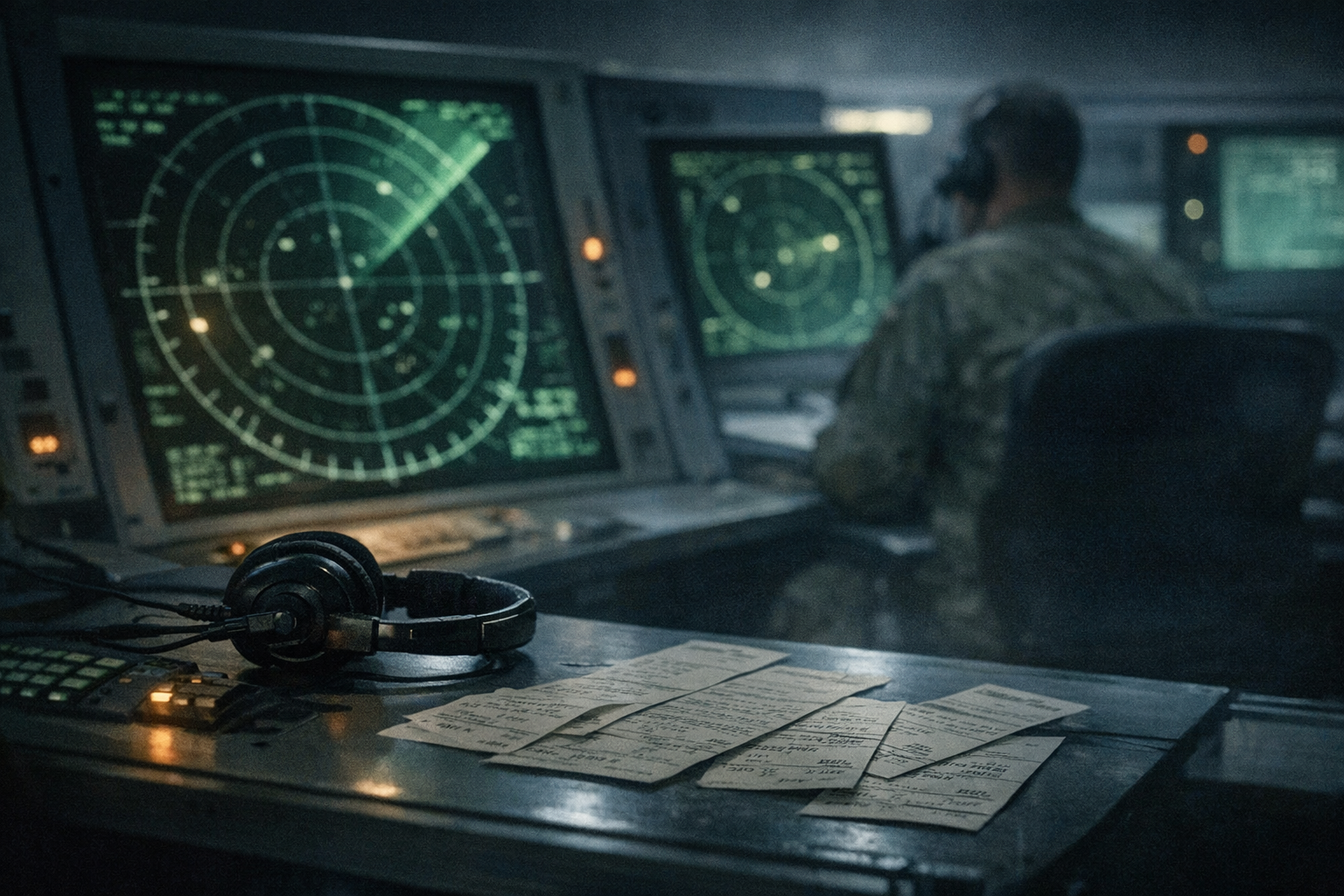
The screen in the dark operations room lights up first. A blip appears, vanishes, then reappears somewhere it should not be, and within minutes people outside that room are saying the military has radar proof of something not from this world. But radar has a strange power: it can feel exact even when the picture is still incomplete.
UFO radar evidence usually means radar data tied to an unknown object, sometimes backed by pilot reports or video. Supporters often treat radar as the strongest possible proof because it seems more objective than memory or grainy footage. The more likely reality is that radar can be very valuable, but on its own it often shows only that a sensor detected something unusual — not what that thing actually was.
What Happened
This article’s angle is narrow on purpose: it is not another UFO sighting story, and it is not a recap of one famous encounter. It is an evidence-breakdown piece about how radar gets used, misread, limited, and strengthened when it is combined with other sources. The real question is not whether radar sounds impressive. It is what radar can honestly prove, and where that promise starts to fall apart.
Radar entered UFO culture because it seemed like the machine version of a witness. If a person saw a strange light, people could argue about fear, memory, distance, or weather. If a radar system tracked something odd, the case suddenly felt more serious. A blip on a military or civilian screen sounded harder to dismiss than a story told afterward.
That is why radar-heavy cases keep returning. Readers see it in the NORAD UFO Tracking: Hard Radar Evidence or Stories Built on Missing Data? debate, in the Belgian wave, and in military incidents linked to video. Radar gives a case structure. It suggests time stamps, speed, altitude, direction, and a record that might exist somewhere beyond human memory.
But here is the mini-scene that often gets lost. Imagine an operator staring at a scope near the end of a long shift. There is chatter in the room. Someone asks whether the return is weather clutter, a transponder problem, a track merge, or something moving in a way that does not fit the expected traffic picture. The screen does not say “alien.” It only says that the system registered something, and now trained people have to decide how much confidence to place in that return.
That matters because “radar evidence” is not one thing. There is primary radar, which detects reflected energy from an object. There is secondary radar, which depends on a transponder responding. There are tracking systems that combine radar with infrared, visual reports, ADS-B data, and other inputs into one cleaner-looking picture. By the time the public hears “radar confirmed it,” several layers of interpretation may already have been added.
In other words, radar can be strong evidence of detection without being strong evidence of identity. That distinction is what many UFO arguments skip too quickly.
Why People Believe It
People believe radar-based UFO claims because radar feels mechanical, not emotional. A witness can be mistaken. A camera can miss context. But a radar display seems clinical. Numbers, tracks, and screen returns feel like the language of proof.
There is also a trust transfer happening. Most readers do not understand radar in technical detail, so they borrow the authority of the institutions that use it. If a Navy crew, air-defense network, or trained controller noticed something unusual, the public often assumes the unknown must be deeply mysterious. That assumption is understandable. These are not casual observers looking out a bedroom window.
Another reason radar is persuasive is that it appears to remove the oldest weakness in UFO stories: “maybe they just saw it wrong.” Once a case includes instrument returns, supporters feel the mystery has crossed from anecdote into hard data. That is part of why Navy UFO Videos Explained: Why Gimbal, GoFast, and Omaha Still Divide People continues to hold attention. Readers do not just see video. They imagine a larger sensor picture behind it.
Radar also rewards imagination because the public rarely gets the full raw record. People may hear a pilot say there was radar contact, or read a report saying systems tracked an object, but they often never see the unfiltered data, calibration history, track quality, or the full conversation around uncertainty. That missing layer makes the case feel both secret and stronger than it may actually be.
Then there is a simple psychological effect: radar sounds technical, so repeating the word itself can make a claim feel settled. In UFO culture, “it was on radar” sometimes gets used almost like a shortcut for “therefore it was real in the strongest sense.” But real is a broad word. A real return is not the same thing as a real craft of unknown origin.
Claims vs Evidence
Claim: if an object appears on radar, especially military radar, that is basically proof of a genuine UFO in the extraordinary sense people mean.
What the evidence can support: a radar system detected something, or multiple systems appeared to track something, at a particular time and place. In stronger cases, radar may also support estimates about movement, altitude changes, or the fact that trained operators considered the return unusual enough to note or investigate.
What it usually does not support by itself: the exact identity, shape, intent, origin, or exotic nature of the object.
The first issue is sensor limitation. Radar is powerful, but it is not magic. Returns can be affected by weather, birds, balloons, clutter, propagation effects, interference, software filtering, unusual angles, and simple track confusion. A screen can present a clean symbol even when the underlying situation is messy. That does not make radar useless. It means radar interpretation always lives inside system limits.
The second issue is raw data versus retelling. Many famous UFO radar stories survive mostly through secondhand descriptions. A witness says radar saw impossible movement. A report says there were tracks. A documentary repeats that claim. But unless the raw plots, quality flags, timing, and surrounding records are available, the public is often judging a summary, not the evidence itself.
The third issue is primary versus secondary radar. Primary radar may show that something reflected energy, but not what it was. Secondary radar depends on cooperative aircraft replying with a transponder. If a target appears on primary but not secondary, that can sound dramatic. Sometimes it is. But it can also point to many ordinary possibilities, including objects that were never expected to answer with a transponder in the first place.
The fourth issue is sensor fusion. Modern systems often merge different inputs into one display, which is useful operationally but easy to oversimplify later. If a pilot, radar operator, and infrared system all seem to point at the same event, that is much better than one lonely blip. But even then, the real strength depends on whether the records truly align in time, location, and interpretation. A fused picture can look more certain than the weakest part of it really is.
This is where the Belgian case becomes useful. Belgian UFO Wave: Mass Sighting, Radar Case, or a Story Shaped by Expectation? matters not because it closes the question, but because it shows how radar, witnesses, and public expectation can reinforce each other while still leaving major room for doubt.
The fifth issue is the jump from unusual to extraordinary. Radar evidence may support that something was unidentified in the moment. That is not the same as proving it was advanced nonhuman technology. “Unidentified” only means the case remained unresolved with the information available at the time. People often treat that unresolved gap as if it already contains the most dramatic answer.
Reality Check
The reality check is not that radar should be ignored. In fact, radar is often one of the most valuable parts of a serious UFO case because it can provide timing, location, persistence, and independent detection beyond a witness story. If you had to choose between a claim with only memory and a claim with documented sensor support, you would obviously prefer the second one.
But the stronger logical point is that radar becomes persuasive when it is part of a stack, not when it is treated like a magic stamp. The best cases combine several things: reliable radar data, visual observation by trained people, matching video or infrared, consistent timelines, known sensor performance, and enough raw material for outside review.
That is one reason the Tic Tac UFO Incident: Best Military Evidence or a Story Bigger Than the Data? remains so important. People keep returning to it because it seems to offer the stronger version of the pattern: pilots, radar, and a broader military context instead of one isolated report. Even there, though, the public debate still turns on missing data, interpretation, and what was not released alongside the story.
So what would make radar-based UFO evidence genuinely stronger in plain English? First, preserved raw data rather than just testimony that radar saw something. Second, known chain of custody so nobody has to guess where the files came from or whether they were altered. Third, corroboration across independent systems that were not just copying the same mistaken track. Fourth, contextual records that rule out routine explanations like balloons, clutter, calibration issues, or known traffic. Fifth, enough disclosure for qualified outsiders to test the claim instead of simply trusting a retelling.
Without that stack, radar often functions more like a force multiplier for mystery than a final answer. It upgrades a story, but it does not always resolve it. And because radar language sounds technical, weak cases can borrow the prestige of strong instrumentation without delivering the underlying proof.
What we do know is narrower and more honest. Radar can show that something was there in some operational sense. It can show that trained systems and trained people took an event seriously. It can even show that a case deserves more attention than a random light in the sky. What it cannot do, by itself, is close the leap from “something odd was detected” to “we know what extraordinary thing it was.”
Conclusion
Radar has become one of the most powerful words in UFO arguments because it feels like the point where mystery meets machinery. It suggests a cleaner form of truth, one less vulnerable to memory, rumor, or bad footage. That is why radar-based cases carry so much weight in public imagination.
But that weight has to be handled carefully. Radar can strengthen a case, frame a timeline, and prove that an event was not just somebody telling a spooky story later. It can also be partial, misread, incomplete, or impossible to evaluate well from summaries alone.
So if the search question is whether radar is proof of UFOs, the honest answer is no — not by itself. If the deeper question is why radar still matters, the answer is yes: it matters because it can move a case closer to seriousness when it is preserved, corroborated, and open to review. The real standard is not whether radar was involved. It is whether the total evidence holds together once the excitement wears off.
🔎 If this story stayed with you, the author suggests these real cases next:
- NORAD UFO Tracking: Hard Radar Evidence or Stories Built on Missing Data?
- Belgian UFO Wave: Mass Sighting, Radar Case, or a Story Shaped by Expectation?
- Tic Tac UFO Incident: Best Military Evidence or a Story Bigger Than the Data?
Explore more Alien & UFO Theories stories here: