
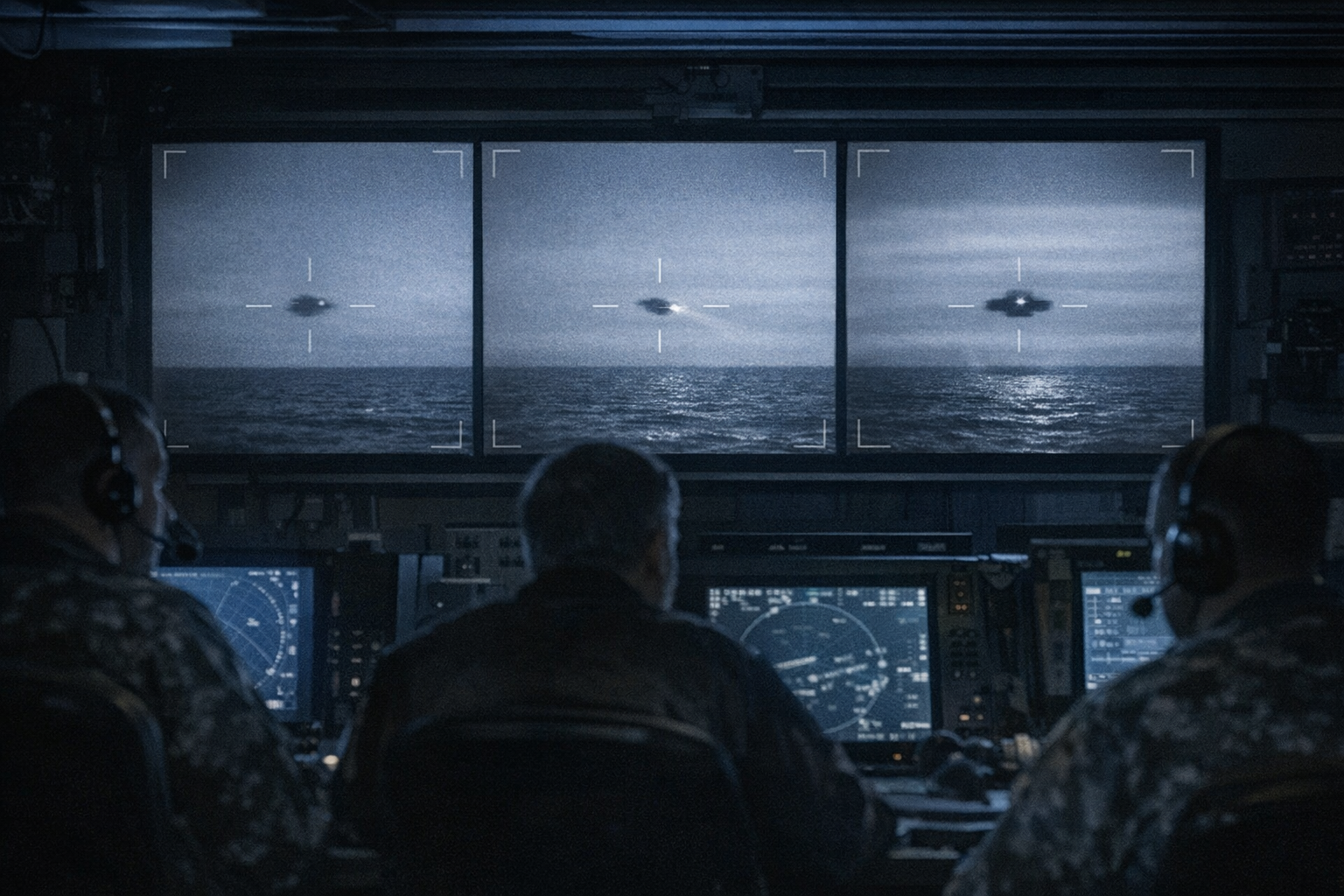
The clips came from inside military systems, passed through official channels, and landed in public view with the weight of secrecy still clinging to them. On grainy screens, under sensor labels most viewers could not decode, the navy UFO videos seemed to offer something rare in this subject: hidden footage the government did not want ignored, but could not fully explain away.
The Navy UFO videos usually refer to three high-profile military cases tied to official release and public debate: Gimbal, GoFast, and USS Omaha. Supporters claim the footage shows extraordinary craft performing beyond known technology, while skeptics argue the videos are much less conclusive than they look at first glance. The most grounded reality is that the videos are real military recordings of objects or signatures that drew attention, but the footage alone does not prove alien craft, and official release created more certainty than the visual evidence itself can carry.
What Happened
The unique angle here matters: this is not a generic UFO roundup. It is an evidence-comparison story. The real question is not whether these clips feel mysterious. It is what each one actually shows, what each one does not prove, and why official release pushed many viewers further than the footage itself justified.
The Gimbal video became one of the most discussed clips because it looked dramatic even to casual viewers. The image appears to show an object rotating while moving across the frame. That single visual moment did a lot of work in the public imagination. Rotation suggests control. Control suggests engineering. Engineering suggests intelligence. But as the site’s earlier piece on Gimbal UFO Video explains, the strongest debate is not about whether the clip exists. It is about whether the apparent rotation belongs to the object itself or to the sensor system viewing it.
GoFast triggered a different reaction. In that clip, the object seems to race over the water at startling speed while pilots react in real time. It feels like the cleanest kind of proof because the scene gives the illusion of direct pursuit. Yet the argument around GoFast UFO Video has always been narrower and more technical: if the target was farther away than viewers assumed, its movement may have looked much faster on screen than it really was.
Then came the USS Omaha footage, which added a night-vision atmosphere that made the story feel even more closed-door and more serious. A glowing object appears above the ocean, and later discussion around the case centered on claims that it descended into the water. In the public mind, that leap was huge. The site’s piece on USS Omaha UFO Video points out the central problem: once a short clip is paired with surrounding claims, many readers stop distinguishing between what the camera captured and what later reporting said happened.
One reason these three cases keep traveling together is timing. They arrived during a period when military UAP stories were moving out of fringe culture and into mainstream reporting. By the time people also revisited broader collections like Pentagon UFO Videos, the framing had already changed. The public was no longer asking only whether strange footage existed. It was asking whether official release itself amounted to partial confirmation.
Picture the ordinary viewer late at night, laptop open, replaying one clip at half speed, then another, then a third. The room is quiet except for keyboard clicks and the faint hum of a fan. Each video is short. Each leaves gaps. Yet together they feel like pieces of a locked file drawer that somehow slid open. That human moment is part of the story. People were not just watching footage. They were watching secrecy crack, at least a little.
Why People Believe It
People believe these videos show something extraordinary because official context changes how ambiguity feels. A blurry civilian clip from social media can be dismissed as noise. Military footage tied to pilots, ships, targeting systems, and defense reporting feels different before a single frame is analyzed. Authority gives uncertainty more weight.
There is also a comparison effect. One strange video can be shrugged off. Three different military-linked cases, discussed across years, create the impression of a repeating pattern. Viewers start thinking less about any one object and more about a hidden class of objects that authorities keep encountering. That logic also feeds stories like the Tic Tac UFO Incident, where multiple layers of witness testimony and system data make the case feel larger than a single image.
The angle of official release matters even more than many people realize. Once the government confirms a clip is authentic in the narrow sense that it came from real military systems, many readers unconsciously upgrade that into a much bigger claim. Authentic footage becomes authentic interpretation. That is the step where belief often outruns evidence.
Another reason the theory sticks is emotional economy. People have spent years hearing that the government hides things, renames things, and discloses only what it has to. So when footage appears without a satisfying final answer, the empty space does not stay empty. It fills with inference. If officials admit the clips are real but do not resolve them cleanly, believers ask the obvious next question: what are they not saying?
And in fairness, some of that distrust is not irrational. Reviews such as the AARO UAP Report show how the modern UAP conversation is shaped by limited public access, uneven records, and the persistent gap between official caution and public expectation. That gap does not prove aliens. But it does explain why these videos feel heavier than their runtime should allow.
Claims vs Evidence
Claim: Because Gimbal appears to rotate, it shows a craft making impossible controlled movements. Evidence: The rotation is real in the video, but what caused it is still debated. A dramatic visual effect is not automatically the same as a dramatic maneuver. Sensor behavior, glare, and imaging limits remain serious alternative explanations.
Claim: GoFast proves a craft was skimming the ocean at extraordinary speed. Evidence: The clip clearly captured something the observers wanted to track, but the speed estimate depends heavily on distance and angle. Without firm public measurement of those values, the video alone does not prove extreme velocity.
Claim: USS Omaha shows an object entering the water, which rules out ordinary explanations. Evidence: The strongest public evidence is still the clip itself plus later reporting around the event. That is not nothing, but it is weaker than many summaries suggest. A short recording does not automatically validate every dramatic detail attached afterward.
Claim: Since all three clips were officially released, the government was quietly confirming nonhuman craft. Evidence: Official release confirms the footage was treated as real military material, not as internet fabrication. It does not confirm the most extreme interpretation of what the objects were. Governments can acknowledge unresolved footage for many reasons, including transparency pressure, airspace safety, and public interest.
Claim: Multiple Navy videos together create proof even if each video alone is incomplete. Evidence: Comparison helps reveal patterns, but only if the cases are genuinely comparable. Gimbal, GoFast, and Omaha do not prove the same thing in the same way. One raises a rotation question. One raises a speed question. One raises a reporting-context question. Grouping them makes the cluster feel stronger, but it can also hide how different the evidence problems really are.
That misunderstood detail is the heart of this story. People often think comparison strengthens certainty. Sometimes comparison exposes weakness instead. When you line these cases up side by side, what stands out is not one clean conclusion. It is three different ways that limited footage can invite oversized interpretation.
Reality Check
The cleanest way to understand the Navy UFO videos is to separate official status from evidentiary strength. Official status matters. These were not random hoax uploads. They were connected to real military systems and real defense conversations. That alone makes them more serious than ordinary internet clips.
But evidentiary strength is a different question. Gimbal is visually striking, yet interpretation depends on whether the system or the object is producing the most dramatic effect. GoFast feels like raw speed, yet the perception of speed may rely on assumptions the public cannot independently verify from the clip alone. Omaha feels like the most cinematic case, but much of its power comes from the story built around the footage, not from what the brief image settles by itself.
This is the contradiction that keeps dividing people. Official release makes the subject feel less dismissible, while the footage remains too thin to deliver the certainty believers want. In other words, the government helped validate the importance of the conversation without resolving the central mystery inside it.
That is why this topic lands in the middle zone rather than at either extreme. The videos are not meaningless. They show real events or signals that prompted real attention. But they also do not cross the line into public proof of alien technology. If anything, they show how easily authenticated uncertainty can be mistaken for authenticated explanation.
The strongest conclusion is narrower and more useful. Gimbal, GoFast, and Omaha still divide people because they each combine three volatile ingredients: military authority, limited imagery, and a public already primed to suspect hidden knowledge. The release made the clips culturally important. It did not make them self-explaining.
Conclusion
Navy UFO videos remain compelling because they feel like secret evidence finally pushed into daylight. But once you compare them carefully, the deeper lesson is not that the mystery is solved. It is that official footage can create certainty in the public imagination long before it creates clarity in the evidence.
That is the unique angle this comparison reveals. Gimbal, GoFast, and Omaha do not form one neat proof package. They form a case study in how modern UAP belief grows: a real release, a short clip, an unresolved question, and then a larger conclusion built on top of it.
If you came here asking what the Navy UFO videos actually prove, the most honest answer is simple. They prove the military recorded and took interest in unusual cases. They do not, by themselves, prove alien craft. What keeps the argument alive is not just what the footage shows. It is how much room the footage leaves for people to imagine the rest.
🔎 If this story stayed with you, the author suggests these real cases next:
- Pentagon UFO Videos: What the Navy Footage Confirmed — and What It Didn’t
- Tic Tac UFO Incident: Best Military Evidence or a Story Bigger Than the Data?
- AARO UAP Report: Clear Answers or a Review That Left the Biggest Claims Open?
Explore more Alien & UFO Theories stories here: