The room looked less like a scientific breakthrough than a display someone wanted the world to see before anyone could check the paperwork. That is what gave the Nazca mummies their power from the start: not just the bodies themselves, but the unsettling possibility that something historic had appeared without a clear trail behind it.
Nazca mummies is the name given to several unusual preserved bodies promoted as possible nonhuman beings linked to Peru. Supporters say the bodies could be alien or at least not fully human. What reality likely shows, based on the public record, is a case weakened less by one dramatic flaw than by a whole chain of them: unclear origins, disputed testing, recycled promoters, and a chain of custody too broken to support extraordinary claims.
What Happened
The story reached a global audience in waves. Reports about strange mummified bodies tied to the Nazca region in Peru began spreading in 2017 through UFO-friendly media, including Gaia and figures already known for promoting sensational alien cases. The bodies were presented as ancient, unusual, and possibly nonhuman, with special attention paid to details like three fingers, elongated skulls, and claims that scans or DNA tests showed something outside normal human history.
That alone was enough to ignite the internet. A body in a desert tomb is one kind of mystery. A body described as ancient and possibly extraterrestrial is another. The setting did a lot of the work. Nazca already carries a mythic charge because of the Nazca Lines, the giant geoglyphs that have inspired decades of alien speculation. So when these specimens appeared, they did not arrive in a neutral landscape. They arrived in a place where many people were already primed to connect Peru with hidden contact stories.
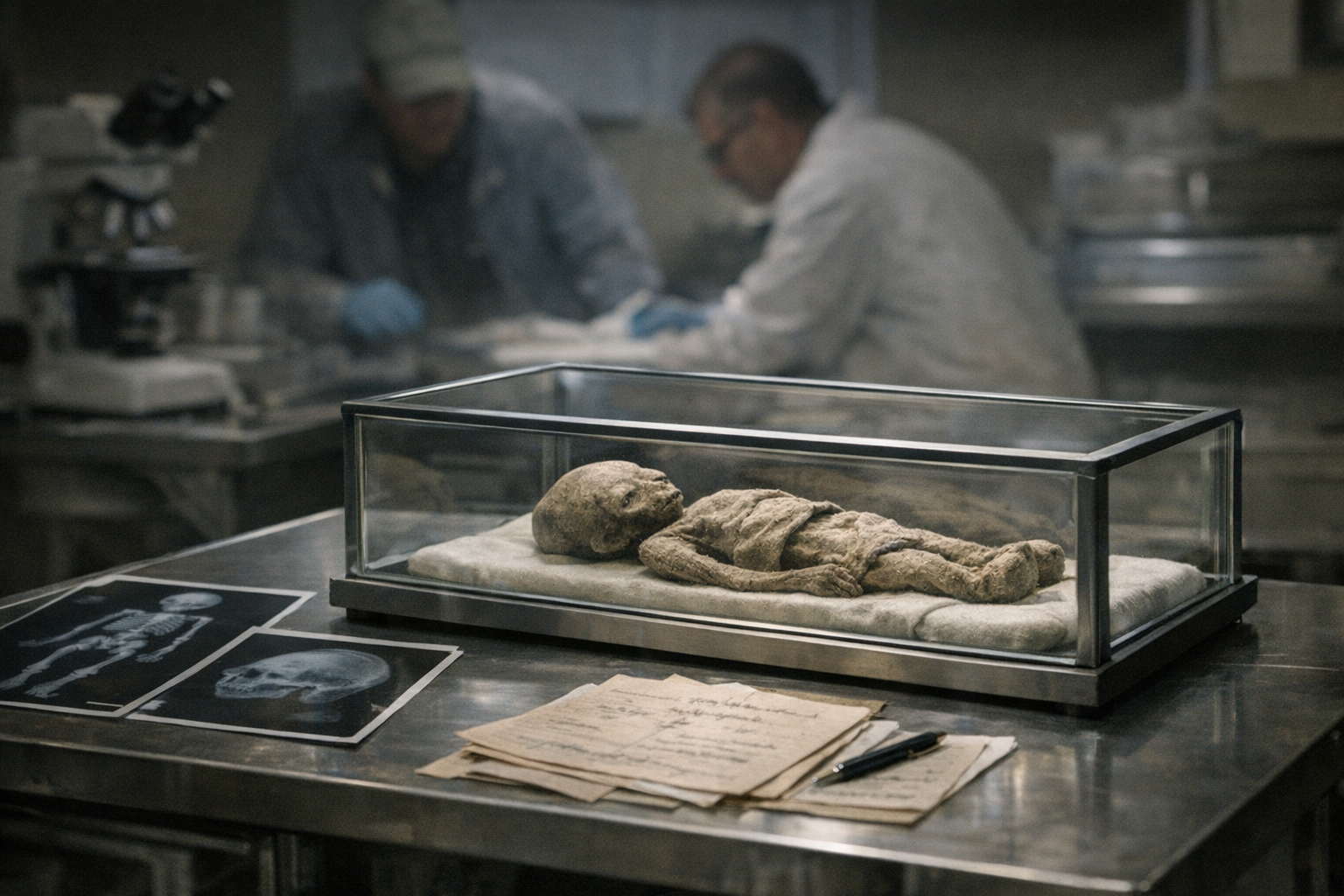
Picture the moment as many viewers first saw it. A dim room. White-coated examiners. X-rays on a screen. A careful voice saying this might not belong to any known human pattern. For a few seconds, it feels like the opening scene of a documentary where the impossible is about to become official. That feeling matters because it explains why the case spread so fast before most people ever asked the boring but crucial questions: who found these bodies, where exactly were they kept, who handled them, and how can outside experts verify that timeline?
Those questions became more important as the story evolved. In 2023, the controversy exploded again when Mexican ufologist Jaime Maussan presented alleged nonhuman bodies to Mexico’s Congress. That created a fresh cycle of headlines, but it did not solve the old problem. Public spectacle is not the same as public verification. A body shown under bright lights can still come with a dark and messy paper trail.
And that is the angle that makes this story different from a generic alien-body article. The central issue is not just what the specimens look like. It is whether the evidence traveled in a trustworthy way. That is the same pressure point that runs through debates over UFO crash retrieval claims. If the chain of custody is weak, every dramatic claim that follows sits on unstable ground.
Why People Believe It
Physical evidence has a special power over the human mind. Testimony can be doubted. Lights in the sky can be dismissed as misidentification. But a body in a box feels different. It seems concrete. It seems like the argument is over before it begins. That emotional reaction helps explain why the Nazca case spread far beyond ordinary UFO audiences.
There is also the visual factor. The specimens look unusual enough to trigger instant fascination. Three fingers, altered skull shape, and preserved tissue all create the impression that viewers are looking at something outside the normal range. Even if experts later argue that the bodies were assembled, modified, or misrepresented, the first image often sticks harder than the later correction.
Belief also grows because the case arrives during a period when more people are open to hidden-evidence stories. Once readers spend time with topics like David Grusch’s UFO claims or allegations of secret analysis programs, they become more willing to think that hard proof could be sitting somewhere outside public view. In that climate, a specimen does not feel like an isolated oddity. It feels like the missing physical piece of a much bigger puzzle.
Another reason the story survives is that supporters often point to technical language. CT scans, carbon dating, DNA percentages, forensic testimony, and medical imaging all sound authoritative. But technical language can create confidence long before the underlying process is clear. A report matters less than many people assume if the sample source is uncertain, if independent labs cannot access the material cleanly, or if the body may have been altered before examination.
There is one more force at work: distrust of institutions. Some people assume mainstream science or government-linked experts would bury a genuine discovery. That suspicion is not created from nowhere. Real institutions have hidden information before. But the existence of real secrecy elsewhere does not repair missing provenance here. It only makes people more willing to overlook the gap.
Claims vs Evidence
Claim: The Nazca mummies are authentic nonhuman or extraterrestrial bodies.
Evidence: Public promoters have pointed to body shape, scans, carbon dating of samples, and claims that some DNA results did not fit simple expectations. But there is no broad, settled public scientific consensus that these specimens are alien. What exists instead is a noisy mix of claims, counterclaims, partial examinations, and sharp disagreement over the origin and integrity of the bodies themselves.
Claim: The unusual anatomy proves the specimens were not fabricated.
Evidence: Unusual does not automatically mean authentic. Critics, including Peruvian officials and researchers cited in reporting over several years, have argued that at least some alleged alien bodies in this orbit were constructed or manipulated using human and animal remains, adhesives, and staged presentation. Even when one specific specimen is discussed as if it stands alone, the wider controversy matters because it damages confidence in the whole stream of promotion around the case.
Claim: Scientific testing has already settled the matter in favor of the believers.
Evidence: This is where provenance becomes decisive. A scan can describe what is on the table. Carbon dating can estimate the age of sampled material. DNA analysis can produce strange or incomplete results if samples are degraded, contaminated, or poorly documented. None of those tests can magically fix a broken chain of custody. If researchers cannot be sure where a specimen came from, how it was assembled, or who modified it before testing, then even real lab work can answer only a limited question.
Claim: Because the case was shown in a major public venue, it must have cleared a serious credibility threshold.
Evidence: Public staging is not peer review. A congressional room, a viral hearing, or a dramatic press event can make a claim feel official without making it reliable. The same pattern appears in stories about alien technology reverse engineering: institutional language and formal settings can make fragments feel more complete than they are.
Reality Check
The cleanest way to understand the Nazca mummies is this: they are not persuasive evidence of alien bodies because the road leading to the evidence is too compromised. That may sound less exciting than arguing over X-rays, but it is the real center of the case. Extraordinary discoveries do not become credible only because they look strange. They become credible when the handling of the evidence can be traced, repeated, checked, and challenged in the open.
This is where chain of custody stops being a legal-sounding side issue and becomes the whole foundation. Imagine a museum curator being handed a box with no trustworthy excavation record, conflicting stories about who found it, and years of sensational promotion attached. Even before opening the lid, the curator knows the object has a credibility problem. That is the Nazca case in miniature. The spectacle arrives first. The documentation limps behind.
There is also a contradiction believers often have to live with. If these were truly world-changing bodies, you would expect the strongest argument to be the evidence trail: controlled excavation, transparent documentation, access for independent teams, and consistent publication. Instead, the strongest public energy usually comes from visuals, interviews, and arguments about what skeptics are supposedly unwilling to accept. That is backwards. In a genuine breakthrough, the paperwork should be boring and devastatingly solid.
None of this proves that every specimen story connected to Nazca is identical or that every examiner acted in bad faith. It does mean the public case remains weak. The burden is not on skeptics to explain away every photograph. The burden is on promoters to show that the bodies were recovered, preserved, tested, and documented in a way that survives independent scrutiny.
That is why the Nazca mummies fit a larger pattern in conspiracy culture. Physical-evidence stories spread faster than official records because they feel immediate. A body, a fragment, or a strange material sample seems more real than a stack of memos. But without trustworthy handling, even the most dramatic artifact can collapse into uncertainty. It becomes not a solved revelation, but an object lesson in how badly extraordinary evidence can be damaged by bad process.
Conclusion
The Nazca mummies continue to fascinate people because they offer the most seductive kind of mystery: not just a light in the sky or a whispered program name, but something that looks like it can be touched. That makes the case emotionally powerful. It does not make it proven.
Right now, the strongest explanation is not that alien bodies have finally been placed on the table for the world to study. It is that a dramatic set of specimens entered public view without the kind of transparent provenance needed to support such an extraordinary conclusion. Until that changes, the mystery remains modern, viral, and compelling—but still built on bad proof.
🔎 If this story stayed with you, the author suggests these real cases next:
- UFO Crash Retrieval Claims: Hidden Recovery Program or Testimony Without Proof?
- Alien Technology Reverse Engineering: Secret Breakthroughs or Stories Built on Fragments?
- Alien Signals from Space: Do Strange Radio Bursts Really Suggest Intelligence?
Explore more Alien & UFO Theories stories here: