
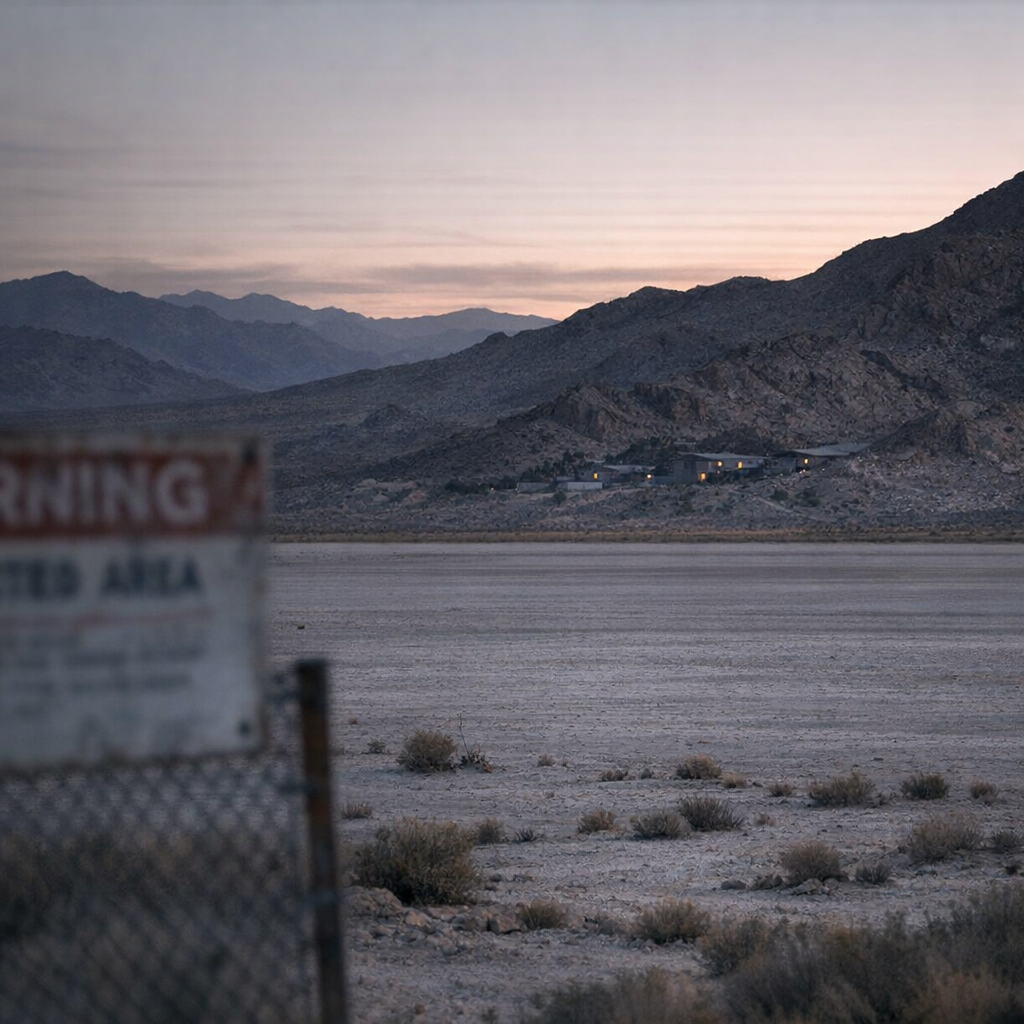
There is a dry basin in Nevada that barely looks like a secret at all—just pale ground, ridgelines, and distance. But for decades, believers have stared at that empty patch near Area 51 and asked whether the real story was never inside the famous base, but hidden just over the next rise at a place called Area 51 S4.
Area 51 S4 is the alleged site Bob Lazar said sat near Papoose Lake, south of the main Area 51 complex, where alien craft were supposedly stored and studied. Supporters claim it was a hidden facility built into the landscape and kept off ordinary maps. The more likely reality is that S4 became powerful because it turned a vague secrecy story into a physical place people could imagine, even though public records, maps, and confirmed evidence still do not prove the site existed as Lazar described.
What Happened
To understand why S4 matters, you have to start with a simple problem in UFO lore. A secret base like Area 51 already feels mysterious, but mystery alone is slippery. People want a door, a room, a hangar, a point on a map. S4 gave the larger legend that missing shape.
In 1989, Bob Lazar publicly claimed he had worked not at the main Area 51 site itself, but at a separate facility called S4 near Papoose Lake. He described it as a place built into the side of a mountain, with concealed hangar doors that blended into the desert. According to Lazar, this was where recovered craft were being reverse engineered.
That physical-place claim is what made the story stick. If he had only said, “the government has secret alien technology somewhere,” it would have landed like hundreds of other rumors. But by attaching the story to a named location—close enough to the Area 51 myth to feel plausible, separate enough to sound even more hidden—Lazar gave people something they could search for, argue over, and visualize.
Picture the scene that believers often imagine. A black road ends in dust. The sun has gone down behind the Nevada ridges. Someone unfolds a rough map under weak flashlight light and points toward Papoose Lake, convinced the real secret is not where tourists watch the perimeter lines, but farther off, where the ground looks empty. That image has done a lot of work for the legend.
The problem is that stories built around a place can sound stronger than they are. A named location feels testable. It feels like the kind of thing that should either exist or not exist. But in practice, the debate around S4 became a foggy mix of desert geography, memory, rumor, and the natural difficulty of proving what is not publicly visible inside a military testing region.
Over time, S4 became an extension of the larger Area 51 alien rumors machine. It also became central to the story of Bob Lazar, because S4 was the piece that made his account feel less like a general belief and more like inside knowledge. And once people connected it to later conversations about alien technology reverse engineering, the location started to carry more symbolic weight than most unverified places ever do.
Why People Believe It
People believe S4 for a few very human reasons. First, the claim sits next to something undeniably real. Area 51 is not fiction. It is a real, heavily restricted military testing site wrapped in decades of secrecy. Once a real secret place exists, the public becomes more willing to believe there are deeper secret places nested around it.
Second, S4 solves a storytelling need. The wider UFO world is full of fragments: crash stories, strange lights, whispers about black programs, and witness accounts that rarely fit together neatly. S4 acts like a missing bridge. It says the craft were recovered somewhere, moved somewhere, and studied somewhere specific. That makes the entire mythology feel more organized.
Third, there is the geography effect. Nevada desert terrain is vast, repetitive, and visually deceptive. Dry lake beds, mountain cuts, and restricted ranges naturally invite projection. If someone already expects concealment, an empty landscape does not look empty. It looks edited.
There is also the Lazar factor. He did not just provide a location name. He offered mechanical detail, routines, security framing, and the suggestion that he knew how the hidden world was arranged. That kind of detail is persuasive even when it is not proven. People often confuse specificity with verification.
And finally, believers are not wrong to notice that real military secrecy has often hidden surprising things. The United States has tested aircraft in the desert that, at the time, looked impossible to ordinary observers. That history matters. It gives S4 a base layer of plausibility. The leap comes after that, when real secrecy gets stretched into proof of a specific alien-storage site.
Claims vs Evidence
Claim: S4 was a hidden facility near Papoose Lake where recovered alien craft were stored and studied.
What supports the claim: Bob Lazar has repeated the basic story for decades, and supporters argue that the location detail itself is meaningful. Some also point to the fact that highly secret work really did happen in the broader Nevada test environment, so a lesser-known sub-site does not sound impossible on its face.
What the evidence does not show: There is no confirmed public documentation proving that an S4 facility existed in the form Lazar described. No released site plans, authenticated employment records tied to that specific role, or independently verified imagery have established a mountain-hangar reverse-engineering complex at Papoose Lake.
Claim: The lack of records is itself proof that the site was successfully hidden.
What supports the claim: In conspiracy logic, absence can look like intentional erasure. If a place was extremely classified, people assume its paperwork would be buried, renamed, or compartmentalized out of reach.
What the evidence suggests instead: Missing proof is not the same thing as proof of concealment. It can also mean the claim was exaggerated, remembered loosely, or built from a real setting plus fictional additions. This is one reason S4 survives so well: the same gap can feed both belief and doubt.
Claim: Maps and geography point toward a hidden installation.
What supports the claim: Papoose Lake sits near already sensitive territory, and that alone makes people feel they are looking at the edge of something protected. Supporters sometimes treat the remoteness, terrain, and restricted region as indirect support for Lazar’s account.
What the evidence shows: Remoteness is not unusual in that part of Nevada, and sensitive geography by itself does not confirm a specific buried facility. The physical-place argument is emotionally strong because people can picture it, but the documented case remains thin. A blank area on a public map is not evidence of alien hangars. It is often just a blank area on a public map.
Claim: Because later UFO secrecy stories mention hidden programs, Lazar’s S4 account looks more credible in hindsight.
What supports the claim: Newer debates over UFO crash retrieval claims and government secrecy make older stories feel newly relevant. Supporters see a pattern: whistleblowers today, insider claims yesterday, same hidden machinery underneath.
What the evidence shows: Similar themes do not equal confirmation. Later claims can make an older story feel less ridiculous without actually proving its facts. S4 may fit the broader legend well, but fit is not proof.
Reality Check
The most grounded way to read S4 is not as a solved mystery, but as a location story that became stronger than its evidence. That distinction matters. Some conspiracy theories live or die on photographs. Others live on psychology. S4 lives mostly on placement.
It gave UFO culture something powerful: a hidden annex to an already hidden world. That is almost perfect storytelling architecture. The famous base is too visible, so the real secret must be nearby but deeper. The public knows the name Area 51, so the truer story must sit behind a smaller code, whispered like an internal label.
There is also a contradiction at the center of the S4 idea that keeps it alive. If the facility were visible enough to be confidently located and described, it should have left a clearer public trail by now. But if it was hidden so perfectly that no trail survives, then the public claim becomes nearly impossible to test. That tension creates a story that can resist closure almost forever.
Another overlooked detail is that a lot of the emotional force comes from landscape, not evidence. Dry lake beds and desert ridges are visually simple, which lets imagination do heavy lifting. In a city, a hidden base story runs into roads, witnesses, permits, and noise. In the Nevada desert, emptiness itself becomes part of the myth.
That is why S4 works as a belief engine even without solid confirmation. It turns public distrust into a map problem. It says: you are not wrong to think something was hidden; you were just looking at the wrong place. For readers, that is a compelling twist. For investigators, it is still not enough.
What we can say with confidence is narrower. The Area 51 region really was secretive. Lazar’s account really shaped modern UFO culture. The idea of S4 really became one of the most durable sub-legends in the entire Area 51 orbit. What we cannot say is that the physical site has been publicly proved as a real alien reverse-engineering installation.
Conclusion
So, is Area 51 S4 a hidden site or a story that outgrew the map? Based on public evidence, it looks much more like the second. The claim remains memorable because it attaches a legendary secret to a real landscape, not because the proof has ever become solid.
S4 matters anyway. It shows how conspiracy belief often needs more than an idea. It needs a place. A ridge. A dry lake. A code name that sounds half bureaucratic and half forbidden. Once those pieces lock together, a theory can feel concrete even when the evidence is still thin.
That may be the clearest lesson of all. The power of S4 was never just that it might exist. The power was that it made the broader Area 51 myth feel physically reachable, as if one more map, one more witness, or one more released file might finally bring the hidden door into view. So far, that door remains part of the story—not part of the confirmed record.
🔎 If this story stayed with you, the author suggests these real cases next:
- Area 51 Alien Rumors: Why a Real Secret Base Became the Center of UFO Lore
- Bob Lazar Explained: Insider Whistleblower or the Story That Made Area 51 Legendary?
- Alien Technology Reverse Engineering: Secret Breakthroughs or Stories Built on Fragments?
Explore more Alien & UFO Theories stories here: