
Also covered in: UFO Disclosure: Hearings, Whistleblowers, and the Proof Gap
What Happened
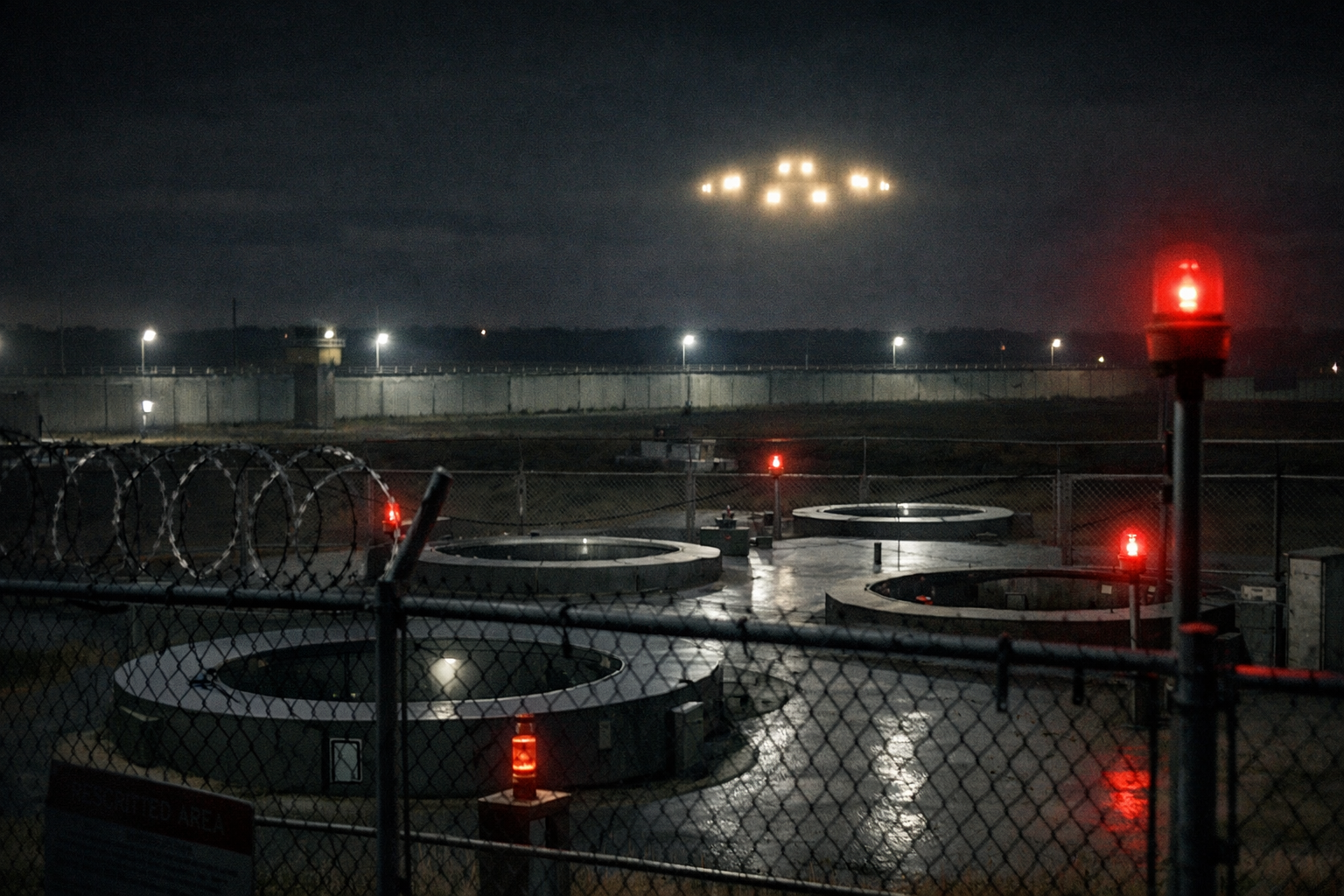
The theory centers on a pattern, not one single famous sighting. Over the years, witnesses connected to nuclear sites in the United States and elsewhere have claimed that unidentified lights or craft appeared near some of the most heavily protected places on Earth. These stories often point back to Cold War missile fields, when fear, secrecy, and constant readiness shaped daily life.
One of the most discussed sets of claims came from former U.S. Air Force personnel tied to Malmstrom Air Force Base in Montana. Some said unusual aerial activity was reported near missile facilities in the late 1960s. In later interviews, a few witnesses also said missile systems went offline around the same time, which turned the story from a strange sighting into something far more serious.
Picture the mood inside that world for a second. A young officer sits in a concrete control room deep underground, trained to think in checklists and codes, while phone calls come in from topside security teams describing lights moving where there should only be stars. Even if nothing supernatural happened, that kind of report would be enough to tighten every nerve in the room.
Supporters of the theory argue that these were not isolated moments. They point to repeated accounts involving missile sites, weapons storage areas, and other nuclear-linked facilities. The basic claim is simple: if unexplained objects really appeared near these locations more than once, then the pattern itself matters, even before anyone explains what the objects were.
Some later writers expanded the story much further. In the most dramatic versions, the objects were not just watching. They were supposedly able to interfere with nuclear systems, send warnings, or demonstrate control over human weapons. That is where the story moved from military mystery into full conspiracy territory.
There is a reason this angle has stayed alive. Nuclear bases are among the last places people expect confusion. If something unusual shows up there, readers assume the military would know what it was, record it clearly, and explain it. When that does not happen, suspicion grows fast.
This is also why stories about official secrecy around UFOs often circle back to military infrastructure. On Crack the Conspiracy, posts like Government UFO Programs: Why the Files Never Really Closed show how official attention itself can keep a mystery alive, even when clear answers remain scarce.
Why People Believe It
The strongest reason people believe this theory is that it does not begin with random internet rumors. It begins with former military witnesses, old press accounts, and a setting that already feels serious. A strange light over an empty field is one thing. A strange light over a nuclear weapons site sounds like a national security event.
Another reason is the Cold War backdrop. The public already knows governments hid enormous amounts of military information during that period. Secret tests, classified programs, and public cover stories were real parts of that era. Because of that history, many readers find it easy to believe that an embarrassing or unexplained incident near a missile base might have been buried or softened.
The story also carries a built-in emotional hook. Nuclear weapons represent the highest level of human power and danger. So when people hear that unknown objects may have appeared over those sites, the idea feels symbolic as well as factual. It sounds like someone, or something, was looking directly at the most destructive tools we have ever made.
Belief is strengthened by repetition across decades. The details change from witness to witness, but the same basic image returns: guarded base, night sky, alarmed personnel, unexplained lights. A repeated shape like that is powerful. Even when the evidence is uneven, the story becomes harder to dismiss as a one-off misunderstanding.
There is also a trust factor. Retired officers speaking calmly about old incidents often sound more credible than dramatic UFO influencers online. Their rank, training, and measured style make audiences think they had little to gain by inventing the story years later.
And once readers have already absorbed other military UFO cases, the nuclear-base pattern feels like the next logical step. Stories such as Pentagon UFO Videos: What the Navy Footage Confirmed — and What It Didn’t make many people more open to the idea that unusual objects have entered restricted military airspace without easy explanation.
Claims vs Evidence
Claim: Unidentified craft repeatedly appeared over nuclear bases and missile sites. Evidence: There are witness statements, interviews, and later public discussions that point to several incidents. Some of these claims involve real personnel connected to real bases. That gives the story weight.
Claim: The military has records proving these events happened exactly as described. Evidence: Publicly available documentation is limited. There are records of security concerns, sightings, and investigations in some cases, but not a clean, complete file that settles the matter. That gap is one of the main reasons the theory keeps growing.
Claim: UFOs shut down or interfered with nuclear missiles. Evidence: This is one of the most famous parts of the story, but it is also one of the hardest to prove. Former personnel have described missile malfunctions and linked them to aerial events. However, there is no widely accepted public record showing an unknown craft directly caused those technical failures.
Claim: The objects were extraterrestrial. Evidence: There is no confirmed evidence that alien craft visited nuclear sites. Even if unusual aerial incidents did occur, that alone would not identify the source. Misidentification, limited observation conditions, equipment issues, secret human technology, and ordinary rumor growth all remain possible explanations.
Claim: The government covered up the truth because the incidents exposed a security weakness. Evidence: This is plausible at a general level, because militaries do hide vulnerabilities. But plausible is not the same as proven. What we do know is that secrecy around national defense naturally creates information gaps. Those gaps invite both serious investigation and wild speculation.
There is another issue people often miss. Memory changes over time. Some of the best-known accounts were shared or expanded years after the original events. That does not automatically make them false, but it does mean historians have to be careful. Human memory is not a recording device, especially when the event was stressful and unusual.
This is where comparison helps. In cases like Rendlesham Forest Incident: Britain’s Roswell or a Cold War Story That Grew in the Dark?, the mix of witness confidence, military setting, and missing certainty creates a very similar problem. The story may contain a real unexplained core, but later retellings can make that core seem larger and cleaner than the original evidence allows.
Reality Check
The most reasonable conclusion is not that the whole story is fake, and not that aliens definitely disabled nuclear weapons. It is that the pattern deserves attention, but the strongest versions of the theory go well beyond what can currently be proved. Something may have been seen near certain facilities. That part is possible. The leap from “something strange was reported” to “nonhuman craft were sending a message about nukes” is much bigger.
There are several grounded explanations for at least some reports. During the Cold War, military sites operated under extreme pressure. Security teams were trained to react quickly to anything unusual. Lights in the sky could be aircraft, satellites, atmospheric effects, stars near the horizon, or human activity judged in tense conditions. Once a base rumor started, later reports could also be shaped by expectation.
Technical failures add another layer. Missile systems and support equipment are complex. If a malfunction happened around the same time as a sighting report, people would naturally connect the two. But coincidence is not proof of causation. Without clear technical records tying one event to the other, the connection stays suggestive rather than settled.
At the same time, the theory survives because the official answers often feel incomplete. When authorities respond with silence, vague comments, or missing records, they do not calm suspicion. They feed it. In that sense, the real fuel behind this conspiracy may not be alien evidence at all. It may be the familiar mix of secrecy, fragmented documentation, and public distrust.
So the reality check is this: there is enough here to justify serious curiosity, but not enough to claim a confirmed extraterrestrial intervention at nuclear sites. The strongest evidence supports a pattern of reports and concern. The weakest leap turns that pattern into certainty about who or what was behind it.
Conclusion
The story of UFOs over nuclear bases has lasted because it touches a very specific fear. If the most protected places in the world can host unexplained incidents, then maybe the people in charge do not understand the sky as well as we assume. That idea is powerful, and it does not fade easily.
What we do know is that former personnel have kept these stories alive, journalists and researchers have kept returning to them, and the military setting gives the mystery unusual weight. What we do not know is whether the underlying cause was extraordinary, human, technical, or simply misunderstood in the moment.
That leaves this case in the category where many of the most durable conspiracy stories live: partly supported, partly stretched, and still unsettled enough to keep people looking up.
🔎 If this story stayed with you, the author suggests these real cases next:
- Pentagon UFO Videos: What the Navy Footage Confirmed — and What It Didn’t
- Government UFO Programs: Why the Files Never Really Closed
- Rendlesham Forest Incident: Britain’s Roswell or a Cold War Story That Grew in the Dark?
Explore more Alien & UFO Theories stories here: