
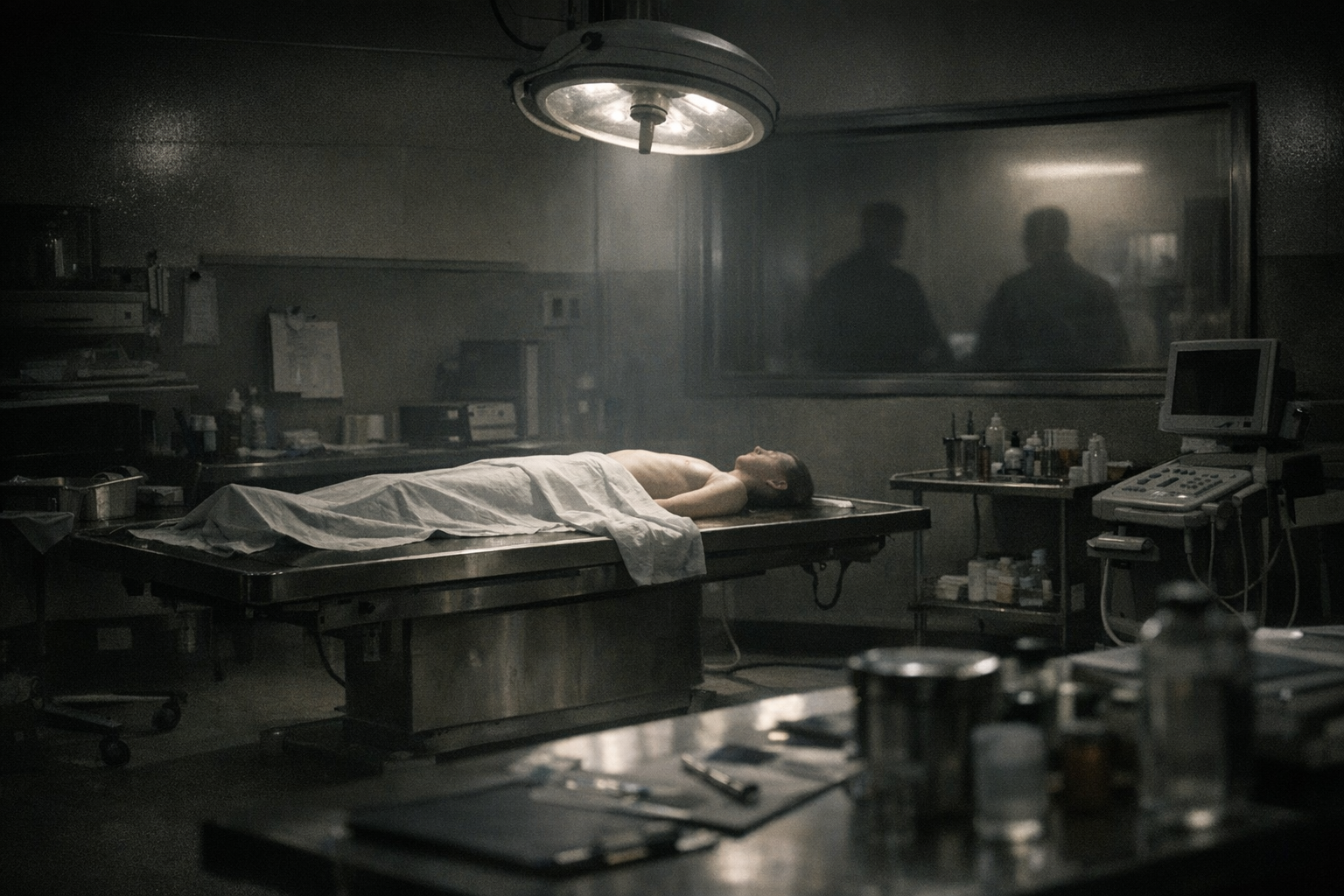
The file was never supposed to leave the room. In story after story, people describe dim exam tables, cold metal walls, and the feeling that someone was using them for a plan they were not allowed to understand. At the center of that fear sits the alien hybrid theory — the claim that some UFO encounters were not just about observation, but about a hidden breeding program between humans and something not quite human.
What Happened
The hybrid idea grew out of alien abduction stories that spread widely in the late 20th century. Some witnesses said they were taken aboard strange craft, examined under bright lights, and shown children with unusual eyes, pale skin, or features that looked partly human and partly alien. In the most disturbing versions, experiencers believed they were being used to help create a new species.
These stories often followed a familiar pattern. A person would describe missing time, a silent road, a bedroom filled with strange light, or a memory that only seemed to return later. What made the hybrid version different was the added claim that the encounter had a purpose. It was not random contact. It was reproduction, genetic testing, or some long-running program hidden behind secrecy and fear.
One of the most influential figures in this world was Budd Hopkins, an artist and UFO researcher who collected many abduction accounts. Later, Harvard psychiatrist John Mack treated experiencers seriously enough to make the subject far more visible. Their work did not prove the claims, but it gave them structure. The idea of ordinary people carrying the same terrifying memory suddenly felt, to believers, like a pattern instead of a collection of strange personal stories.
A mini-scene shows why the theory stuck. Imagine waking at 3:12 in the morning, heart racing, with the hallway light somehow on and dirt on your bare feet. You cannot explain how you got there. By itself, that moment could mean stress, a dream, sleepwalking, or confused memory. But if someone later tells you that other people saw small beings, bright rooms, and children who looked “almost human,” the personal shock can harden into a story about hidden purpose.
As the idea spread, it moved beyond UFO books and late-night radio. It entered documentaries, convention talks, online forums, and fiction. Over time, the hybrid narrative became one of the darkest branches of alien lore because it mixed cosmic mystery with a very human fear: losing control over your own body.
That theme connects closely with other encounter stories already explored on the site, especially Alien Abduction Stories: Why So Many Nighttime Encounters Feel Real. It also overlaps with the wider culture of secrecy built around Area 51 Alien Rumors: Why a Real Secret Base Became the Center of UFO Lore, where restricted access helps rumor grow faster than evidence.
Why People Believe It
Part of the answer is emotional force. Hybrid stories are vivid, personal, and intimate in a way many conspiracy theories are not. They are not about a hidden file in an archive or a secret meeting behind closed doors. They are about the body, memory, pregnancy, family, and fear. When a theory touches those parts of life, it can feel real even without physical proof.
Another reason is recurring narrative detail. Many experiencers described similar settings: smooth rooms, medical procedures, unusual beings, and telepathic communication. Supporters argue that these repeated themes suggest people were reporting the same event from different places. To them, the pattern feels too specific to dismiss as coincidence.
But there is another explanation for recurring detail. Once a set of well-known stories enters books, television, podcasts, and internet culture, later accounts can start to borrow the same shape. People may not even realize they are doing it. Memory is not a recording device. It can be influenced by suggestion, fear, media exposure, and the way a question gets asked.
The hybrid theory also grew during a period of rising anxiety around genetics, fertility, and scientific control. In the 1980s and 1990s, people were hearing more about DNA, reproductive technology, cloning, and government secrecy all at once. In that environment, a story about hidden breeding programs did not sound like pure fantasy to everyone. It sounded like a nightmare version of modern science.
Culturally, the theory offered a darker update to older folklore. Many societies have stories about beings that enter the home at night, steal children, replace children, or cross the line between human and nonhuman worlds. The characters changed, but the structure remained familiar. What used to be spirits or fairies became aliens in clinical rooms.
Claims vs Evidence
Claim: Some abductees say aliens used human beings in a hidden reproductive program. They describe medical exams, removed eggs or sperm, pregnancies that did not continue normally, or meetings with hybrid children. Supporters say the emotional intensity of these stories suggests that something real happened.
What the evidence shows: There is no confirmed physical evidence proving the existence of an alien-human hybrid program. No verified DNA sample, medical record, recovered body, or independently confirmed laboratory result has established that hybrids exist. The strongest material offered in support is almost always testimony.
Claim: Similar witness reports from different people point to a real external event.
What the evidence shows: Similar reports can happen for many reasons besides a real shared alien program. Sleep paralysis can create terrifying sensations of presence, restraint, pressure, and vivid visual detail. False-memory research shows that recall can become distorted, especially when hypnosis or leading questioning is involved. Trauma, anxiety, and suggestion can also shape how people interpret hard-to-explain experiences.
Claim: Hypnotic regression helps people recover hidden memories of abduction and hybrid encounters.
What the evidence shows: This is one of the weakest parts of the case. Many psychologists warn that hypnosis can increase confidence in a memory without increasing accuracy. A person may sincerely believe what they recall under hypnosis, but sincerity is not the same thing as proof. That matters because many famous hybrid accounts were developed or expanded through memory-recovery methods.
Claim: Government secrecy around UFOs suggests the hybrid story may be buried with other hidden truths.
What the evidence shows: Governments really have hidden military projects, misled the public at times, and investigated unusual aerial reports. That is true. But evidence of secrecy in one area does not automatically confirm a different claim about alien reproduction. This is where theories often jump too far. A real wall of secrecy can make almost any hidden-story idea feel possible, even when direct evidence is missing.
What we do know is that UFO culture contains many cases built around mystery, witness testimony, and uncertain interpretation. Some, like Travis Walton UFO Incident: The 5 Days That Turned a Logger Into a Legend, remain famous because the human story is strong even when the facts stay debated. The hybrid theory fits that same pattern, but with even less verifiable support.
Reality Check
The hybrid theory is powerful because it joins two fears at once: hidden intelligence and loss of bodily control. That combination can produce stories people never forget. But when we step back from the emotional force of the narrative, the foundation stays thin.
There is no confirmed evidence that alien-human hybrids exist. There is no verified biological sample. There is no publicly confirmed institution, program, or whistleblower with independently testable proof. The theory survives mostly through repeated personal testimony, cultural reinforcement, and the idea that missing evidence is itself part of the cover-up.
That last part is where logic becomes important. A theory cannot become stronger every time evidence fails to appear. If every gap is treated as proof of better concealment, the claim becomes impossible to test. Once that happens, it stops functioning like an investigation and starts functioning like a belief system.
At the same time, dismissing every experiencer as dishonest would be too simple. Many people seem genuinely shaken by what they believe happened. Some may have gone through frightening sleep events, mental stress, trauma, or misinterpreted bodily experiences. Others may be working from memories shaped over time by media, community, and suggestion. The distress can be real even if the alien explanation is not.
The most grounded conclusion is that the hybrid story tells us more about human fear than alien biology. It reflects anxiety about reproduction, identity, medical power, and what might happen when technology or outside force reaches into private life. That does not make the story meaningless. It makes it revealing in a different way.
Conclusion
The alien hybrid theory remains one of the most unsettling ideas in UFO culture because it feels personal, invasive, and hidden by design. It takes the mystery of alien contact and turns it into something much more intimate: a claim that human beings were being used for a program they could barely remember.
But after the fear, the patterns, and the secrecy are stripped down, the same problem remains. The case is built on testimony, not confirmed evidence. People may sincerely believe they experienced something extraordinary, yet belief alone cannot establish that a secret hybrid project ever existed.
So the theory sits in a familiar place on Crack the Conspiracy: gripping to hear, important to examine, but unsupported by verified proof. It survives because it speaks to deep human worries, not because the evidence has finally caught up with the story.
🔎 If this story stayed with you, the author suggests these real cases next:
- Alien Abduction Stories: Why So Many Nighttime Encounters Feel Real
- Travis Walton UFO Incident: The 5 Days That Turned a Logger Into a Legend
- Government UFO Programs: From Project Blue Book to AATIP to AARO
Explore more Alien & UFO Theories stories here: