
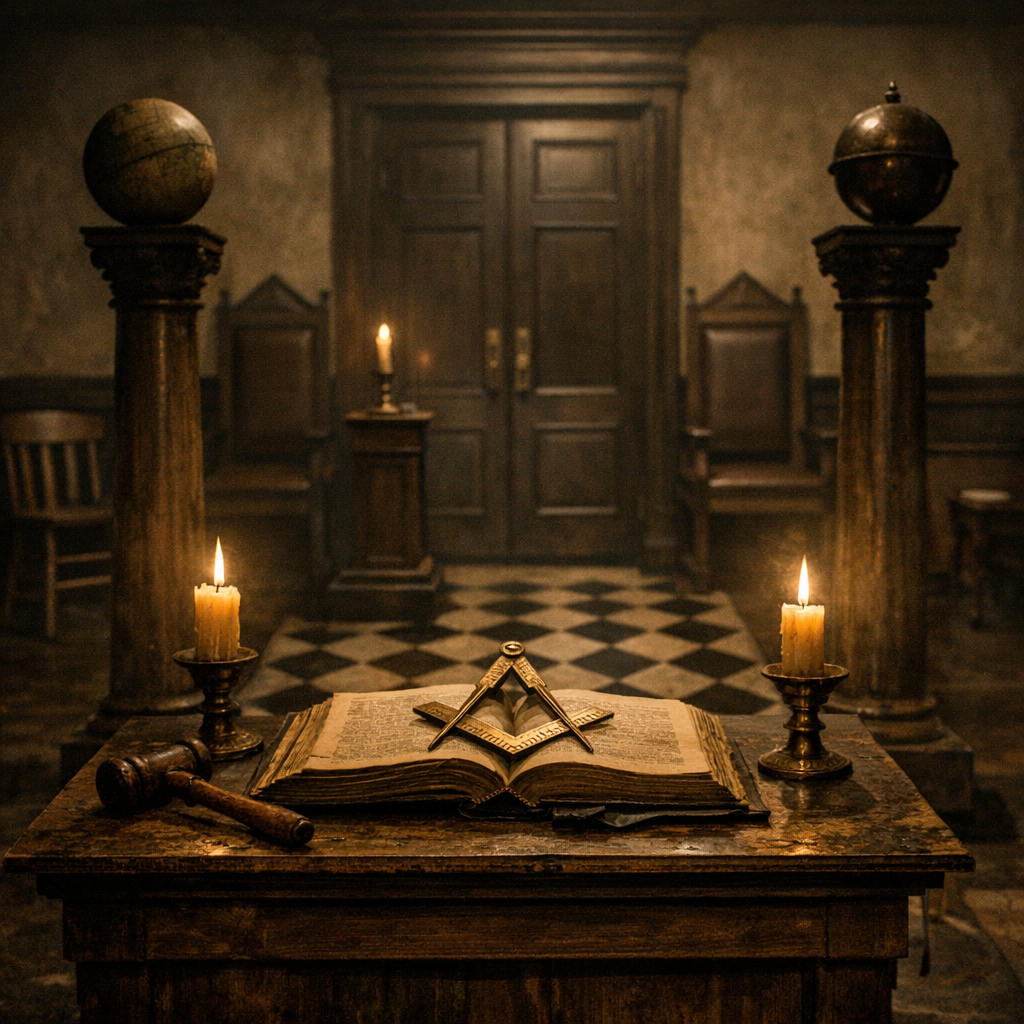
The doors are closed, the handshake is private, and the symbols on the wall look older than the country around them. That mix of restricted access and ritual mystery is why Freemasons explained has become more than a history question. For many people, it feels like a glimpse through a keyhole into a world that was never meant to be fully seen.
What Happened
Freemasonry is a fraternal organization with roots that are still debated in detail, but most historians trace modern Freemasonry to Britain in the late 1600s and early 1700s. It grew from older guild traditions, ceremonial customs, and Enlightenment-era social clubs into a structured brotherhood with lodges, degrees, symbols, and moral teachings.
Over time, Masonic lodges spread across Europe and the United States. Members included merchants, local leaders, military officers, and in some cases famous public figures. That alone was enough to make outsiders curious. A group with private meetings, recognizable symbols, and well-connected members almost invites suspicion, especially when the group does not feel a need to explain every ritual to the public.
Inside a lodge, the reality is usually more ordinary than the mythology. Members take part in ceremonial degree work, use symbolic language, and support charitable projects. The organization presents itself as a brotherhood focused on moral improvement, mutual support, and community service. But the very features that help create group identity inside the lodge look different from the outside. Secrecy to one person can look like discipline. Secrecy to another can look like concealment.
That outsider feeling has mattered for centuries. In the 1820s, the disappearance of William Morgan in New York helped trigger one of the biggest anti-Masonic panics in American history. Morgan had threatened to publish Masonic secrets, then vanished under suspicious circumstances. The case was never resolved cleanly, and many people concluded that Masons had silenced him. Whether every rumor was true is still debated, but the scandal gave the public a vivid story: secret men, hidden loyalty, and a witness who disappeared after promising to expose them.
That was the moment when Freemasonry became more than a private fraternity in the public imagination. It became a conspiracy magnet. Later generations layered on more claims: that Masons secretly controlled governments, directed revolutions, shaped global finance, or formed the inner circle of a much larger hidden network. By then, the symbols had already done their work. Once people start seeing an all-seeing eye, aprons, pillars, and coded gestures as signs of hidden power, every photograph and public ceremony starts to feel like a clue.
Why People Believe It
The simplest answer is that Freemasonry combines privacy with status. People are naturally suspicious of groups they cannot fully observe, especially when those groups include judges, business leaders, politicians, police officers, or military officers. Even if the group’s real activities are boring most of the time, private access creates a sense that something important must be happening behind closed doors.
Symbols also do a lot of the work. Freemasonry is rich in visual language: compasses, squares, pillars, aprons, tracing boards, and ceremonial phrases. Symbol-heavy groups are easy to mythologize because symbols feel meaningful even before they are understood. A public charity group with no imagery rarely inspires wild theories. A centuries-old brotherhood with ritual language almost guarantees them.
There is also a social reason conspiracy claims grow around the Masons. They sit at the intersection of two ideas people find powerful: elite networking and secret knowledge. Many conspiracy stories become sticky when they suggest that ordinary people are seeing only the stage while a hidden group runs the script. That same logic shows up in broader stories about The New World Order or elite gatherings like Bohemian Grove. Freemasonry fits that pattern almost too perfectly.
And then there is the emotional angle. Secrecy makes people fill in gaps with imagination. If a group refuses to reveal everything, outsiders often assume the hidden part is more dramatic than it really is. That does not prove innocence. But it does explain why ordinary fraternal customs can grow into stories about world control, occult power, or hidden allegiance stronger than public law.
Claims vs Evidence
Claim: Freemasons are a secret ruling class that directly controls governments from behind the scenes.
Evidence: Freemasonry has included influential members, and local relationships inside lodges may have created informal social power. But broad claims of unified global control are not supported by solid evidence. Lodges are decentralized, vary by region, and often disagree with one another. That is very different from a single command structure quietly running world events.
Claim: Masonic symbols in public life prove hidden domination.
Evidence: Masonic imagery is real and publicly visible in many places, including architecture, memorials, and historical artifacts. But a symbol’s presence does not prove a hidden operation. Symbolism can show influence, tradition, or affiliation without proving a covert conspiracy.
Claim: Freemasons are mainly an occult religion disguised as a social club.
Evidence: Freemasonry uses ritual, allegory, and moral symbolism, which can look mystical to outsiders. Yet most mainstream Masonic organizations describe themselves as fraternal, not religious, and require belief in a higher power rather than membership in a specific faith. Critics may still object to the rituals, but the leap from ceremonial symbolism to occult control is not well supported.
Claim: The William Morgan case proves every major fear about the Masons is true.
Evidence: Morgan’s disappearance is one of the strongest historical reasons public suspicion took hold. It shows that Masonic loyalty and secrecy could overlap with intimidation in a deeply troubling way. But one scandal, even a serious one, does not automatically prove every later theory about global manipulation.
Claim: If Freemasonry were harmless, it would have no secrets at all.
Evidence: Many private groups, from fraternities to civic orders to religious communities, keep some rituals or internal customs private without being criminal or all-powerful. Privacy deserves scrutiny when power is involved, but privacy by itself is not evidence of a massive conspiracy.
Reality Check
The reality sits in an uncomfortable middle ground, which is usually where the most interesting stories live. Freemasonry is not just a random myth invented by paranoid outsiders. It is a real organization with real rituals, real symbols, and a long history of selective access. That alone is enough to justify curiosity. A group cannot spend centuries guarding ceremonies and then act surprised when people wonder what else it may be guarding.
At the same time, the strongest claims about Freemasonry tend to run far ahead of the evidence. There is no clear proof that modern Freemasons operate as a unified shadow government directing world events. The organization appears too fragmented, too varied, and too public in many of its local activities for that claim to hold up cleanly.
The better question is not “Do the Freemasons secretly control everything?” It is “Why do groups like this attract so much suspicion?” The answer is that they combine old rituals, hidden knowledge, selective membership, and occasional proximity to power. Add one historical scandal like William Morgan, and the myth-making engine never really stops.
There is also a useful lesson here for conspiracy analysis. Sometimes a theory survives because it is fully true. Sometimes it survives because it contains a smaller truth at the center. In Freemasonry’s case, that smaller truth is simple: secrecy and influence make people uneasy, and sometimes for good reason. But that discomfort does not automatically turn every dramatic claim into fact.
For CrackTheConspiracy, Freemasonry works best as a dividing line between visible secrecy and invisible power. The secrecy is real. The symbols are real. The history is real. The leap from that reality to world-controlling super-network is where evidence starts thinning out fast.
Conclusion
Freemasonry has lasted for centuries because it offers members identity, ritual, continuity, and belonging. It has lasted in conspiracy culture for the opposite reason: it offers outsiders mystery, ambiguity, and the sense that something bigger may be hiding in plain sight.
That tension is what keeps the subject alive. Freemasons are neither a simple charity club with nothing unusual about them nor a proven hidden government with a master plan. They are a private brotherhood whose secrecy created a vacuum, and history filled that vacuum with suspicion. Some of that suspicion comes from real patterns of influence and real episodes that damaged public trust. Much of the rest comes from symbols, fear, and the human urge to connect every hidden door to a hidden empire.
🔎 If this story stuck with you, you might want to explore these next: