
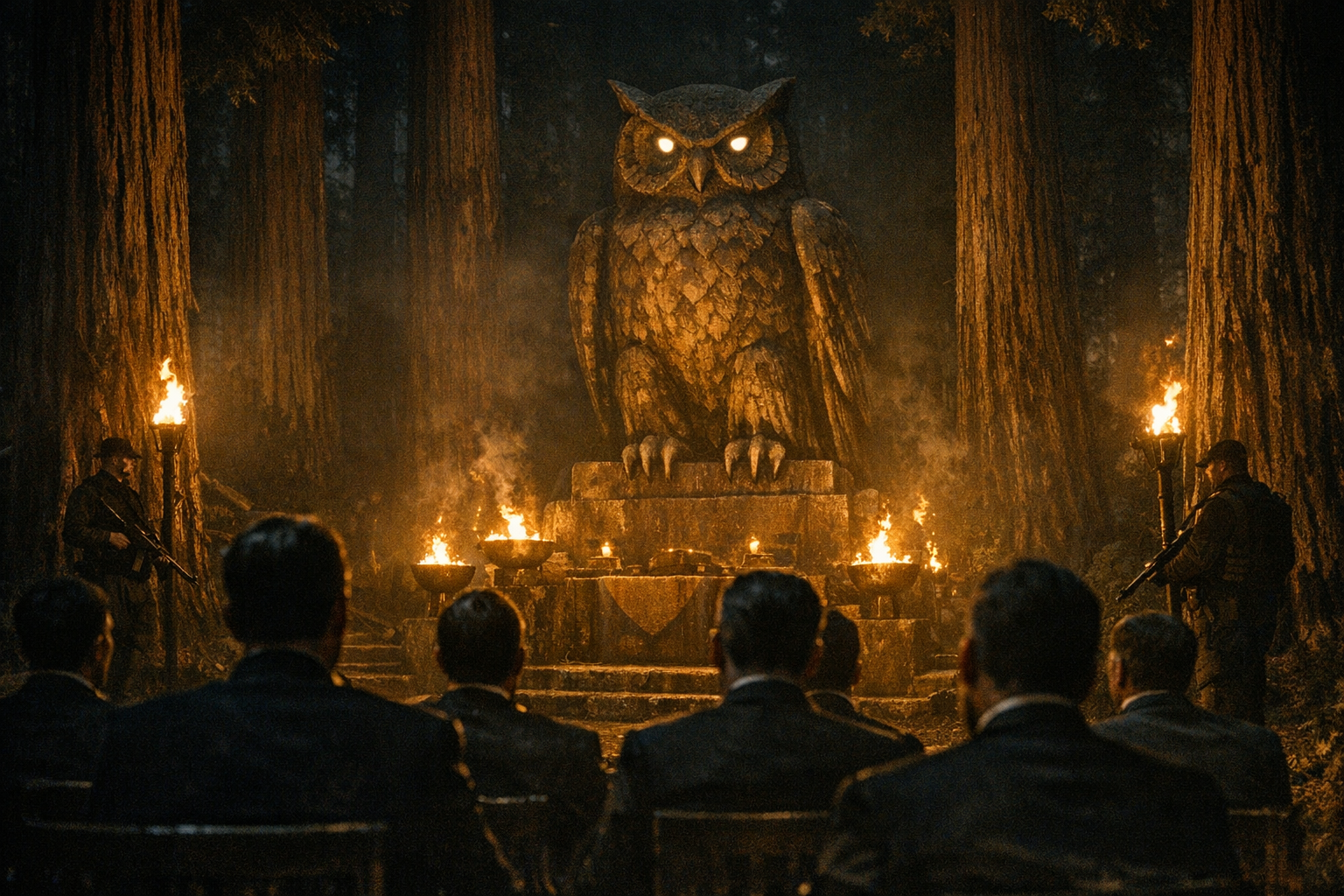
Every July, behind locked gates in a redwood forest most people will never enter, some of America’s richest and most connected men gather beside a giant stone owl while torchlight cuts through the dark. That image is the heart of the Bohemian Grove conspiracy: the idea that what happens at this hidden retreat is more than private networking, and that outsiders are seeing only the costume of something much deeper.
What Happened
Bohemian Grove is a private campground in Monte Rio, California, owned by the Bohemian Club. For more than a century, the club has hosted an annual summer encampment attended by business leaders, former presidents, military figures, lawyers, media executives, and other elite guests.
The gathering is real. The guest lists have included famous names. The strict privacy around the event is also real. Phones, cameras, and outsiders are not welcome, which has helped turn a secluded retreat into one of the most discussed secret-society stories in modern conspiracy culture.
The most famous image tied to the event is the Cremation of Care ceremony. In that ritual, robed members stage a theatrical performance in front of a large owl statue. To critics, it looks like occult symbolism wrapped in elite theater. To defenders, it is little more than an old-fashioned club tradition meant to mark the start of a private summer camp for powerful men.
The controversy grew louder after journalists and activists managed to capture footage from inside the grounds. Those clips did not prove criminal plotting, but they did confirm the atmosphere outsiders had long imagined: exclusivity, ritual, influence, and a level of privacy rarely available to ordinary people.
Why People Believe It
The theory survives because the setting practically writes the mystery for itself. A hidden redwood retreat. Presidents and CEOs away from public view. Symbolic rituals. A giant owl. The visual details feel less like a normal club and more like a scene from a thriller.
There is also the issue of access. When people with major political and financial influence gather in private, it is reasonable to ask what conversations are happening there. Even if no formal decisions are made at Bohemian Grove, informal relationships can shape future choices in government, media, and business.
That is where the Bohemian Grove conspiracy moves from curiosity to suspicion. Supporters of the theory argue that secrecy itself is the signal. If the event were harmless, they ask, why the closed gates, the security, and the strange ceremony?
Some versions go much further, claiming world events are planned there, that secret deals are made under the cover of ritual, or that the grove is tied to older occult traditions. Those claims are dramatic, and they spread easily online because the known details already feel unusual enough to make almost anything sound possible.
Claims vs Evidence
Claim: Bohemian Grove is a place where powerful men secretly coordinate world events. Evidence: Powerful people really do attend, and private discussions almost certainly happen. But there is no verified public evidence showing that official state policy or major global operations are secretly directed there as a formal function of the gathering.
Claim: The owl ritual proves occult or sinister activity. Evidence: The ritual exists and has been recorded. Its symbolism is real. But symbolism by itself is not proof of criminal behavior, supernatural belief, or hidden control networks.
Claim: Important political and business alliances are strengthened at the grove. Evidence: This is plausible. Exclusive social spaces often help influential people build trust and maintain networks. That does not automatically mean a conspiracy in the criminal sense, but it does support concerns about elite access and informal power.
Claim: The event is just harmless theater and relaxation. Evidence: That explanation fits part of the record, but it may also be too simple. When major public figures gather behind closed gates, even casual conversations can matter. The strongest factual position is that the retreat is real, secretive, influential as a social network, and still not proven to be the command center of a hidden world order.
For similar questions about hidden influence, see The New World Order and Shadow Governments. Those stories explore how fears about unseen power grow when institutions stop looking transparent.
Reality Check
The best evidence does not support the wildest versions of the story. There is no verified public record showing that Bohemian Grove members perform human sacrifice, run occult operations, or issue secret orders that directly control world events.
At the same time, dismissing every concern would be too easy. The real issue is not whether the ritual looks strange. It is whether extreme privacy allows elite people to build influence away from scrutiny. That concern is serious, even without turning the grove into a supernatural command center.
In other words, the strongest case is not that Bohemian Grove is fake, and not that every rumor is true. It is that a real private network of powerful men meets in a secretive setting that invites public distrust. The atmosphere creates conspiracy fuel, but the leap from secrecy to total hidden control still lacks hard proof.
Conclusion
Bohemian Grove sits in the uncomfortable space where conspiracy stories thrive best: a place where the facts are strange enough to be unsettling, but not strong enough to confirm the biggest claims. The retreat is real. The secrecy is real. The ritual is real. The hidden master plan remains unproven.
That is why the story still holds attention. It speaks to a deeper fear that power works differently behind closed doors than it does in public. Whether Bohemian Grove is a secret retreat, elite ritual, or overblown conspiracy depends on how much meaning you think secrecy itself should carry.
?If this story stuck with you, you might want to explore these next: