
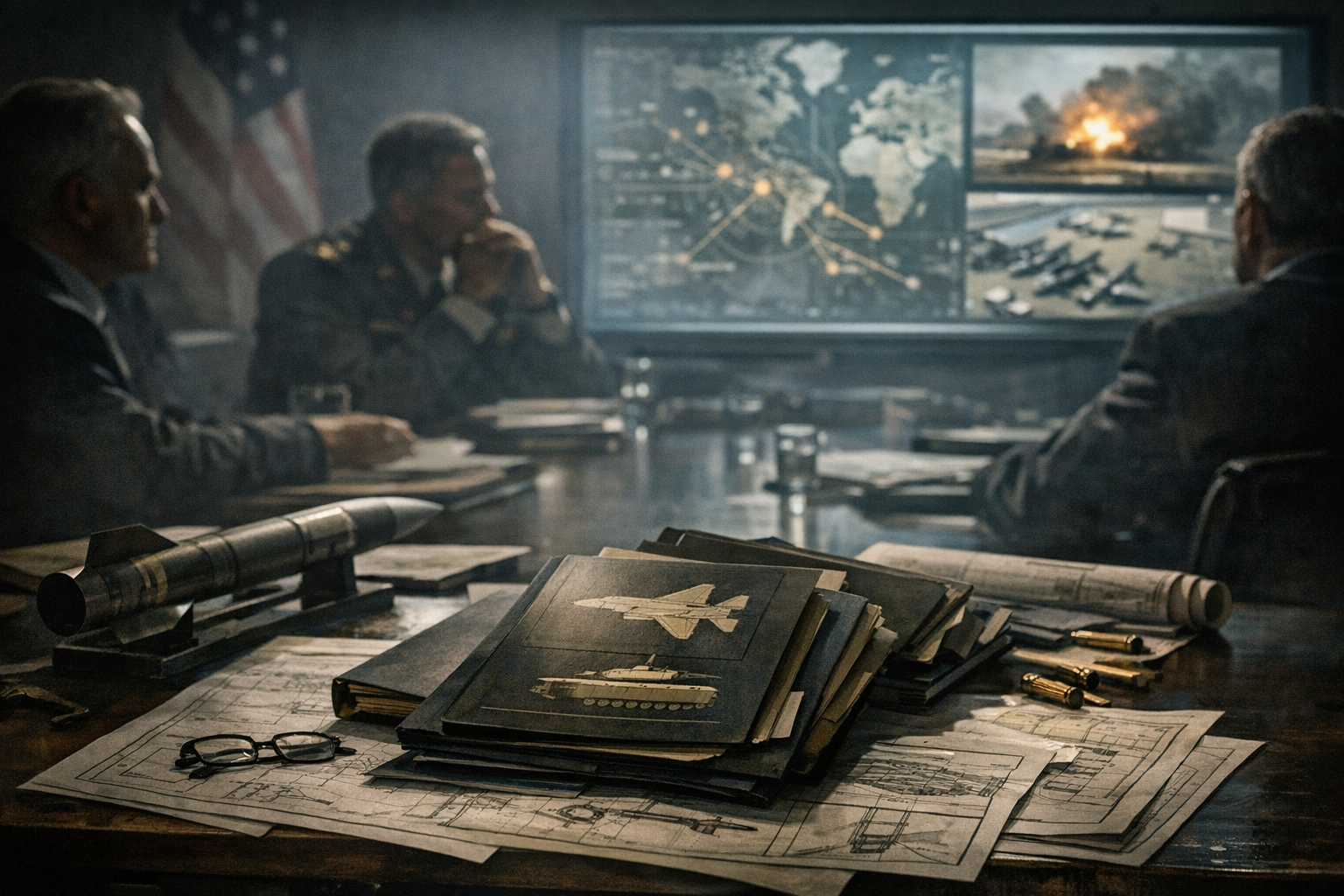
The warning came near the end, almost like a last look over the shoulder before the lights went out. In a cold television frame, President Dwight D. Eisenhower spoke about the military-industrial complex and hinted at a danger buried inside locked contracts, defense rooms, and permanent war planning. It sounded less like a policy speech and more like a door opening for one second before it slammed shut again.
What Happened
The phrase “military-industrial complex” entered American life in 1961, during Eisenhower’s farewell address. He had been a five-star general before he became president, so he was not speaking as an outsider. He was warning that the growing relationship between the armed forces, weapons companies, and political power could become too influential if the public stopped paying attention.
That warning mattered because the United States had changed after World War II. Before the war, the country did not keep a giant permanent defense system running at full speed all the time. After the war, and especially during the Cold War, it did. Massive budgets, long-term weapons programs, overseas bases, intelligence operations, and private contractors became a regular part of national life.
For many people, that shift raised an uneasy question: if war and military tension bring money, jobs, and power to major institutions, what happens when peace starts to threaten those benefits? That is the idea at the center of the conspiracy theory. The strongest version says endless war does not simply happen because of fear or bad policy. It says a powerful network benefits from conflict so consistently that war becomes part of the business model.
🔎 Related Investigation:
You can see why the idea sticks. Picture a defense plant in a small town. The gates open before sunrise. Workers stream in with coffee cups and lunch boxes. Inside, the products are not toys, shoes, or cars. They are missiles, aircraft systems, armor, surveillance tools, and software built for conflict. For the people inside, it is work. For the public outside, it can feel like war has an economic heartbeat.
The theory grew stronger over time because the United States kept fighting or preparing for conflict in one form or another. Korea, Vietnam, the arms race, Iraq, Afghanistan, and newer proxy struggles all fed the suspicion that war had become too permanent to be accidental. Add in lobbying, classified contracts, revolving-door careers, and campaign donations, and the idea starts to look less like pure fantasy and more like a system that deserves scrutiny.
That does not mean every claim is true. But it does explain why the military-industrial complex sits in a strange place. It is not a conspiracy born only on internet forums. It is partly rooted in a real presidential warning, real spending, and real institutional power.
This is also where the story overlaps with broader fears about hidden influence in government. Readers who have looked at hidden networks inside government power will recognize the same basic anxiety: decisions that look public on the surface may be pushed by forces the public rarely sees.
Why People Believe It
People believe this theory because it starts with something documented. Defense contractors do lobby. Politicians do receive money from industries tied to military spending. Retired generals and former officials do move into private-sector jobs. Congress does approve enormous defense budgets, often with support from both parties. None of that is speculative.
Another reason is that modern war often feels distant from ordinary democratic control. Big decisions are made through intelligence briefings, security language, closed hearings, and international strategy most people never see firsthand. When ordinary citizens cannot easily trace who influenced a decision, suspicion fills the gap.
History also helps the theory survive. The Iraq War is one of the biggest examples people point to. Critics argue that flawed claims about weapons of mass destruction, combined with the profits connected to military operations and rebuilding contracts, showed how fear, policy failure, and private incentives could overlap in dangerous ways. Even if someone does not believe war was fully “manufactured,” they may still believe powerful interests had every reason not to challenge it.
The theory also appeals because it offers a clean explanation for a messy world. Wars are chaotic, with many causes: ideology, nationalism, fear, resources, retaliation, and political mistakes. That complexity is hard to hold in your head. A hidden profit machine is simpler. It gives the public a villain, a motive, and a pattern.
There is another emotional layer too. Families send children to war. Taxpayers fund it. Veterans live with the consequences long after headlines fade. So when people see giant profits, rising stock prices, or expanding contractor influence during wartime, the moral shock is intense. It feels wrong in a way that is easy to turn into conspiracy.
That same concern appears in stories about media influence and public consent. The suspicion that powerful institutions can shape what people accept did not appear out of nowhere, which is part of why stories like Operation Mockingbird continue to draw attention.
Claims vs Evidence
Claim: Wars are routinely created or extended because defense companies and political insiders profit from them.
What supports it: There is clear evidence that war creates major financial opportunities for contractors. Companies compete for huge government contracts. Lobbying records show strong efforts to influence lawmakers. The revolving door between government, military leadership, think tanks, and private contractors is well documented. Some lawmakers also represent districts where defense jobs are economically important, which creates pressure to keep funding flowing.
What does not support the strongest version: There is no confirmed evidence of one all-controlling group secretly manufacturing every war from behind the curtain. Real wars usually come from a mix of intelligence failures, ideology, rival states, security fears, political calculation, and genuine geopolitical conflict. Profit can influence a system without proving total control over it.
Claim: Eisenhower was exposing a hidden machine that had already taken over American policy.
What supports it: Eisenhower clearly believed the danger was serious enough to name publicly. His warning was not vague. He described the risk of “unwarranted influence” from a powerful new alignment between military institutions and industry. That alone is extraordinary, especially because it came from someone with deep insider knowledge.
What limits the claim: His speech was a warning, not a confession. He did not say the system had fully captured the government. He said citizens and officials needed to guard against that possibility. In other words, the evidence supports concern, not proof of a total covert takeover.
Claim: Endless war proves the system is intentionally designed to keep conflict alive.
What supports it: The modern defense structure is built for continuity. Budgets roll forward. New threats replace old ones. Once a military program creates jobs, contracts, and strategic dependence, it becomes hard to shut down. Institutions often protect themselves, and that can produce momentum toward more spending and more intervention.
What weakens it: A system that is hard to stop is not the same as a secret cabal directing every event. Bureaucracy, political fear, public pressure after attacks, international rivalry, and policy failure can also produce long wars. Sometimes a machine keeps running because no one can slow it down, not because a mastermind designed every turn.
Reality Check
The most honest conclusion is that this theory is partly grounded in reality and partly inflated by simplification. The military-industrial complex is not imaginary. The relationship between defense spending, contractors, lobbying, and political power is real. The incentives inside that system are real too. If a company profits from conflict, that creates a structural problem even without a smoke-filled room conspiracy.
That is the heart of the issue. A democracy does not need one secret mastermind to drift toward harmful decisions. It only needs overlapping incentives, weak accountability, fear-driven politics, and an industry that benefits when threats grow. That kind of system can look conspiratorial from the outside because its results are so consistent.
At the same time, the strongest version of the theory goes too far. Not every war begins as a planned money scheme. Not every intervention is fake. Not every official or contractor is part of some unified hidden network. When people reduce every conflict to profit alone, they ignore the very real role of ideology, global rivalry, retaliation, and strategic miscalculation.
So where does that leave us? It leaves us with a partial, not a total answer. There is documented evidence that defense interests can shape policy, distort priorities, and make peace less attractive to powerful institutions. But there is not confirmed evidence that every war is secretly scripted by one invisible machine.
That distinction matters. If we call it all fantasy, we miss a real warning about money and power. If we call it all proven conspiracy, we stop thinking carefully. The more useful view is harder: there are genuine incentives inside the system that deserve public scrutiny, and those incentives can push a nation toward choices that look disturbingly close to what conspiracy theorists fear.
Conclusion
The reason this story refuses to die is simple. It began with a warning from a president who knew the system from the inside, and history kept giving people reasons to revisit it. Budgets expanded. wars dragged on. Contractors grew richer. Public trust got weaker.
That does not prove endless war is controlled by one hidden hand. But it does show why the theory feels more serious than many others. The best conclusion is that the military-industrial complex is not a fantasy villain and not an all-powerful puppet master. It is a real structure of influence that can reward conflict, resist accountability, and make bad decisions easier to repeat.
And maybe that is the most unsettling answer of all. Sometimes the scariest conspiracy is not a secret plan. It is an open system, visible in plain sight, that keeps moving because too many powerful people have learned how to live off its momentum.
🔎 If this story stayed with you, the author suggests these real cases next:
- Deep State Explained: Hidden Ruling Network or Just the Machinery of Government?
- Operation Mockingbird: Did the CIA Really Shape the News?
- Mass Surveillance State: How Much Does the Government Really See?
Explore more Political Conspiracies stories here: