
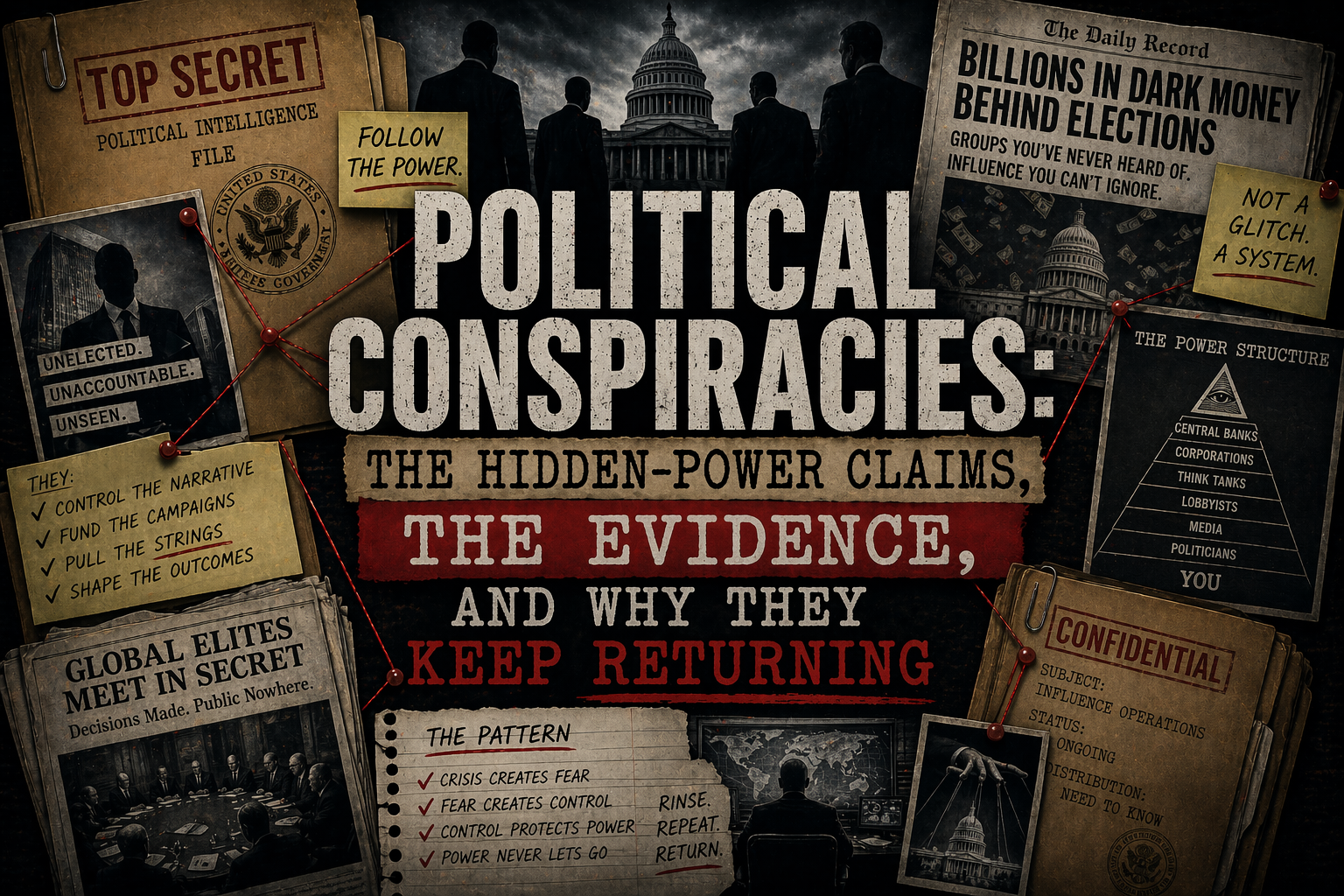
A sealed file, a redacted hearing, a surveillance leak, a whisper that elected leaders are only the visible layer of a much deeper machine-this is how political conspiracies pull people in. They rarely begin with pure fantasy. They begin where secrecy is real, trust is thin, and the public has just enough evidence to suspect more than it can cleanly prove.
This is why political conspiracies never behave like a single story. They are a gateway category. One reader arrives through election suspicion, another through covert intelligence history, another through media manipulation claims, and another through the fear that unelected systems outlast every administration. The details differ, but the pattern is familiar: something hidden is confirmed, public confidence drops, and a larger theory grows around the gap.
If this category works, it should do three things clearly. First, it should hook you with the real reason these claims survive: institutions sometimes do hide important things. Second, it should investigate how the strongest stories in this cluster connect. Third, it should give clarity by separating what is documented, what is plausible, and what becomes too large for the evidence to carry.
Setup: why this category keeps pulling readers back
Political conspiracy culture survives because politics already contains the ingredients that make suspicion feel reasonable. Governments classify records. Intelligence agencies operate behind closed doors. lobbying networks shape outcomes far from public view. Media narratives can narrow what people see. Security systems collect more information than most citizens ever fully understand. Once the public knows those things are real, it becomes much easier to believe there may be a deeper layer still hidden from view.
That is why the category is bigger than any one scandal. A single revelation rarely settles anything. It tends to widen the field. One confirmed surveillance program pushes readers toward bigger questions about control. One declassified covert operation makes later hidden-state claims feel less absurd. One misleading official timeline can make every future contradiction feel loaded with intent.
What people claim
The strongest claims in this category usually fall into a few connected lanes. Some readers are drawn to the hidden-bureaucracy argument in Deep State Explained, where the suspicion is that long-lived security and administrative systems shape policy no matter who wins office. Others move toward the more dramatic framing in Shadow Governments, where influence stops looking structural and starts looking like concealed coordination.
Another lane centers on information control. Operation Mockingbird keeps returning because it captures a fear that many people already carry: if narratives can be shaped, then public reality itself can be managed. From there, readers often connect media suspicion to broader elite-control stories, including older globalist frameworks like New World Order, where scattered institutions are interpreted as parts of one larger command structure.
Then there are the event-driven flashpoints. Election Fraud Theories concentrate distrust around legitimacy itself. False Flag Operations attach suspicion to crisis events and the fear of engineered pretexts. CIA Assassination Plots and Intelligence Agencies and Hidden Government Power pull readers toward the older question of how much covert action can shape the visible political world without the public ever seeing the full record.
Why it spread
These theories spread because they offer a cleaner story than ordinary political complexity. Bureaucracy is hard to follow. Institutional overlap is boring. Partial records are frustrating. A hidden-power framework turns all of that into a readable plot. Instead of disconnected failures, there is a system. Instead of contradiction, there is strategy. Instead of uncertainty, there is design.
But the category does not spread on psychology alone. It spreads because history keeps feeding it. Documented surveillance programs, propaganda efforts, covert planning, selective leaks, and elite influence networks all give the public genuine reasons to distrust easy official reassurance. The crucial point is that real secrecy does not prove every larger claim. It creates the opening in which larger claims can thrive.
The internet widened that opening. A declassified file, a clipped video, a leaked email, a congressional hearing, a half-correct thread, and a fabricated rumor now travel together. Readers often encounter the whole pile at once. That makes it much harder to separate confirmed record from narrative escalation, and much easier to feel that everything belongs to one hidden architecture.
What the evidence shows
The evidence across this category supports something serious but narrower than the grandest theories claim. It supports the idea that political systems contain real opacity, real incentives to conceal, and real institutions that can shape public life beyond what voters directly see. That is not fantasy. Surveillance history, covert action history, influence campaigns, and classified decision-making all belong to the documented record.
What the evidence usually does not support is the jump from hidden systems to a total hidden command. A durable bureaucracy is not the same thing as an all-powerful cabal. Narrative influence is not the same thing as absolute media control. Elite coordination around shared interests is not the same thing as a single master plan directing every crisis. This distinction is the most important one in the entire category, because the smaller claim is often strong enough to make the larger claim feel emotionally true even when it is not fully evidenced.
That is also why this category is best read as a network instead of a verdict. Start with the structural stories like Deep State, Mass Surveillance State, and Military-Industrial Complex. Then move to case studies involving media, intelligence, elections, and covert action. Read them side by side and the pattern becomes clearer: secrecy and power regularly create suspicion, but suspicion becomes conspiracy when it starts treating every gap as proof of one unified hidden ruler.
Where confusion came from
Most confusion here comes from stacking different kinds of truth into one pile. A real covert program sits next to a speculative thread. A genuine archival record sits next to a sweeping interpretation. A public lie told during one crisis is used to validate a much bigger theory about every other crisis. After enough stacking, readers stop asking which parts are documented and start asking how far the system really goes.
That confusion is reinforced by tone. Online political conspiracy content often presents uncertainty as confidence. It smooths over distinctions between influence, manipulation, secrecy, bureaucracy, corruption, and total control. But those are not interchangeable ideas. When they get blurred together, category pages become vague and overloaded. When they are separated, readers can actually see why the strongest stories remain compelling without pretending they all prove the same thing.
Reality Check
The reality check is not that political conspiracies are nonsense. It is that they become most persuasive where the public has been given real reasons to doubt-but not enough evidence to safely conclude everything. That middle ground is where this category lives. It is why these stories never fully die, and why they deserve investigation rather than reflexive dismissal.
The clearest reading is this: political conspiracy theories keep returning because genuine secrecy, institutional self-protection, and partial disclosure repeatedly teach the public that visible politics is not the whole picture. At the same time, the evidence rarely supports the idea that every scandal, election dispute, war narrative, leak, and media cycle belongs to one invisible hand. The category is strongest when it shows both truths at once.
So if you are using this page as a way in, follow the chain with that standard in mind. Start with the documented structures of distrust. Move outward to the louder claims only after the evidence is clear. That is how you keep the hook, keep the investigation, and still end with clarity.
If this story made you think, here are more conspiracy investigations worth exploring next:
- Deep State Explained: Hidden Ruling Network or Just the Machinery of Government?
- Mass Surveillance State: How Much Does the Government Really See?
- Election Fraud Theories: What the Claims Said vs What the Evidence Actually Showed
Explore more in this category:
Political Conspiracies