
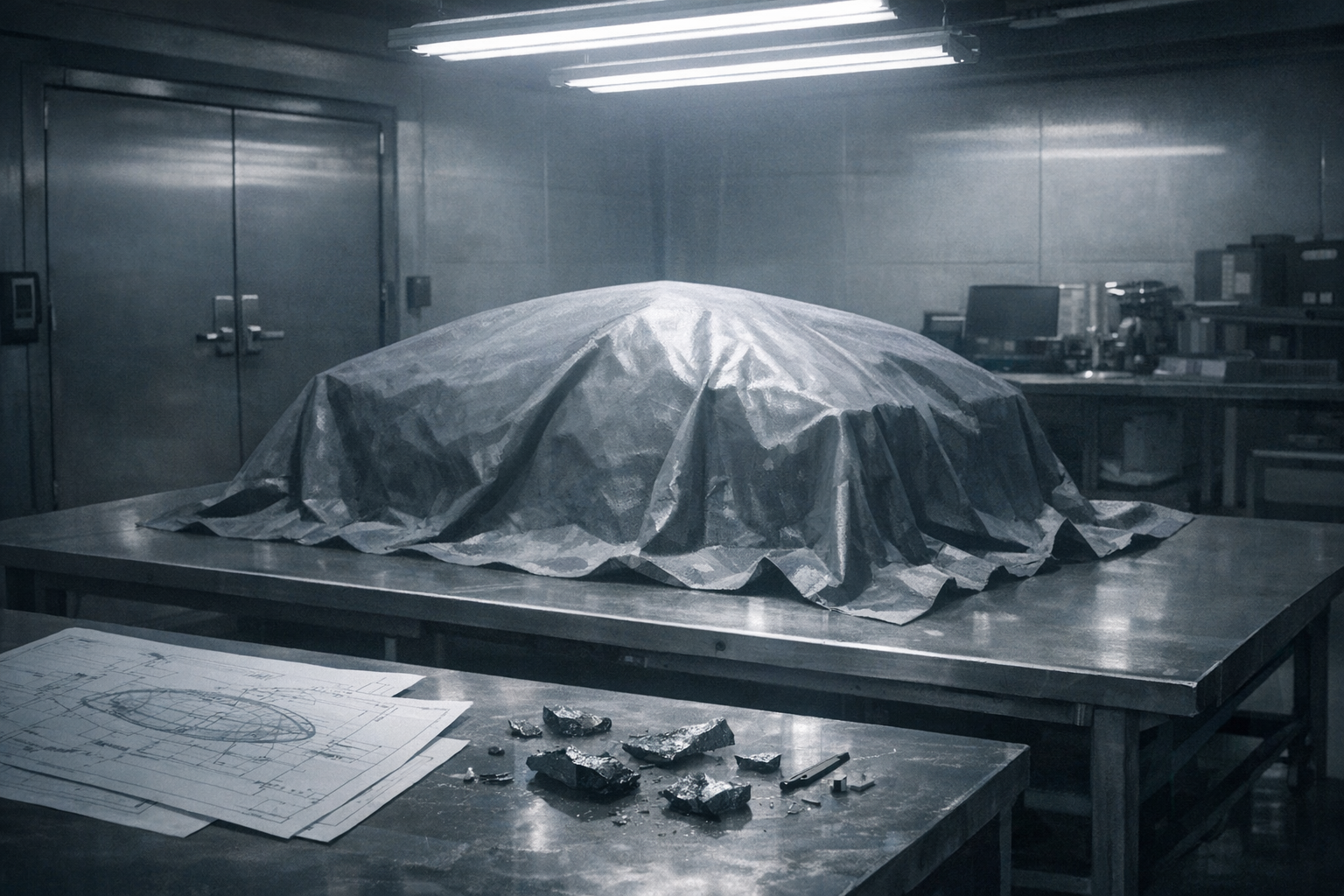
Behind badge-locked doors and windowless labs, the rumor has always felt more dangerous than the crash itself. The real forbidden idea is not that something strange may have been recovered, but that alien reverse engineering may have quietly turned that recovery into knowledge, far from public view. If that were true, the biggest secret would not be a wreck in the desert. It would be a breakthrough nobody was supposed to see.
What Happened
The theory of alien technology reverse engineering sits one step beyond the usual UFO debate. It asks people to imagine that governments or defense contractors did not just recover unusual material, but studied it in secret and tried to make it work. In this version of the story, the mystery is not only what fell from the sky. It is what happened after the doors closed.
The modern version of the claim pulls from several older threads. Roswell gave the public the image of a hidden recovery. Area 51 gave that image a physical home in the popular imagination. Later, classified aerospace programs and official language about unidentified aerial phenomena helped the theory grow. Each piece added one more layer to the same question: if something nonhuman was ever collected, would anyone admit it before trying to learn from it first?
There is also a very human scene buried inside the theory. Picture a young engineer entering a secure building before sunrise, surrendering a phone at the desk, and being led past a steel door into a room where an object sits under harsh white lights. Maybe it is only a strange alloy fragment. Maybe it does nothing at all. But the possibility that it might matter is enough to make the story feel real.
Over time, the claim expanded. Some versions say recovered materials showed impossible weight, unusual layered structures, or properties beyond known manufacturing. Other versions go much further and claim full craft, propulsion systems, or energy devices were hidden inside private contractor programs. Supporters often tie the theory to defense secrecy for the same reason readers keep returning to Government UFO Programs: real classified work exists, so a more dramatic hidden project does not feel impossible to imagine.
The strongest recent fuel has come from whistleblower-style testimony. Public figures, former officials, and people linked to military or intelligence circles have claimed that retrieval and analysis programs exist or once existed. These statements rarely arrive with a machine on a table or a technical paper proving what was found. Instead, they keep the theory alive by suggesting that somewhere behind layers of compartmentalization, a conversion effort is still under way.
Why People Believe It
People believe this theory because it feels like the next logical step. If recovered objects are the first secret, reverse engineering is the second. A hidden craft with no follow-up raises one kind of mystery. A hidden craft that may have changed technology raises a much bigger one. It turns a distant UFO story into a story about human power, secrecy, and advantage.
The theory also borrows credibility from the real world of military contracting. Most people already accept that advanced aircraft, surveillance tools, and weapons systems can be developed in classified environments for years before the public hears about them. Once that idea is in place, believers only need to extend it one more step and ask whether classified programs ever studied something far outside known engineering.
Another reason the story lasts is that fragments sound more believable than complete miracles. Believers do not always claim a perfect flying saucer was rebuilt and flown. Often they focus on scraps, metamaterials, layered alloys, or rumors of propulsion research that never reached public demonstration. As with Roswell UFO Crash, the surviving power of the story comes from the gap between what people suspect and what they can prove.
There is also the emotional pull of stolen history. If nonhuman technology were recovered and studied behind closed doors, believers feel the public would be the last to know about the most important discovery in human history. That sense of exclusion gives the theory its edge. It does not just promise a secret. It promises a secret unfairly kept from everyone else.
Claims vs Evidence
The claims usually fall into three levels. The first says unusual materials were recovered from crashes or incidents and quietly transferred to government or contractor labs. The second says scientists tried to understand these materials and identify how they were made, what they could do, or whether they came from a nonhuman source. The third, strongest claim says actual breakthroughs followed, including advances in propulsion, sensors, energy systems, or materials science.
The evidence is far less solid than the theory sounds. Most support comes from testimony, secondhand reporting, rumor chains, and interpretation of secrecy itself. Some officials and former insiders have spoken publicly about crash-retrieval or analysis claims, but public documentation that proves nonhuman origin or successful reverse engineering has not appeared in a way independent researchers can verify. Extraordinary technical claims need more than suggestive stories.
Believers sometimes point to unusual material reports as if they close the case. But “unusual” is not the same as “nonhuman.” Advanced alloys, layered composites, and odd manufacturing features can be misdescribed, misunderstood, or removed from context. Even if a fragment were genuinely hard to explain, that still would not prove a working alien machine stood behind it.
There is another gap here that often gets overlooked. Recovering an object and reverse engineering it are completely different problems. Engineers can take apart a phone today and still fail to reproduce every material, software layer, and fabrication step that made it possible. Now imagine applying that challenge to a hypothetical technology built by a nonhuman intelligence. The leap from possession to understanding would be enormous.
Claims of secret breakthroughs run into the same problem. If reverse engineering succeeded, where is the unmistakable result? Some theorists answer that the proof is scattered across stealth aircraft, microelectronics, fiber optics, or energy research. But these fields have documented human development paths, known inventors, and long public histories. Secrecy can hide projects. It does not automatically erase the visible chain of technological progress.
Reality Check
The reality check is not that the theory is impossible. It is that each step requires stronger proof than believers usually provide. Real governments keep real secrets. Real military programs use compartmentalization. Real contractors handle sensitive research. None of that is in doubt. The question is whether those facts justify the much bigger conclusion that nonhuman technology was recovered and translated into useful human systems. Right now, the public evidence does not get us there.
The most important weakness is the distance between testimony and demonstration. A whistleblower can raise a serious question. A classified rumor can justify further reporting. But neither one is the same as a verified sample, a reproducible test, or a clear technical record. In science and engineering, the more extraordinary the claim, the more heavily it depends on direct, independent confirmation. On that standard, alien reverse engineering remains unproven.
There is also a storytelling trap built into the theory. Every absence becomes part of the explanation. No public proof? That means the program is secure. No breakthrough revealed? That means the material is too advanced. Conflicting witness accounts? That means compartmentalization is working. A theory can survive a long time when every missing piece is used as evidence of deeper secrecy.
The simpler explanation is usually the stronger one. Governments may have investigated unusual reports, collected debris from misunderstood incidents, and hidden ordinary national-security work behind extraordinary rumors. People may have encountered real secrecy and filled the blank space with the most dramatic answer available. That does not make every witness dishonest. It means sincere testimony can coexist with weak evidence.
The most grounded conclusion is that secret analysis of anomalous reports or materials is plausible in principle, but public proof of successful reverse engineering of nonhuman technology is still missing. The theory survives because it sits exactly where conspiracy stories are hardest to kill: between a little real secrecy and a much larger imagined result.
Conclusion
Alien technology reverse engineering remains one of the most seductive UFO-era claims because it promises more than contact. It promises access. Not just a sighting in the sky, but a hidden workshop where human beings may have stared at something beyond their own science and tried to make it theirs.
That is why the story keeps pulling people back. It blends forbidden access, black-budget secrecy, technical mystery, and the fear that history’s biggest discovery could be sitting inside a contractor vault while the public argues online about lights in the distance. It feels cinematic because it attaches the unknown to a room, a lab, and a machine.
But when the claims are separated from the evidence, the case remains far weaker than the myth. There are stories, hints, and enough secrecy to keep curiosity alive. There is not yet public proof that governments or contractors quietly learned to use nonhuman technology. For now, the fragments are intriguing. The breakthrough remains a story.
🔎 If this story stayed with you, the author suggests these real cases next:
- Roswell UFO Crash: What the Original Witnesses Claimed and What the Records Actually Show
- Government UFO Programs: From Project Blue Book to AATIP to AARO
- Alien Disclosure Timeline: Are We Seeing Revelation or Repackaged Secrecy?
Explore more Alien & UFO Theories stories here: