
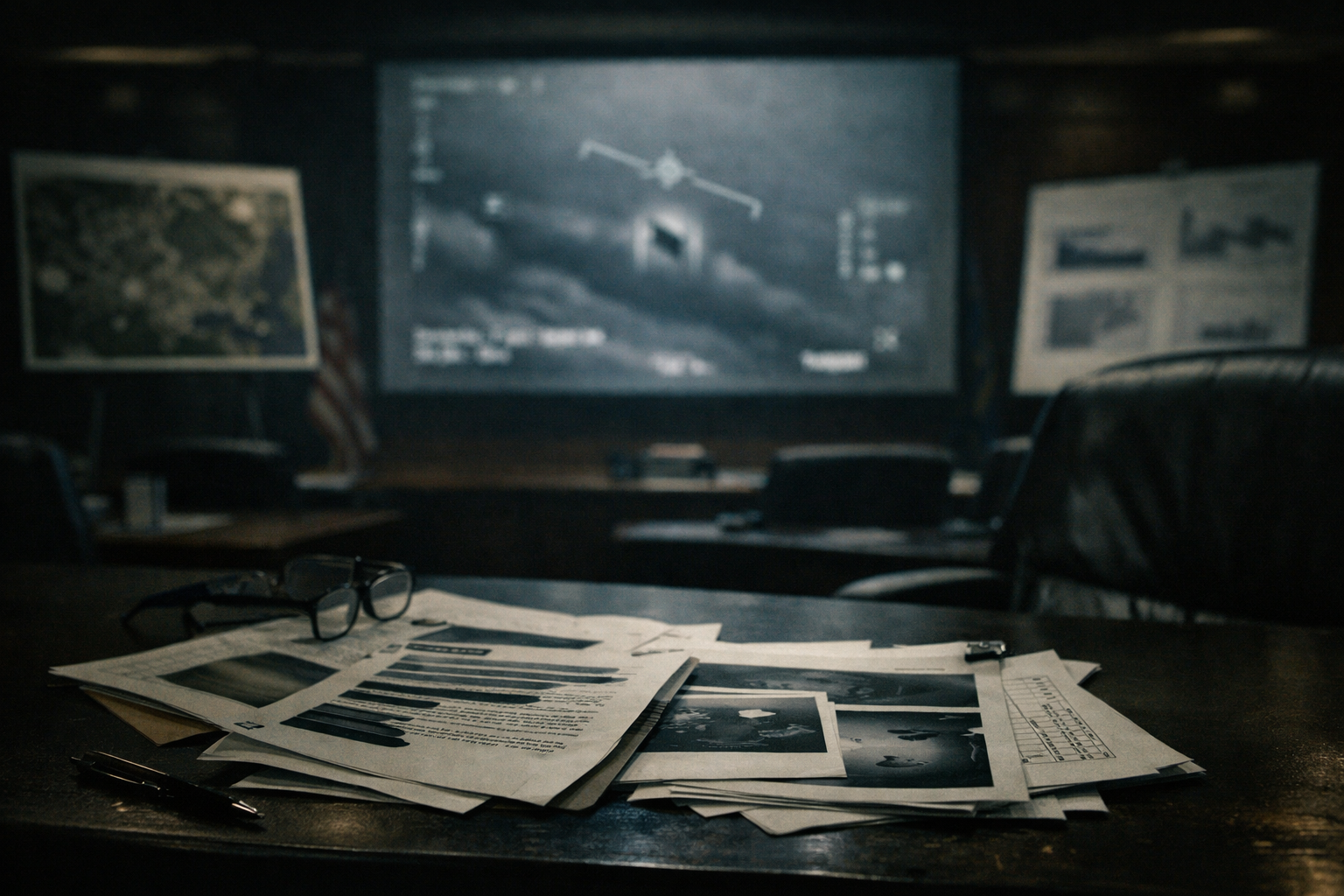
The file was supposed to calm the room, not thicken it. Instead, when officials released the government’s review, readers were left staring at the same uneasy gap between what had been ruled out and what still felt hidden.
The AARO UAP report is the Pentagon office’s attempt to explain what the government reviewed about unidentified anomalous phenomena, including old rumors about secret crash-retrieval programs and nonhuman technology. Supporters of UFO disclosure say it was a key official test of the biggest claims. The likely reality is narrower: the report rejected major allegations it said were unsupported, but it did not erase public suspicion or fully settle every unresolved case.
What Happened
The modern UFO debate changed when the U.S. government stopped treating every strange sighting like a joke. Military videos were authenticated. Congress held hearings. Whistleblowers made claims about hidden programs. Then the All-domain Anomaly Resolution Office, or AARO, was pushed to do something more difficult than collecting reports. It had to review the record itself.
That is what makes this story different from another witness account. The angle here is the official review. The question is not simply whether UFO believers were convinced. The question is what the government’s own review said it examined, what it dismissed, and what it still could not turn into a clean ending.
AARO’s historical review was presented as a look across decades of government involvement with UAP-related claims. In simple terms, it was supposed to ask whether there was evidence for long-running secret programs involving recovered alien craft, reverse engineering, or hidden knowledge kept outside normal oversight. That mattered because those exact ideas had become central to the modern disclosure wave, especially after stories covered in David Grusch UFO Claims and the broader debate around UFO Disclosure: Hearings, Whistleblowers, and the Proof Gap.
On paper, the report sounded blunt. AARO said it found no verified evidence that the U.S. government had secretly possessed extraterrestrial craft or reverse-engineered nonhuman technology. That was the headline many readers saw. For skeptics, it looked like a long-awaited official reality check. For believers, it looked more like a review that had spoken clearly without proving it had looked everywhere that mattered.
That tension is why the report became so important so quickly. It was not just another statement from a spokesperson. It was the government stepping into the center of the modern argument and saying, in effect, we checked and did not confirm the biggest story.
Why People Believe It
To understand why people were never going to read the AARO report as a simple final answer, you have to picture the atmosphere it entered. Imagine someone who had spent the last few years watching hearing clips late at night, seeing former officials speak in careful language, hearing talk of crash retrievals, and noticing that the government kept returning to the subject. By the time the report arrived, trust was already thin and suspense was already built in.
That matters because belief in this subject does not come from one memo alone. It grows out of a pattern. The public has seen real secrecy around military programs before. The public has watched official language shift from ridicule to caution. The public also knows that a closed review can say “we found nothing” without giving outsiders enough access to test every step.
There is also a deeper psychological reason. A named office, a formal review, and a government seal do not only create trust. Sometimes they create suspicion. If an agency speaks too firmly on a subject people already think is buried behind classification, the firmness itself can sound like part of the wall. That is why some readers came away saying the report debunked the claims, while others came away saying it only showed how tightly controlled the conversation still was.
The site’s earlier piece on Government UFO Programs helps explain that loop. The core suspicion is not just “there are strange objects.” It is “if these programs keep existing under new names, how can the public be sure any one office really saw the full picture?” Once that doubt exists, every official review is judged against more than its words. It is judged against decades of distrust.
Claims vs Evidence
The strongest claim around the AARO review is straightforward: if the office checked the historical record and found no proof of secret nonhuman technology programs, then the biggest modern UFO allegations have been decisively undercut. That is a fair point, up to a point. An official review matters. It is evidence that at least part of the government examined these stories and did not validate them.
But evidence has layers, and this is where the public often rushes. AARO’s conclusion is not the same thing as proving every case is explained. It is also not the same thing as proving every witness was dishonest. What the report mainly addressed was the larger architecture of the claim: hidden legacy programs, recovered craft, and institutional concealment. Saying those allegations were not verified is significant. It is just narrower than saying the mystery is solved.
There is a second claim from critics of the report: that AARO rejected major allegations without satisfying outsiders that it had full access to every compartment, witness, or document believers think exists. That criticism also deserves to be stated clearly. If a review cannot show the public its whole path through classified terrain, skeptics of the review will naturally say the real evidence still sits elsewhere.
Still, that criticism has limits too. Suggesting hidden evidence might exist is not the same as producing it. This is the same proof problem that runs through UFO Crash Retrieval Claims. A public story can be dramatic, credible-sounding, and even partly connected to real secrecy without crossing the line into confirmed fact.
A misunderstood detail in this debate is the difference between “AARO found no proof” and “AARO explained everything.” Those are not the same sentence. The report pushed back on extraordinary hidden-program claims. It did not transform every UAP report into a solved weather balloon, drone, or sensor glitch. Some incidents remain unresolved for ordinary reasons: missing data, incomplete records, or conflicting observations. Unresolved does not automatically mean extraterrestrial. But it also does not read like total closure, and that is exactly why the argument survives.
Reality Check
The grounded reading of the AARO report sits in the middle, which is where these stories usually become most uncomfortable. The report does matter because it is an official review, not just a rumor. It tells us that a government office publicly rejected the most explosive version of the modern UFO story after reviewing records and claims available to it. That alone is more substantial than endless internet recycling.
At the same time, the report does not magically remove the conditions that created public distrust in the first place. Classification still exists. Access is still uneven. The public still sees cases where the government admits something unusual happened without offering a satisfying final explanation. That unresolved atmosphere is one reason posts like Pentagon UFO Videos: What the Navy Footage Confirmed – and What It Didn’t and Alien Disclosure Timeline: Are We Seeing Revelation or Repackaged Secrecy? continue to attract readers. They show how official acknowledgment can reduce ridicule without creating certainty.
So what should a careful reader actually take away? First, there is still no confirmed public evidence that AARO uncovered a hidden extraterrestrial recovery program. Second, there is also no good reason to treat every unresolved case as if the report quietly solved it. The report narrows the field. It does not close the mystery.
That may sound unsatisfying, but it is the most honest answer. If you came looking for a dramatic reveal, the report does not deliver one. If you came looking for a clean debunking that ends the whole disclosure era, it does not fully deliver that either. What it really does is reset the burden of proof. After AARO, people making the biggest claims need more than implication, more than atmosphere, and more than the idea that secrecy itself is evidence.
Conclusion
The AARO report was supposed to be an official map through one of the loudest arguments in modern conspiracy culture. In some ways, it succeeded. It clearly stated that the government review did not verify hidden crash-retrieval or reverse-engineering programs. That is not a small point.
But the report also showed why this subject keeps rebuilding itself. Official reviews can reject claims, yet still leave enough unknowns, enough limited access, and enough older distrust for the public to feel the center of the story remains just out of sight. In other words, AARO answered part of the question while leaving the biggest emotional engine of the debate intact.
That is why the fairest conclusion is also the least dramatic one. The report did not confirm the grand UFO disclosure narrative. It also did not create the kind of airtight closure that makes everyone walk away. It gave the public a firmer official line, but not the final silence that true certainty usually brings.
🔎 If this story stayed with you, the author suggests these real cases next:
- UFO Disclosure: Hearings, Whistleblowers, and the Proof Gap
- David Grusch UFO Claims: What Was Alleged, What Was Verified?
- Government UFO Programs: Why the Files Never Really Closed
Explore more Alien & UFO Theories stories here: