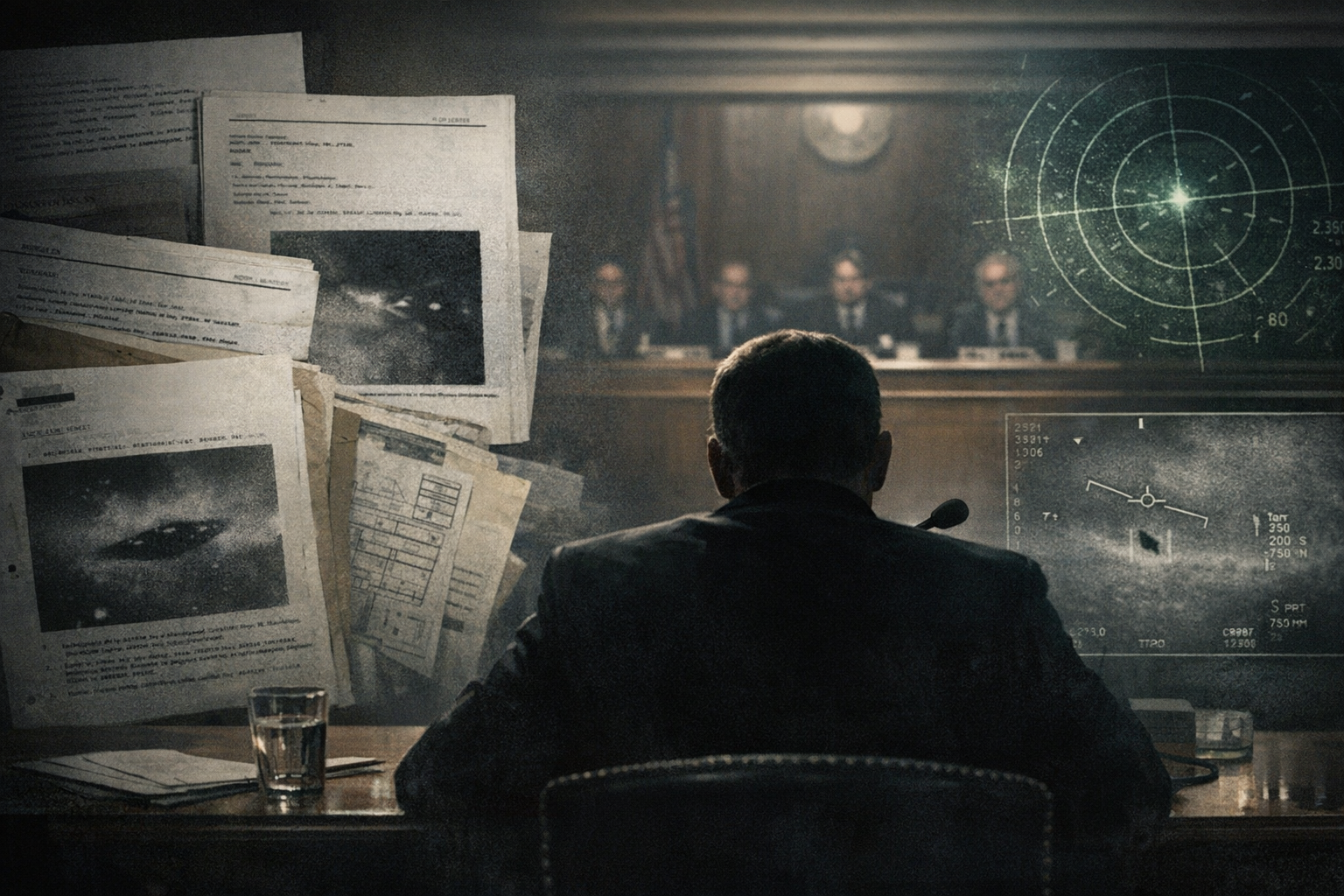
The door opens, the microphones switch on, and the room suddenly treats UFOs like government business instead of late-night folklore. Witnesses speak carefully, lawmakers ask about classified programs, and every answer seems to point toward a deeper file cabinet the public is not allowed to open. That is the strange power of modern UFO disclosure: it feels official, but it still stops just short of proof.
UFO disclosure is the public push to find out what governments, defense agencies, contractors, and oversight bodies know about unexplained aerial phenomena. People claim the hearings, whistleblower complaints, leaked documents, and military videos point to hidden programs, recovered craft, or even nonhuman intelligence. The reality is more careful: official interest is real, secrecy is real, and some cases remain unresolved, but the public proof for the biggest claims still has not been released.
What Happened
For decades, UFO disclosure moved in waves. There were famous sightings, government projects, witness stories, and declassified files, but most of it lived on the edge of public trust. That changed when military footage, congressional hearings, and official UAP reviews made the subject feel less like a fringe argument and more like an oversight problem.
The modern disclosure era is not one single revelation. It is a chain of events: pilots reported strange objects, videos were confirmed as real military footage, Congress held hearings, whistleblowers made claims about hidden programs, and agencies released reports that admitted some cases could not be easily identified. None of that proves aliens. But it does prove that the government has treated some UFO reports as serious enough to investigate.
Short timeline:
- Military videos become public: Footage linked to Navy encounters gives the subject a new kind of legitimacy.
- Official reviews begin: Pentagon-linked efforts and later reporting structures try to sort sightings, sensor data, and safety concerns.
- Congress gets involved: Public hearings ask what agencies know and whether information has been hidden from lawmakers.
- Whistleblowers step forward: Former officials and insiders make claims about retrieval programs, retaliation fears, and classified evidence.
- Legislation follows: Disclosure proposals and whistleblower channels try to force a cleaner process for reporting and review.
That is why the topic now works best as a hub, not a single case. The AARO UAP Report raises one set of questions about official review. UAP Hearing 2026 Claims raises another about public testimony and political pressure. The broader disclosure story connects those pieces without pretending they all prove the same thing.
Why People Believe It
People believe the disclosure story because it contains pieces that are hard to dismiss. The government has acknowledged UAP reporting. Military witnesses have described encounters. Some videos and documents are real. Lawmakers have taken the subject seriously enough to hold hearings and push for records. For readers used to decades of ridicule, that shift feels huge.
There is also a deep trust problem. When officials say, “We looked into it, but the evidence is classified,” the public hears a familiar pattern: important information exists, but ordinary people cannot see it. That gap gives conspiracy claims room to grow. It does not mean every claim is true, but it explains why vague answers can feel like confirmation.
Whistleblower claims add emotional force because they sound like a map to hidden rooms. David Grusch UFO Claims became a major example of this dynamic: specific allegations, serious settings, and intense public interest, but limited public evidence that ordinary readers could independently verify. That combination is exactly why disclosure feels both compelling and unfinished.
The same pattern appears with whistleblower protection debates. UAP whistleblower laws suggest that insiders may need formal channels to report sensitive claims. Supporters see that as a sign the system knows more than it says. Skeptics see it as a way to manage reports responsibly without treating every allegation as confirmed fact.
Claims vs Evidence
Claim: The government has already confirmed alien craft are real.
Evidence: No public U.S. government release has confirmed that. Officials have confirmed that some sightings are unidentified, that military personnel reported them, and that some material remains classified or unresolved. “Unidentified” means not explained from available data. It does not automatically mean extraterrestrial.
Claim: Hearings prove a massive cover-up is cracking open.
Evidence: Hearings prove political attention, not final proof. They can expose inconsistencies, pressure agencies, and create records. But a hearing is still built on testimony, documents, and what witnesses are allowed to say. The Schumer UAP Disclosure Act shows how lawmakers have tried to push disclosure mechanisms, but proposed disclosure law is not the same as proof of every hidden-program claim.
Claim: Whistleblowers must have the evidence, or they would not risk speaking.
Evidence: Whistleblowers can be important, and retaliation concerns should be taken seriously. But public readers still need checkable evidence. The key question in UFO whistleblower evidence is not whether a person sounds credible. It is whether the claim comes with documents, materials, chain of custody, sensor records, or testimony that can be tested outside the classified system.
Claim: Leaked files and document dumps prove officials hid the truth.
Evidence: Some documents show real interest, confusion, secrecy, or investigation. They rarely prove the most dramatic conclusion by themselves. UFO leaks and document dumps can be valuable, but a memo saying something was investigated is not the same as proof of what the object was.
Claim: Military videos show technology beyond human capability.
Evidence: Videos matter because they are tied to real systems and trained personnel. But video is still limited by angle, range, sensor behavior, compression, and missing context. That is why Navy UFO videos remain powerful but incomplete evidence. They changed the tone of the debate, yet they do not close the proof gap on their own.
Reality Check
The strongest version of the UFO disclosure argument is not “aliens are confirmed.” It is this: governments have collected reports they cannot always explain, some systems have operated with too little transparency, and public oversight often lags behind classified programs. That is a real civic issue even if every strange object eventually turns out to have a human, sensor, or natural explanation.
The weakest version of the argument tries to combine every hearing, whistleblower, video, rumor, and leaked document into one single conclusion. That is where the evidence gets stretched. A pilot report is not the same as a recovered craft. A classified program is not automatically an alien program. A lawmaker asking a hard question is not proof that the answer is extraterrestrial.
This is the proof gap. Disclosure has produced official attention, better reporting channels, public hearings, and more serious language. It has not produced open, independently testable evidence for the biggest claims: intact nonhuman craft, biological remains, or a verified program that can be examined outside classification. Until that happens, the subject remains serious but unresolved.
That does not make the whole topic fake. It makes the evidence uneven. Some claims deserve investigation. Some deserve skepticism. Some may be distorted by secrecy, memory, institutional limits, or media hype. The most honest approach is to separate what is confirmed from what is alleged, then keep asking for evidence that can survive outside a classified briefing.
Conclusion
UFO disclosure is no longer just a question of whether people saw strange lights in the sky. It is now about hearings, documents, whistleblower channels, military footage, official reviews, and public trust. That makes the topic more serious than old UFO folklore, but not as settled as believers often want it to be.
The reality is balanced but frustrating. The government has admitted enough to keep the mystery alive. Whistleblowers and lawmakers have raised enough questions to justify continued scrutiny. But the public still has not received the kind of evidence that would turn the largest claims from allegations into established fact.
That is why the UFO disclosure story keeps returning to the same place: not a closed case, not a confirmed alien revelation, but a growing record of official attention with a missing final piece. Until that piece is public, the proof gap remains the center of the story.
🔎 If this story stayed with you, the author suggests these real cases next:
- AARO UAP Report: Clear Answers or a Review That Left the Biggest Claims Open?
- UAP Hearing 2026 Claims: New Disclosure or the Same Proof Gap Again?
- UFO Whistleblower Evidence: What Would Real Proof Actually Have to Look Like?
Explore more Alien & UFO Theories stories here: