
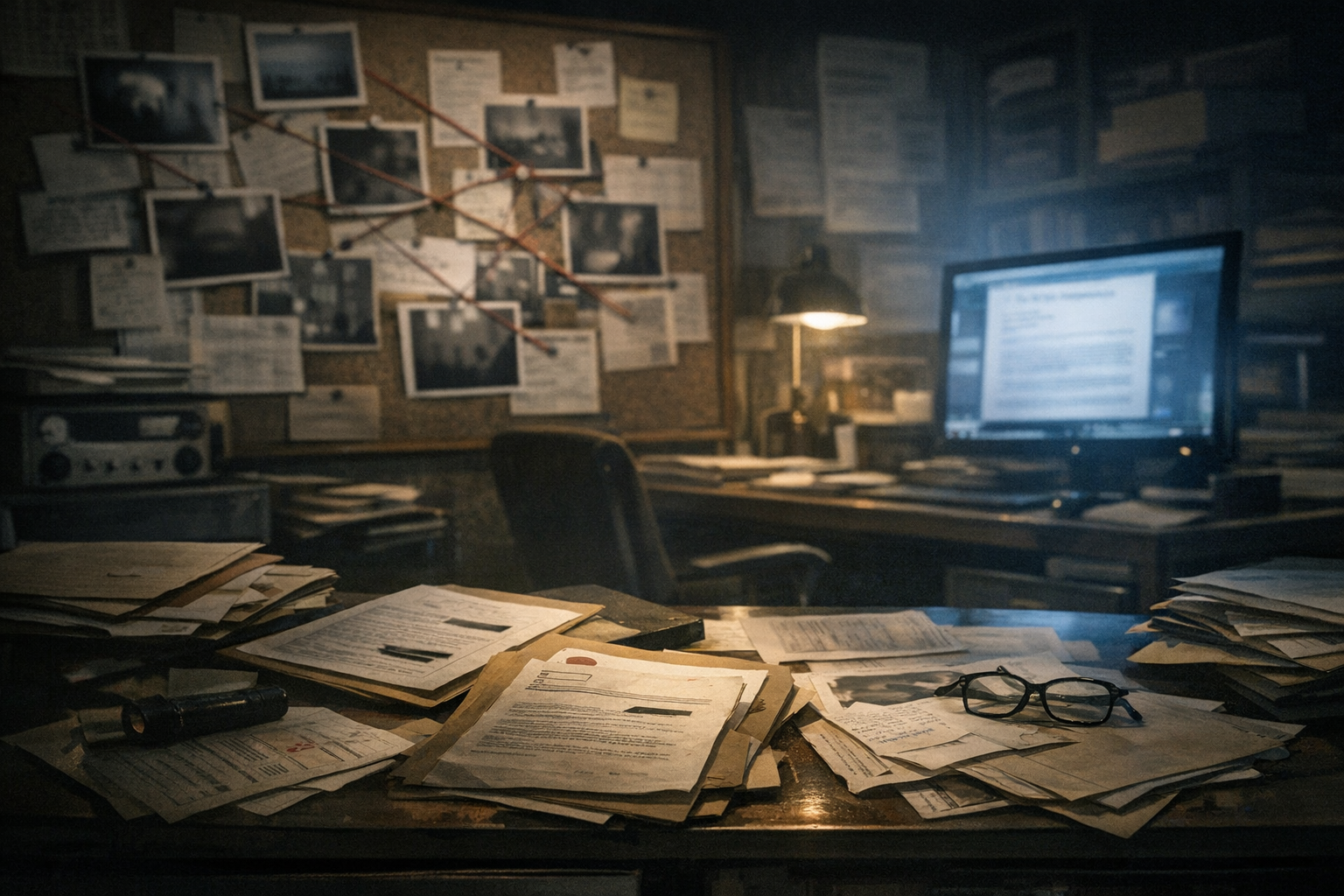
The file that changes everything never seems to arrive clean. It shows up half-scanned, passed through private circles, wrapped in whispers about insiders, cover stories, and one simple warning: some of what you are about to read may be false on purpose. That is where the UFO disinformation theory begins — not with a spaceship, but with the fear that the trail itself has been tampered with.
UFO disinformation theory is the idea that false or distorted stories are deliberately mixed into real UFO secrecy so the public can never sort signal from noise. Supporters claim agencies, contractors, or insiders seed bad leads to hide the truth about advanced craft or hidden programs. The more likely reality is narrower: governments do keep secrets, rumors do spread inside secretive worlds, and hoaxes do thrive there — but the disinformation idea can also become a catch-all answer that explains every gap without proving any one claim.
What Happened
This article’s angle matters: it is not mainly about whether aliens are real. It is about the mechanism of belief management. Why do so many UFO debates end with the same move — if the evidence is weak, missing, contradictory, or too strange to verify, someone says that may be because the falsehood was planted there on purpose?
The idea did not come out of nowhere. UFO culture has always lived in a space crowded by secrecy, defense programs, classified budgets, rumor networks, and people claiming insider access. When a subject already contains real information barriers, the public naturally starts to suspect that some of those barriers are active, not accidental.
That suspicion feels especially strong when a document, witness, or leak creates a burst of certainty and then begins to wobble under scrutiny. The MJ-12 Documents: Leaked UFO Files or One of the Most Persistent Hoaxes? debate is a good example. For believers, documents like those do not merely raise a question about authenticity. They raise a second, darker question: if the files are fake, were they just faked by a random hoaxer, or were they part of something designed to shape the whole story?
Picture the human moment behind that suspicion. A reader stays up late moving from one scanned memo to another, then to a forum post, then to an interview clip from years apart. One source sounds confident. Another source quietly backs away. A date does not line up. A name appears nowhere in public records. Instead of closing the tab and deciding the case is weak, the reader feels pulled deeper. The contradiction itself starts to feel like evidence.
That is how the theory expands. A bad document is no longer just a bad document. A failed prediction is no longer just a failed prediction. An unverifiable insider story is no longer just unverifiable. Each weakness can be re-read as proof that someone wanted the truth buried inside confusion.
Modern disclosure culture gives this theory even more fuel. Whistleblower stories, compartmented program claims, and partial official reviews create a world where real uncertainty is everywhere. In that environment, the logic behind UFO Leaks and Document Dumps: Why Hidden Files Rarely End the Mystery becomes central: leaked material rarely settles anything because hidden-source stories can add mystery faster than they add proof.
Why People Believe It
People believe the UFO disinformation theory because it sits on top of something true: secretive institutions sometimes do shape narratives. That does not automatically prove a coordinated UFO psyop, but it gives the idea a realistic starting point. If governments manage information in war, intelligence, and technology, it is not irrational for people to wonder whether they might also do it around unidentified aerial claims.
Another reason is that the theory resolves emotional frustration. UFO followers spend years watching big claims arrive with missing records, blurred sourcing, and dramatic testimony that never quite turns into public proof. The disinformation theory offers a satisfying explanation for why that keeps happening. It says the confusion is not a failure of the evidence. It is the plan.
There is also a credibility trap. When a witness sounds serious, people do not want to throw the claim away just because the hard proof never arrives. So the mind looks for a bridge between sincerity and uncertainty. Deliberate narrative shaping becomes that bridge. It protects the witness from being dismissed while protecting the believer from admitting the case may still be thin. You can see a related tension in UFO Whistleblower Retaliation: Silenced Witnesses or the Story That Makes Claims Feel True?, where the feeling of suppression can make unsupported claims seem more credible than they would otherwise be.
The theory is also persuasive because it is flexible. It can explain hoaxes, silence, inconsistency, official denials, selective leaks, and even the existence of competing UFO narratives. If one story says craft were recovered and another says the public is being distracted from secret aircraft, the disinformation model can hold both. It does not break under contradiction. In fact, contradiction often makes it stronger.
And that is precisely the danger. A theory that can explain everything can easily stop testing itself against anything.
Claims vs Evidence
Claim: governments or related actors intentionally spread fake UFO stories to hide the real truth about nonhuman craft, reverse-engineering programs, or secret recoveries.
What the evidence can support: information around UFOs is often incomplete, contaminated by rumor, shaped by secrecy, and vulnerable to hoaxes, selective leaks, and exaggerated retellings. In some cases, officials have had real reasons to protect classified technology, sensor capabilities, or intelligence methods, which can create misleading public impressions even without a grand alien cover-up.
What is still not confirmed: a publicly demonstrated, document-backed system showing that agencies deliberately seeded large amounts of fake UFO content for the specific purpose of concealing extraordinary nonhuman evidence.
The first distinction is between real secrecy and narrative engineering. Real secrecy is easy to document in broad terms. Governments classify programs. Contractors compartment information. Officials decline to discuss capabilities. That is ordinary state behavior. But once people move from “they keep secrets” to “they planted this specific UFO story to manipulate belief,” the burden of proof rises sharply.
The second distinction is between rumor contamination and deliberate planting. Secretive communities generate stories almost by nature. People compare fragments. Secondhand claims grow in the retelling. Someone mishears an acronym. Someone else connects it to a famous case. Before long, the story has structure, villains, and hidden compartments. None of that requires a formal disinformation campaign. Sometimes a culture can contaminate itself.
The third distinction is between hoax material and strategic deception. Hoax documents exist. Misleading claims exist. But proving a hoax is not the same as proving a psyop. Many weak UFO artifacts may simply be the work of attention-seekers, believers filling gaps, or confused insiders repeating things they cannot verify. The existence of false material is real. The mechanism behind each piece of false material is not always the same.
This is where Special Access Programs and UFO Secrecy: Hidden Compartments or a Theory Built on Acronyms? becomes useful. Highly restricted programs are real, and the public rarely sees enough of them to feel oriented. That lack of visibility makes extraordinary interpretations easier. But compartmentation by itself does not prove that false UFO stories are being pushed into public culture as cover.
A fourth distinction matters too: selective release is not always the same as deception. An official review may omit details because those details are unrelated classified material. A witness may speak in broad terms because they are legally constrained. A leak may surface without enough context to authenticate it. Those situations can feed suspicion, and sometimes deservedly so. But they do not automatically add up to a designed campaign of myth management.
Finally, there is the evidence problem. If a disinformation campaign is working well, supporters can say the absence of proof is expected. If a supposed smoking gun falls apart, they can say that was planted too. If two accounts clash, one can be labeled real and the other disinformation. The theory can keep absorbing new contradictions without becoming easier to verify. That makes it powerful as a story and weak as a final explanation.
Reality Check
The reality check is not that disinformation never happens. Of course it can. States protect secrets, shape public understanding, and sometimes mislead on matters they consider sensitive. It would be naïve to pretend otherwise. The smarter question is not whether narrative shaping is possible. It is what kind of evidence would show it is happening in a specific UFO case.
A strong case for UFO disinformation would need more than vibes, contradictions, or suspicious timing. It would need records, participants, or verifiable chains showing that false stories were intentionally introduced, by whom, through what channels, and for what purpose. Without that, people may simply be watching a messy mix of secrecy, subculture rumor, commercial hype, hoaxes, and sincere but unproven insider belief.
That broader mix often explains more than the cleanest conspiracy version does. A hidden world full of classified aviation programs, internet speculation, legacy myths, private researchers, and status-seeking insiders does not need a master script to produce confusion. Confusion is what such an ecosystem naturally makes.
The newest official reviews also matter here. Pieces like AARO UAP Report: Clear Answers or a Review That Left the Biggest Claims Open? show why this subject stays unstable. Official bodies can narrow some claims, leave others unresolved, and still fail to satisfy either hard skeptics or true believers. That dissatisfaction creates perfect conditions for the disinformation theory to grow, because every unresolved edge starts to look intentional.
So what should a careful reader do? First, separate three buckets every time: documented secrecy, rumor contamination, and deliberate deception. Second, ask whether a claim depends on missing evidence more than existing evidence. Third, watch for the moment a theory becomes impossible to falsify. If every failed claim is redefined as planted, the theory may no longer be investigating reality. It may be protecting itself.
What we do know is enough to stay serious without getting lost. UFO culture contains real secrecy, real uncertainty, real misinformation, and real incentives for dramatic storytelling. What we do not know, in most cases, is whether those forces are being centrally directed to hide an extraordinary truth. That gap matters.
Conclusion
The UFO disinformation theory survives because it feels like the only explanation big enough to hold all the contradictions. It gives believers a reason why documents wobble, why insiders disagree, why proof never fully arrives, and why the subject keeps producing noise instead of closure. In story terms, it is almost perfect.
But perfect explanations are often the ones that deserve the most pressure. This theory is most useful when it reminds readers that secrecy, rumor, and manipulation are not the same thing. It is least useful when it becomes a universal solvent that dissolves every weakness in the evidence.
So is the government spreading fake UFO stories? It is possible in limited cases, and history gives people reasons not to dismiss that suspicion too quickly. But broad certainty is not justified by public evidence alone. The more grounded answer is that UFO confusion may come from several overlapping forces at once — some secretive, some human, some sloppy, and some maybe strategic. The hard part is not choosing the most dramatic explanation. It is refusing to let the mystery explain itself.
🔎 If this story stayed with you, the author suggests these real cases next:
- MJ-12 Documents: Leaked UFO Files or One of the Most Persistent Hoaxes?
- UFO Leaks and Document Dumps: Why Hidden Files Rarely End the Mystery
- Special Access Programs and UFO Secrecy: Hidden Compartments or a Theory Built on Acronyms?
Explore more Alien & UFO Theories stories here: