
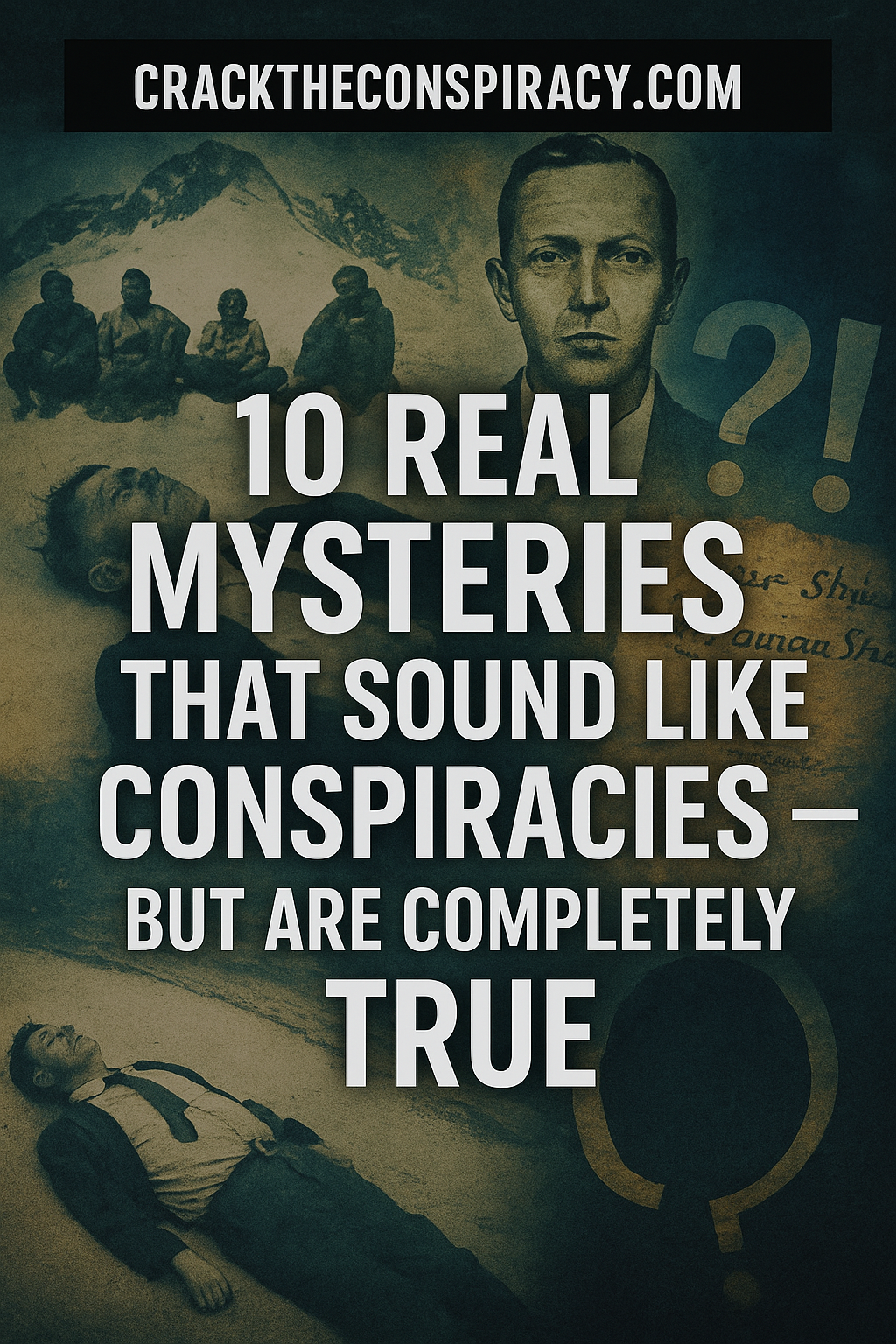
Some mysteries feel like conspiracy theories for a simple reason: the raw facts are already strange enough to sound invented. A missing colony. A dead man with a code in his pocket. Hikers found in the snow after cutting their own tent open. When the evidence is real but the explanation stays incomplete, the internet does what it always does – it turns uncertainty into a bigger story.
Setup
This is where a lot of confusion begins. Not every unsolved case is a conspiracy, and not every official explanation is a cover-up. Sometimes a real event leaves behind scattered evidence, competing witness accounts, damaged records, or details that never fit neatly together. That gap between documentation and certainty is exactly where modern conspiracy packaging thrives.
The ten cases below earned their reputations because something real happened in each one. People disappeared, died, or left behind evidence that still raises questions. But the strongest way to approach them is not as proof of hidden plots. It is to separate the documented facts from the dramatic versions that spread later.
That same pattern shows up all over conspiracy culture. A true fragment becomes a larger narrative, much like what happened with Operation Mockingbird or stories about shadow governments: a real history of secrecy makes the leap to a much bigger theory feel easier than it should.
What people claim
Once a mystery enters online culture, the claims usually follow a familiar script. The Dyatlov Pass deaths become evidence of a military test, a creature attack, or a suppressed operation. The Somerton Man stops being an unidentified death and becomes a cold-war spy thriller. The Wow! signal turns into a near-confirmed alien transmission. Roanoke becomes proof of a vanishing act too total to be ordinary history. The Pollock twins become certainty rather than suggestion in debates over reincarnation.
Even cases with ordinary human stakes get pushed into larger myth. D.B. Cooper becomes the perfect criminal mastermind rather than a man who may simply have died in the wilderness. The Circleville letters become proof of a protected network instead of a case shaped by rumor, fear, and incomplete investigation. The Green Children are treated as visitors from another world instead of a medieval story with layers of retelling attached to it.
The internet rewards the most total explanation, not the most careful one. A mystery with three unresolved points gets retold as a mystery with one explosive answer. That is how real ambiguity starts to look, in circulation, like evidence of hidden design.
Why it spread
These cases spread because they sit in a sweet spot between credibility and impossibility. They are not obvious fiction. They come with dates, names, reports, photographs, or historical references. That gives them enough weight to feel serious. At the same time, each one contains at least one detail that sounds almost too cinematic to be true.
Take Dyatlov Pass. The scene sounds like the start of a thriller: hikers fleeing into freezing darkness, clothing shared among bodies, unexplained injuries, and decades of debate. Or take the Somerton Man, where the phrase “Tamam Shud,” a hidden scrap of text, and a long-anonymous identity invited generations to build a spy story around a real death. The Wow! signal lasted only seconds, which made it perfect internet fuel: brief enough to stay unresolved, technical enough to sound credible, eerie enough to stay memorable.
Pop culture helps too. Documentary editing, creepypasta pacing, and viral threads all teach audiences to expect secret meaning in stray details. That is why the packaging matters. A list of real mysteries can become clickbait in a hurry if it treats each case like a wink toward a hidden truth instead of a documented event with limits. The same conversion from ambiguity into certainty is part of why ideas tied to a supposed New World Order keep resurfacing even when the evidence rarely matches the scale of the claim.
What the evidence shows
The strongest reading of these ten cases is less dramatic and more interesting. The Dyatlov Pass incident remains unusual, but unusual is not the same as impossible. Later reviews pointed toward a natural avalanche-related scenario or comparable environmental chain of events, which does not answer every question but does explain more than many supernatural versions do.
The Somerton Man stayed compelling because key pieces were missing for so long: identity, motive, and context. But modern research narrowed parts of the story without turning it into a proven spy operation. The case became better documented over time, not more fantastical. D.B. Cooper is similar. The hijacking was real, the escape attempt was real, and the mythology expanded because the ending never arrived in a neat, satisfying way.
The Lead Masks Case, the Circleville letters, and the ghost blimp all share a similar structure. They contain legitimate unanswered questions, but not enough verified evidence to support the most dramatic theories attached to them. In each case, the public imagination often outran the record. The Pollock twins remain one of the better-known reincarnation stories, but the evidence sits in testimony and interpretation, not in anything that settles the issue. The Green Children of Woolpit are even further from certainty, preserved through historical retellings that leave plenty of room for embellishment.
And then there is Roanoke. The disappearance was real. The cultural image of a whole colony vanishing without a trace is real. But historians have long argued for more grounded possibilities involving dispersal, migration, conflict, assimilation, and the routine fragmentary nature of colonial records. The problem is not that the facts are boring. The problem is that audiences often treat “not fully resolved” as if it means “probably hidden.”
Where confusion came from
Most confusion comes from mixing categories that should stay separate. An unsolved event is not automatically a conspiracy. A suspicious detail is not the same as a verified pattern. A lack of closure is not proof of suppression. Online retellings blur those lines because certainty travels faster than caution.
This post needed a framing reset for exactly that reason. The old version leaned too hard on list formatting and mystery aesthetics, which made the piece feel like a roundup of spooky proof. A better framing is to show how real mysteries get repackaged. When audiences encounter ten bizarre cases in a row, they start reading them through the same lens they use for entertainment conspiracies, from predictive-coding narratives in movies to celebrity replacement claims. That lens can be fun, but it is not reliable.
The more useful question is not “Which of these proves a conspiracy?” It is “Why do unresolved facts invite conspiracy-shaped storytelling?” Sometimes the answer is distrust. Sometimes it is pattern-seeking. Sometimes it is the influence of media culture that has taught people every loose end must point to a mastermind.
Reality Check
These ten stories are worth reading because they are real mysteries, not because they secretly confirm hidden plots. Their power comes from the opposite tension: documentation without closure. That is what makes them linger.
If there is a lesson here, it is that uncertainty deserves precision. Real cases become distorted when they are sold as proof of something bigger than the evidence can carry. The truth is usually narrower, but it is also more durable. Dyatlov Pass does not need a monster to be haunting. The Somerton Man does not need a full spy ring to remain fascinating. Roanoke does not need a portal to stay historically eerie.
In other words, the mystery is enough. And once you stop forcing these stories into conspiracy templates, they become easier to trust, easier to investigate, and harder to turn into internet mythology.
🔎 If this story made you think, here are more conspiracy investigations worth exploring next:
- Music Industry Myths: Hidden Messages, Satanic Panic, and Why the Rumors Keep Coming Back
- Predictive Programming in Movies: Do Films Reveal the Future Before It Happens?
- Celebrity Cloning Conspiracy: Are Famous People Being Replaced?
📂 Explore more in this category:
Pop Culture and Media