
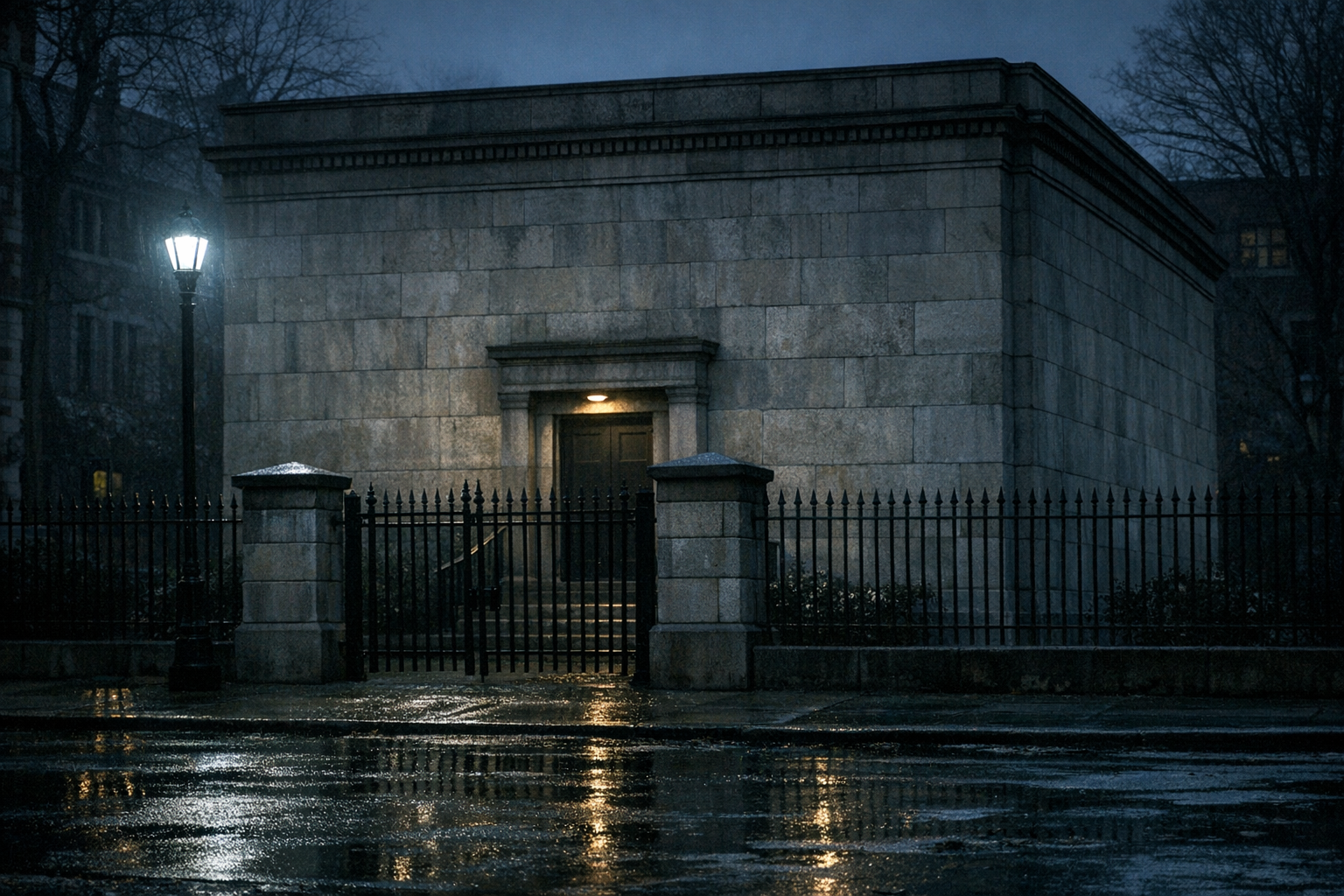
The building has no welcoming windows, only heavy stone and a dark doorway set back from the street. For generations, that sealed-off look has helped turn the Skull and Bones Society into something larger than a college club: a machine for hidden power, whispered about from the sidewalk as if the real decisions of America might be made behind those walls.
That image is hard to shake. A locked Tomb at Yale, secret rituals, famous names, and a membership list that includes presidents, judges, and financiers is exactly the kind of setup that makes people think they are staring at forbidden knowledge. But once you move past the mystique, the real question becomes sharper: does Skull and Bones actually control events behind the scenes, or has secrecy simply made ordinary elite networking look supernatural?
What Happened
Skull and Bones is a senior society at Yale University, founded in 1832. It is one of the school’s most famous secret societies, and over time it became the one most people outside Yale have actually heard of. Its headquarters, often called the Tomb, helped build that reputation. The building looks less like a student hangout and more like a place designed to keep people out.
Every year, the society selects a small number of Yale students, traditionally during the school’s “Tap Day” process. For decades, that ritual alone created a sense of theater. Imagine being a student on campus, watching certain people quietly pulled into a closed circle that everyone knows exists but few can describe clearly. That kind of staged exclusivity is powerful. It makes rumors feel natural.
The society’s history also gave conspiracy culture plenty to work with. Its alumni include William Howard Taft, George H. W. Bush, George W. Bush, John Kerry, and other people who moved into law, banking, intelligence, publishing, and national politics. That overlap between private initiation and public power became the center of the myth.
Then there are the details people remember most. The skull-and-bones emblem. The number 322. Stories about rituals, oaths, nicknames, and a deep culture of silence. Whether every dramatic claim about those rituals is true matters less than the effect. The society feels built to trigger suspicion.
That suspicion got even stronger in the twentieth century, when Americans became more aware of elite institutions, back-channel influence, and the ways personal networks can shape careers. A secret club filled with future insiders did not look harmless to critics. It looked like proof that the game was fixed before the public even knew a game was being played.
That is why Skull and Bones never stayed just a Yale story. It escaped campus and became part of a wider American fear: that important systems are not fully open, and that access matters more than merit. In that sense, the society became a symbol long before it became a target of detailed evidence.
Why People Believe It
People believe the bigger Skull and Bones theories because the ingredients line up almost perfectly. First, there is real secrecy. The group is not open about its inner practices, and secrecy creates a vacuum. Vacuums get filled with stories.
Second, there is real prestige. This is not a random club that disappeared into history. It sits at Yale, one of the most famous universities in the United States, and it has drawn members who later entered the highest levels of public life. When two presidential candidates from the same election cycle both have ties to the same secret society, people do not need much encouragement to start connecting dots.
Third, there is a human pattern at work. When people see a closed network producing visible success, they often assume the network itself must be pulling hidden levers. Sometimes that suspicion is partly reasonable. Elite circles do create opportunities. A society like this can absolutely strengthen trust, introductions, and long-term loyalty among members.
There is also the emotional side. The Tomb, the symbols, and the initiation lore do not feel like plain career-building. They feel theatrical, old, and slightly forbidden. That matters because conspiracy theories spread best when facts are wrapped in atmosphere.
The same pattern shows up in other secret-society stories on the site. With the Bohemian Grove conspiracy, private rituals and elite attendance helped ordinary exclusivity grow into much larger claims. And with Freemasons Explained, symbolism and selective access became raw material for theories that outgrew the documented record.
Claims vs Evidence
Claim: Skull and Bones secretly controls American politics from behind the scenes.
What we know: There is no confirmed evidence that Skull and Bones acts as a central command structure directing the U.S. government. No public record shows the society issuing instructions, coordinating administrations, or operating as a hidden ruling body.
Why the claim persists: Several powerful alumni came from the society, and some of them moved in overlapping political and financial circles. That is enough to make coordinated power feel plausible, especially when outsiders cannot see what happens inside the group.
Claim: Its rituals prove members are bound into a lifelong secret pact that overrides public duty.
What we know: Reports about rituals exist, and secrecy around initiation is real. But ritual secrecy is not the same thing as evidence of a political command network. Many exclusive groups use symbolism, staged tradition, and private ceremony to create loyalty. That may be strange, but it is not proof of national manipulation.
Claim: The society serves as a pipeline that places chosen members into power.
What we know: This is the strongest part of the argument, but it still needs careful wording. There is evidence that elite schools and elite networks help members gain access to internships, introductions, and credibility. A Skull and Bones connection may open doors or deepen trust between insiders. That is very different from proving that the society secretly runs institutions.
Claim: The number 322 and the society’s symbols hide deeper operational meaning.
What we know: The number and symbols clearly matter to the society’s identity, but there is no verified evidence that they point to an ongoing covert program. Most interpretations move quickly from symbolism to control without showing the missing steps in between.
Reality Check
The most grounded way to understand Skull and Bones is this: it is probably less a hidden government than a concentrated example of how elite networks work. That may sound less dramatic, but it is not trivial. Private institutions can shape public life even when they are not running a secret master plan.
If a student enters a society that values ambition, loyalty, and status, and then later meets fellow members in law firms, boardrooms, media companies, or government offices, that creates influence. Influence does not need to be cinematic to be real. A phone call returned faster, an introduction made sooner, or trust extended more easily can quietly matter.
At the same time, conspiracy culture often stretches that truth beyond the evidence. It turns networking into total control, symbols into coded proof, and secrecy into a universal answer. That leap is where the theory becomes weaker. The documented history supports exclusivity and influence. It does not confirm hidden command.
There is also a practical reason the myth survives. A society like Skull and Bones offers a clean villain shape. It is easier to picture power inside one locked building than to accept that influence is often messy, distributed, and built through overlapping schools, families, careers, and institutions.
So the reality check is not that the society is meaningless. It is that the strongest concerns are more ordinary than the wildest theories. Closed elite circles can reproduce privilege. They can reinforce access. They can deepen public mistrust. But those realities are still not the same as proof that a student society secretly steers history.
Conclusion
Skull and Bones became a conspiracy magnet because it was almost designed to become one. The locked Tomb, the symbols, the rituals, and the famous alumni all create the feeling that hidden power must be operating somewhere just out of sight.
What we do know is enough to justify scrutiny. The society reflects how exclusivity and prestige can harden into long-term influence. But there is no confirmed evidence that it functions as a shadow government or a single invisible hand guiding national events.
The most honest conclusion is that Skull and Bones is partially explained. The secrecy is real. The elite connections are real. The myth of total hidden control is much larger than the verified record. And that gap between what can be documented and what gets imagined is exactly where conspiracies like this keep growing.
If this story stayed with you, the author suggests these real cases next:
- Bohemian Grove: The Private Retreat That Keeps Looking Like a Ritual of Power
- Freemasons Explained: The Brotherhood Whose Symbols Keep Feeding Bigger Myths
- Bilderberg Group Meetings: What Happens When the Powerful Meet Behind Closed Doors?
Explore more Secret Societies stories here: