
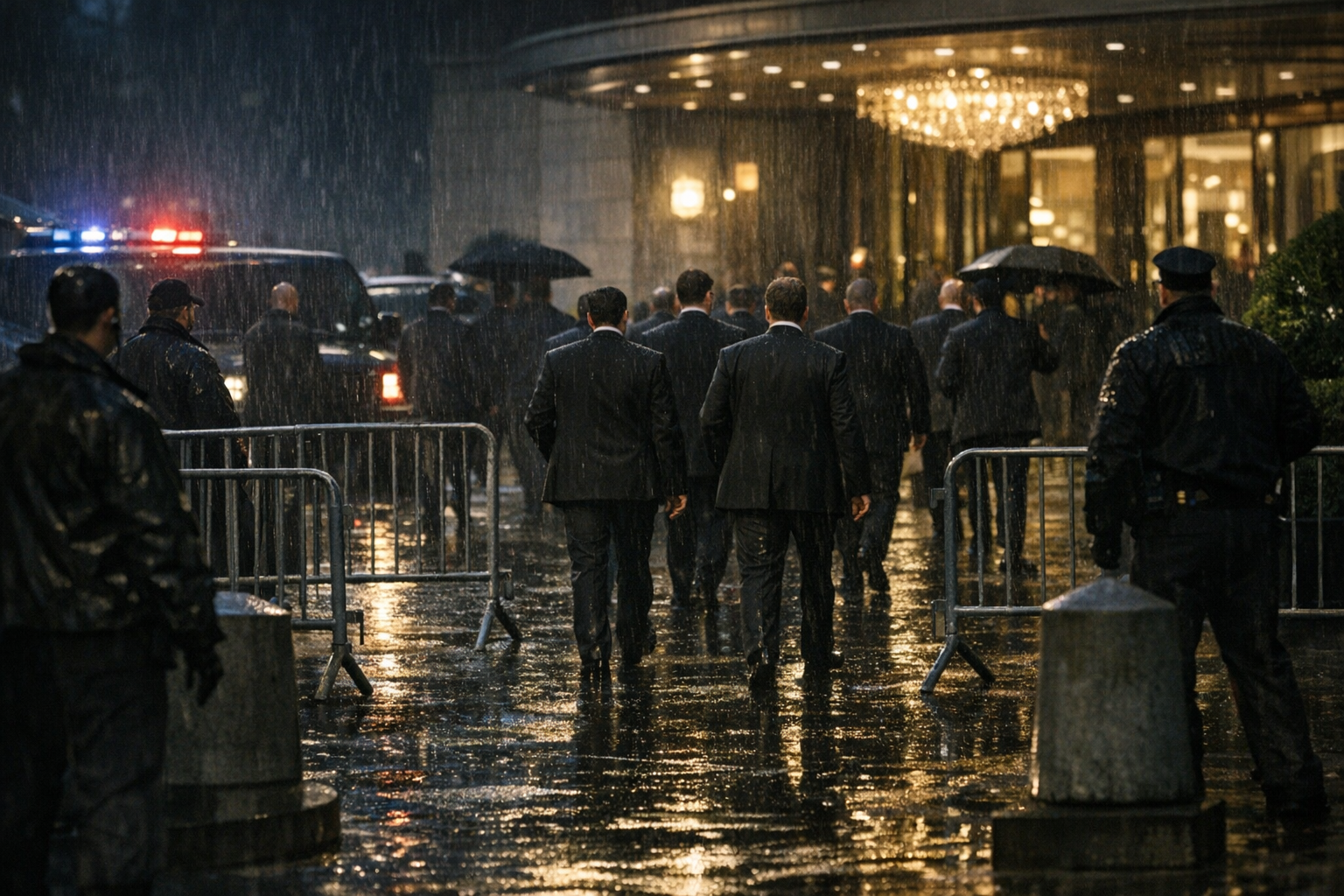
The doors close before the cameras get too close. Black sedans slide under hotel awnings, security guards scan the sidewalks, and behind sealed conference-room glass, some of the most powerful people in politics, finance, technology, and media sit down where the public cannot hear a word. For decades, the Bilderberg Group meetings have fed one question that never really goes away: are these private talks harmless networking, or something much bigger?
What Happened
The Bilderberg Group is a private annual meeting that began in 1954. It was created to bring together influential figures from Europe and North America for off-the-record discussion about world affairs. Attendees have included prime ministers, royalty, central bankers, military leaders, CEOs, academics, and major media figures.
The name comes from the Hotel de Bilderberg in the Netherlands, where the first meeting was held. Since then, the conference has moved between luxury hotels and secured venues in different countries. The official line is that it is a forum for open conversation. No formal votes are announced, no joint policy statements are released, and much of the discussion happens under the Chatham House Rule, which allows people to use the information shared but not identify who said what.
That structure is exactly what keeps the mystery alive. When a meeting includes heads of government, NATO figures, global investors, and tech leaders, people naturally wonder whether these are just discussions or quiet coordination sessions that shape the world before the public ever hears about it.
Part of the tension comes from the scene itself. Protesters gather outside barricades. Journalists try to document arrivals from behind security lines. Guests enter through side roads and guarded entrances. It looks less like a normal conference and more like a place the public is not supposed to understand.
If you have ever read about the Bohemian Grove conspiracy, the pattern feels familiar: powerful people meeting privately, very little transparency, and a public left to fill in the blanks. That gap between what is visible and what is hidden is where most conspiracy theories begin.
Why People Believe It
The simplest reason is secrecy. Most political and business events that claim to influence public life at least produce speeches, press access, recordings, or written summaries. Bilderberg gives very little of that. Even when attendee lists and broad topic lists are released, the real conversations remain hidden.
That secrecy lands differently because of who attends. Critics are not looking at random executives chatting over coffee. They are looking at presidents, cabinet officials, intelligence-linked figures, bankers, defense leaders, and media owners in one place. For many people, that looks less like discussion and more like a planning room.
There is also the issue of timing. Some attendees have later risen to major office, and some policy directions discussed at elite gatherings seem to overlap with real-world events that follow. To conspiracy believers, that pattern suggests influence behind the scenes. To skeptics, it suggests something less dramatic: powerful people often attend the same circles, so overlap is not surprising.
Online culture has pushed the theory even further. Bilderberg is often folded into wider fears about a hidden global elite, the same ecosystem that fuels stories about the New World Order conspiracy and unelected power shaping public life. Once Bilderberg is placed inside that larger narrative, every private dinner, security detail, and missing transcript starts to feel like evidence.
Claims vs Evidence
Claim: Bilderberg secretly controls world governments and dictates major policy decisions.
Evidence: There is no verified public evidence showing that the group issues binding orders to governments or runs a hidden world command structure. No leaked document has confirmed that level of control.
Claim: Media leaders attend so they can help hide what the group is doing.
Evidence: Media figures have attended over the years, which understandably raises eyebrows. But their presence alone does not prove an organized media cover-up. It does show that the line between observer and participant can become uncomfortable when journalists attend closed-door elite events.
Claim: Bilderberg picks future leaders before elections ever happen.
Evidence: Some future presidents, prime ministers, and senior officials attended before taking higher office. That is a real and important fact. But correlation is not the same as proof of selection. Powerful, ambitious people are often invited to elite forums precisely because they are already considered likely to rise.
Claim: The meeting is harmless because nothing official comes out of it.
Evidence: That claim is too simple too. Influence does not have to be formal to be real. Private relationships matter. Elite consensus matters. Informal conversations can shape what later feels politically possible. Even without secret orders, closed-door networking among powerful people can still have serious consequences.
That middle ground is where the story becomes more interesting. The strongest case against the wildest conspiracy claims is the lack of hard proof. The strongest case for public concern is that private influence among elites is not imaginary. It happens all the time, even when it is not part of a grand secret plot.
Reality Check
What we do know is that Bilderberg is real, exclusive, and intentionally private. We also know that people with major institutional power attend it. Those facts alone are enough to justify scrutiny. In democratic societies, citizens have a reasonable interest in understanding how decisions and priorities are shaped.
What we do not know is far more specific: there is no confirmed evidence that Bilderberg is a secret government, a puppet master over world events, or a command center for a single global conspiracy. Many of the biggest claims about it rely on assumption, pattern-reading, and the emotional force of secrecy rather than verifiable documents.
The most realistic interpretation sits between dismissal and panic. Bilderberg probably is not a hidden throne room where world history is scripted line by line. But it also is not meaningless. It is a place where already-powerful people build trust, test ideas, compare priorities, and talk freely without public pressure. That may not be a conspiracy in the dramatic sense, but it is a form of elite access most ordinary people never get.
That distinction matters. If every secretive meeting is treated as proof of total control, serious criticism loses credibility. But if private elite gatherings are waved away as harmless by default, then real power can avoid scrutiny simply by staying informal. The honest answer is less cinematic than the theory, but still worth paying attention to.
Conclusion
The Bilderberg mystery survives because it is built on something real: powerful people do meet behind closed doors, and the public usually learns very little about what happens there. That makes the theory believable at first glance. But when the evidence is separated from the fear, the case for a world-controlling secret society remains unproven.
What remains is a more grounded concern, and maybe a more useful one. Private influence, elite networking, and opaque decision-making do shape the modern world. Bilderberg may not be proof of total coordination, but it is a reminder that power often works best when nobody is watching.
🔎 If this story stuck with you, you might want to explore these next: