
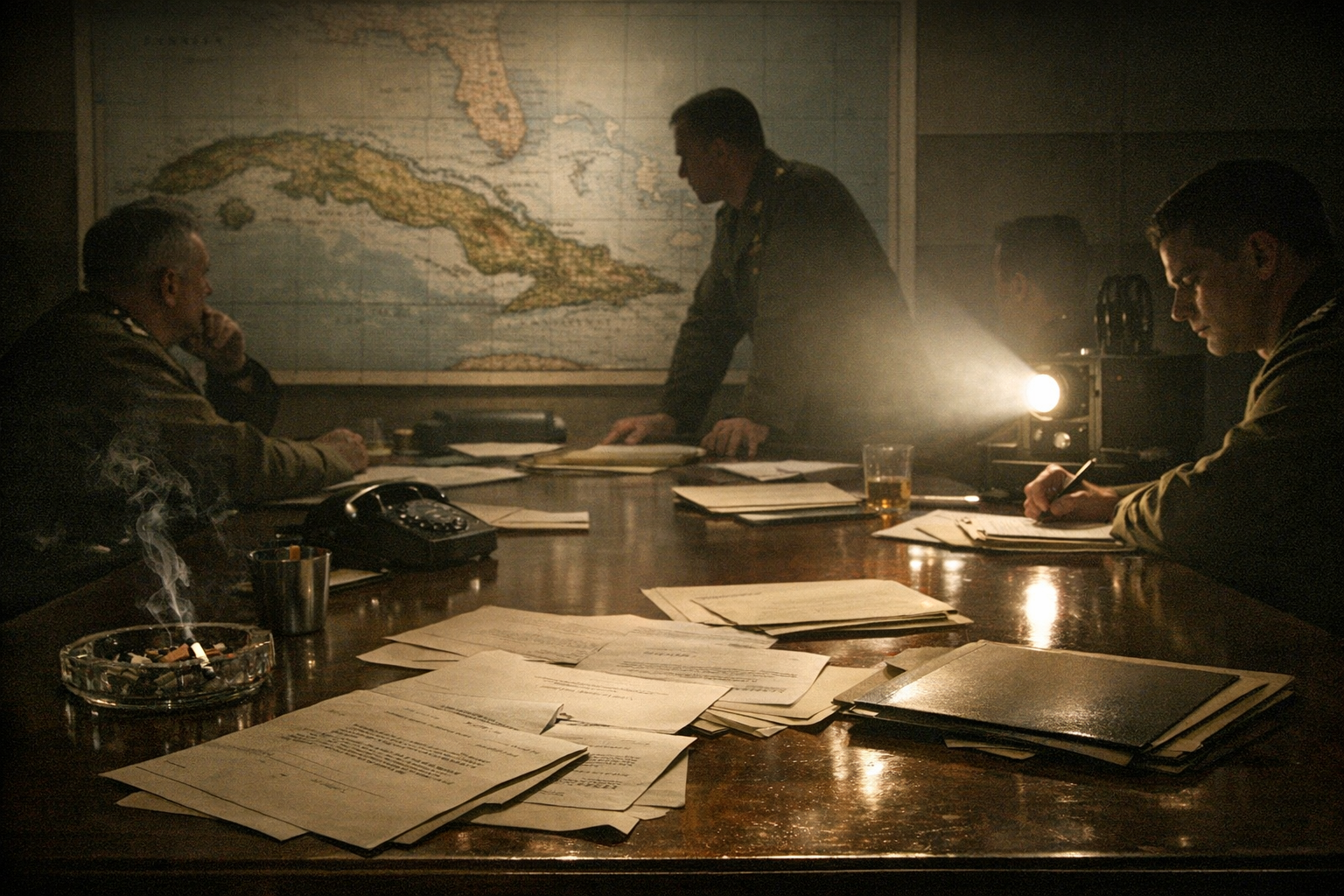
The folder was marked secret, the kind of document that was supposed to stay buried in a Cold War filing cabinet. Inside was a proposal so blunt and unsettling that even now it reads like something leaked from a political thriller: Operation Northwoods, a plan that suggested staging acts of terror and blaming them on Cuba. In a time of fear, missile maps, and closed-door war planning, that idea was not passed around by random cranks. It appeared inside the machinery of the U.S. military.
What Happened
Operation Northwoods was a real proposal created in 1962 by the U.S. Department of Defense during one of the most tense stretches of the Cold War. Fidel Castro had taken power in Cuba. The failed Bay of Pigs invasion was fresh in memory. Washington was looking for ways to remove Castro, weaken his government, and justify stronger action.
That is the setting that matters. This was not a quiet peacetime office pushing paper. It was a period shaped by fear of communism, intelligence operations, nuclear anxiety, and a genuine belief inside parts of the U.S. government that Cuba was a dangerous Soviet foothold just ninety miles from Florida.
🔎 Related Investigation:
Within that climate, the Joint Chiefs of Staff signed off on a memo outlining possible pretexts for military intervention. Some suggestions were propaganda-based. Others were much darker. The document discussed creating or simulating incidents that could be used to build public support for action against Cuba.
Among the most cited ideas were staging attacks, creating fake evidence, and engineering blame so it would fall on the Cuban government. The proposals included scenarios involving hijacked aircraft, attacks tied to Cuban refugees, and even the possibility of causing public outrage through controlled deception. It is the kind of language that stops readers cold because it does not sound like rumor. It sounds administrative.
Picture the human moment behind that paper. Somewhere in Washington, men in uniform sat under fluorescent light, leaning over maps and memos, discussing how outrage might be manufactured if ordinary events failed to produce it. No explosions happened because of Northwoods. No public attack was carried out under that name. But the fact that such ideas reached a formal proposal stage is what keeps the story alive.
The key point is this: Operation Northwoods was proposed, documented, and later declassified. It was not approved by President John F. Kennedy, and it was never implemented. That distinction is everything. Without it, the story turns into myth. With it, the story is already disturbing enough.
That is part of why Northwoods still gets linked to other distrust-heavy stories, including debates around the JFK assassination. Once people learn that top officials really did consider deceptive pretexts on paper, it becomes easier for broader false-flag suspicions to spread far beyond the original document.
Why People Believe It
People do not latch onto Operation Northwoods because it sounds impossible. They latch onto it because the core document is real. In the conspiracy world, that matters more than almost anything else. Many theories start with a vibe, a coincidence, or a rumor. Northwoods starts with paperwork.
🔎 Related Investigation:
It also confirms a fear many people already carry: that governments sometimes justify actions by shaping public perception first. History offers enough real examples of propaganda, covert action, and strategic deception to make that suspicion feel reasonable. Once the public learns that military planners considered fake incidents in 1962, it becomes harder to wave away concerns about later events.
Another reason the theory sticks is that the proposal feels morally shocking. People expect secret planning to be cold, but not this cold. A memo that appears to treat public fear as a tool has a way of burning itself into memory. It feels like a glimpse behind the curtain.
There is also a pattern effect. Northwoods is often used as a bridge theory. Someone starts with the document itself, then jumps to larger claims: maybe other attacks were staged, maybe major crises were manipulated, maybe hidden planners have always operated the same way. That leap is emotionally understandable, but it is still a leap.
The same dynamic has helped stories like the Tuskegee Syphilis Study remain powerful in public memory. When institutions are caught doing something real and deeply unethical, people become more open to believing they may have done worse somewhere else. Sometimes that instinct leads to important questions. Other times it leads to speculation outrunning evidence.
Claims vs Evidence
Claim: The U.S. government planned a false-flag campaign to justify war with Cuba.
Evidence: This claim is substantially supported by the declassified Northwoods documents. The record shows that senior military officials proposed deceptive scenarios that could create a pretext for intervention. That part is not imaginary.
Claim: Operation Northwoods proves that the U.S. government later carried out similar attacks against its own people.
Evidence: There is no confirmed evidence that Northwoods itself was carried out, and there is no automatic line from the 1962 proposal to later unrelated tragedies. The document proves willingness to discuss certain tactics. It does not, by itself, prove that other specific events were orchestrated in the same way.
Claim: President Kennedy was removed because he rejected Operation Northwoods.
Evidence: This is a much bigger claim than the documents support. It is true that Kennedy did not approve the proposal. It is also true that his relationship with elements of the national security establishment was complicated. But direct proof connecting Northwoods rejection to his assassination has not been established by the available evidence.
Claim: The existence of Northwoods shows that all official explanations deserve rejection.
Evidence: Not really. What it shows is that official institutions can produce deeply troubling plans, and that public skepticism can be healthy. But skepticism works best when it stays tied to documents, testimony, timelines, and verifiable facts. If every real scandal becomes proof of every later theory, analysis collapses into suspicion alone.
A useful comparison is the Montauk Project. That story is famous, vivid, and packed with dramatic claims, but it rests on far shakier evidence. Northwoods is different because the starting point is not folklore. It is a declassified government proposal. That makes it stronger as a historical story – and more dangerous when people stretch it beyond what the record actually shows.
Reality Check
Here is the clearest grounded conclusion: Operation Northwoods was real as a proposal and unreal as an operation. That sounds simple, but it is the line many retellings blur. The memo existed. The suggested deceptions were serious. But the plan was not authorized, and the events it described were not executed under that program.
That still leaves an uncomfortable truth. High-level military planners were willing to put options on paper that treated fear, deception, and possible violence as strategic tools. Even if the plan died in the approval process, the document tells us something important about the mindset inside Cold War power centers.
It also explains why Northwoods keeps resurfacing whenever people argue about false flags. Supporters say the document proves governments are capable of manufacturing consent through shock. Critics answer that using one rejected proposal to explain later events is bad logic. Both sides touch a piece of the truth. Governments can consider unethical ideas. But each historical event still has to be judged on its own evidence.
So where does Northwoods land in Crack the Conspiracy terms? Not fully debunked, because the underlying document is genuine. Not fully unexplained, because we know what it was and what happened to it. The most honest label is partially explained: the plan was real, the broader mythology built around it is much less certain, and the biggest lesson comes from how easily one documented proposal can fuel decades of wider suspicion.
That lesson matters today. Once trust breaks, even accurate information starts to feel negotiable. A declassified memo from 1962 still circulates because it speaks to a modern fear: if officials once considered manipulating reality, how often should the public question the story placed in front of them? The answer is not ‘believe nothing.’ It is ‘check everything.’
Conclusion
Operation Northwoods endures because it sits in the narrow space between conspiracy theory and documented history. It gives skeptics something rare: a paper trail. It also gives storytellers something powerful: a moment when secret planning looked alarmingly close to moral collapse.
What we actually know is enough. Military leaders proposed deceptive acts meant to trigger support for action against Cuba. The plan was rejected. It was never carried out. Beyond that, the story becomes a test of discipline. If we stay with the record, Northwoods remains one of the clearest examples of why public scrutiny matters. If we wander too far beyond it, the real scandal gets buried under bigger but weaker claims.
If this story stuck with you, you might want to explore these next: