
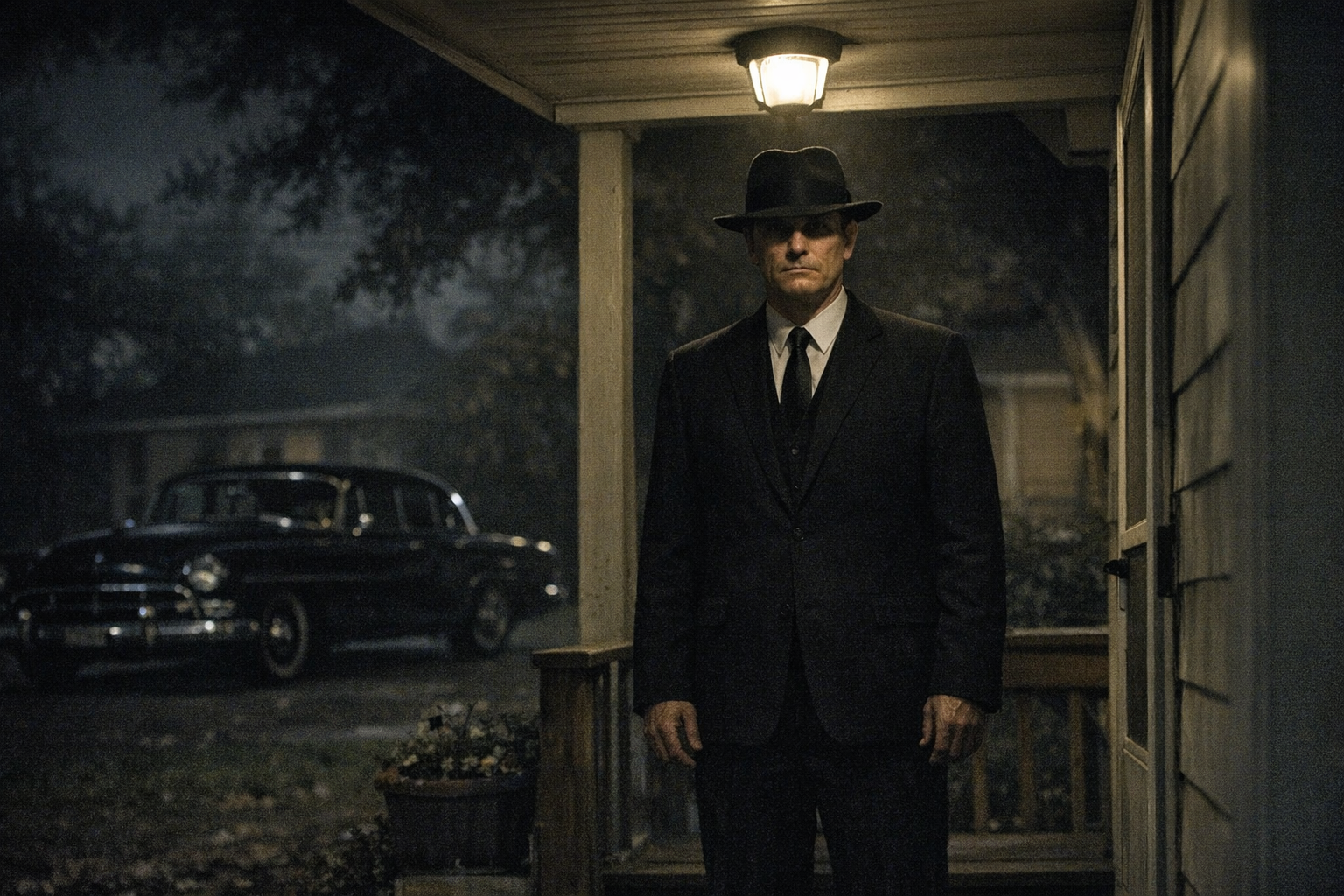
The visitor wore a dark suit that looked almost right, like a costume borrowed from a funeral home and tailored by someone who had never watched people move. He appeared after a UFO report, asked strange questions in a flat voice, and left the witness with a feeling that access to some hidden world had just been denied. That chilling image helped turn Men in Black stories into one of the strangest branches of UFO culture.
For decades, believers have said these figures were not just rumors or movie inspiration. They were enforcers. According to the legend, they showed up after sightings, warned witnesses to stay quiet, and vanished before anyone could prove who they were. The deeper question is not just whether the men were real. It is why this pattern became so powerful in the first place.
What Happened
The modern Men in Black legend usually traces back to the early UFO era of the 1940s and 1950s, when flying saucer reports were spreading fast across the United States. Witnesses did not just describe lights in the sky. Some also claimed they were contacted afterward by odd visitors who seemed to know too much about what they had seen.
🔎 Related Investigation:
One of the most famous early cases involved UFO researcher Albert K. Bender. In the 1950s, Bender said his work on flying saucers drew the attention of mysterious men in dark suits who appeared in unsettling circumstances and pressured him to stop. His account helped shape the idea that UFO witnesses were being monitored by a secretive force.
As the story spread, the details became more theatrical. Witnesses described pale skin, stiff body language, outdated clothing, and strange speech. Some said the men drove old luxury cars with no clear plates. Others said the visitors seemed unfamiliar with ordinary objects, as if they were imitating human behavior from observation rather than experience.
That is part of what made the legend stick. The sightings were not just about fear. They had a human moment at their center. Someone sees something unexplained, goes home shaken, and then a knock comes at the door. The second event feels worse than the first because it suggests the witness was noticed.
Over time, the idea expanded far beyond a few reports. Men in Black became part government-agent rumor, part paranormal tale, and part pop culture icon. Books, television, comics, and films pushed the image further into public imagination. But the original core claim remained the same: after certain UFO encounters, intimidating figures appeared and tried to shut people down.
Why People Believe It
People believe these stories because they fit an emotional pattern that feels believable even when the evidence is weak. If someone reports a UFO and then feels watched, dismissed, or threatened, the idea of quiet intimidation fills the gap. It gives shape to fear.
There is also a larger historical reason. Governments really have kept secrets, especially during the Cold War. Classified military projects, intelligence operations, and surveillance programs were real. That history makes it easier for people to accept the idea that unusual witnesses might also be quietly managed. Articles about government UFO programs have only strengthened that instinct.
The Men in Black legend also survives because witness stories often share a mood, even when the details do not match. The mood is what people remember: a black car, a blank expression, a warning that sounds more disturbing because it is delivered calmly. Shared mood can feel like shared evidence, even when it is not.
Pop culture added another layer. Once the image entered books and movies, people had a ready-made script for describing strange encounters. That does not automatically make every witness dishonest. But it does mean later reports were shaped by a legend that had already become familiar. The more famous the story became, the harder it became to separate raw testimony from folklore.
There is also a psychological pull to the theory. A random sighting is messy and unsatisfying. A secret pattern is cleaner. If the witness was visited afterward, then the event feels connected to a larger hidden system. That makes the world feel more ordered, even if the order is frightening.
Claims vs Evidence
Claim: Men in Black are government agents assigned to suppress UFO evidence.
Evidence: There is no confirmed public record showing a dedicated government unit that visits UFO witnesses in the way the legend describes. Official secrecy around some military activity is real, but the leap from that fact to black-suited intimidation squads has not been demonstrated.
Claim: Men in Black are not human at all, but something stranger pretending to be human.
Evidence: This idea comes mostly from the odd behavior reported in witness stories: robotic speech, bizarre questions, and unnatural mannerisms. These details are memorable, but they are anecdotal. There is no verified physical evidence, no confirmed identity, and no consistent pattern strong enough to prove a nonhuman explanation.
Claim: The consistency of witness reports proves a real intimidation pattern.
Evidence: Some reports do repeat similar themes. But repetition alone is not proof. Once a story enters UFO culture, later witnesses can be influenced by earlier versions, even without meaning to copy them. That is a common problem in folklore, memory studies, and witness testimony.
What we do know is that UFO culture has long included overlap between genuine personal experiences, misinterpretation, fear, and storytelling. The same thing can be seen in famous cases such as the Travis Walton UFO incident, where witness conviction remains strong but debate over interpretation never fully goes away.
Another problem is timing. Many Men in Black reports were written down long after the alleged event. Memory changes. Details harden. Unclear moments become dramatic scenes. That does not mean every witness is lying. It means retrospective stories are especially difficult to verify.
Reality Check
The strongest reality check is simple: Men in Black stories are vivid, but they are not well documented. We have reports, retellings, books, and interviews. We do not have a body of hard evidence that clearly separates these visitors from rumor, mistaken identity, or cultural mythmaking.
That matters because intimidation claims are easy to believe once a person already feels isolated. A witness who reports a UFO may face ridicule, stress, and public attention. Under those conditions, an ordinary encounter can start to feel loaded with secret meaning. A plain stranger at the door can become part of the mystery.
It is also possible that some early stories mixed several realities together. During the Cold War, people did encounter real investigators, local officials, journalists, and security personnel asking questions about strange things seen in the sky. Aircraft testing, radar issues, and military secrecy created conditions where unusual questioning could happen. Later retellings may have transformed some of those moments into something more sinister.
There is another possibility too: the Men in Black legend works because it dramatizes the fear of knowing too much. In that sense, it says as much about human psychology as it does about UFOs. The hidden visitor becomes a symbol of the line people feel they are not supposed to cross.
So where does that leave the theory? Not fully debunked in the sense that unusual witness experiences do exist. But not confirmed either. The better label is partial: there is a real folklore tradition built around genuine claims, yet the evidence for an organized intimidation network remains thin.
Conclusion
Men in Black stories endure because they combine two fears that rarely lose their power: the fear that something impossible was seen, and the fear that someone powerful noticed. That is a strong recipe for legend, especially in UFO culture, where uncertainty is already doing half the work.
There is no confirmed evidence that black-suited enforcers systematically silence UFO witnesses. But there is clear evidence that the idea took hold early, spread widely, and attached itself to the most unsettling parts of the UFO world. That is why the story still lingers. It sits in the gap between testimony and proof, where conspiracy culture often grows best.
If nothing else, Men in Black stories show how a mystery can evolve. A sighting becomes a rumor. A rumor becomes a pattern. A pattern becomes a legend that feels almost too specific to ignore.
🔎 If this story stayed with you, the author suggests these real cases next:
- Roswell UFO Crash: What the Original Witnesses Claimed and What the Records Actually Show
- Pentagon UFO Videos: What the Navy Footage Proves
- UFO Sightings: What People Are Really Seeing in the Sky
Explore more Alien & UFO Theories stories here: