
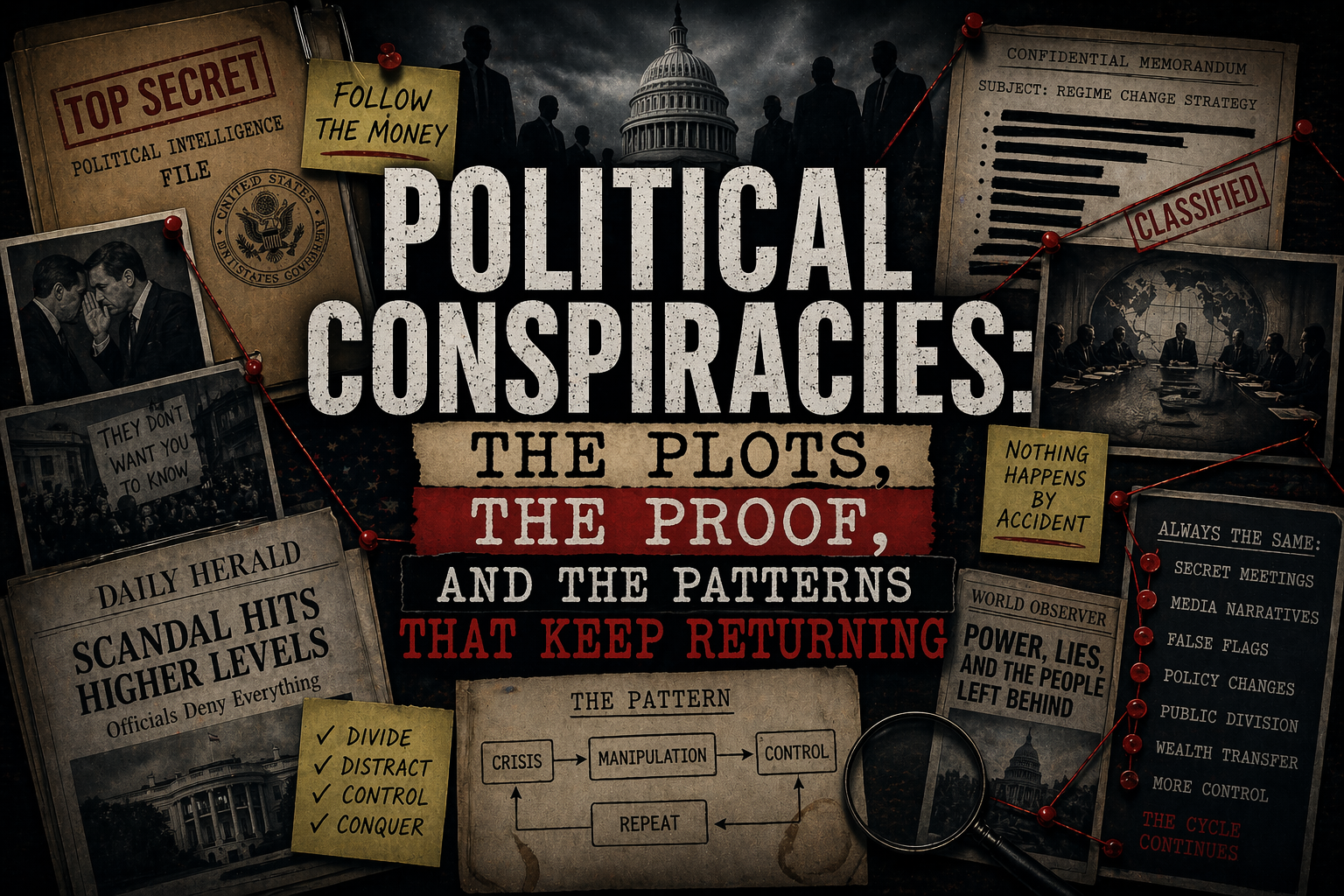
A leaked memo, a closed-door hearing, a declassified surveillance program—each one looks, for a moment, like proof that hidden power is finally stepping into view. That is the engine behind political conspiracy culture. A real secret surfaces, a genuine abuse of power is documented, and the public learns one more time that institutions can mislead, conceal, or manipulate. But the same moment that justifies skepticism also makes exaggeration easier. Soon every contradiction looks coordinated, every bureaucratic gap feels sinister, and every fragment of evidence is pushed toward a grand design.
That is why political conspiracies survive longer than many other theories. They do not grow in a vacuum. They grow in the shadow of confirmed surveillance, covert programs, propaganda efforts, classified operations, and elite networks that really did exist. The category becomes powerful not when readers assume every theory is true, but when they understand how truth, secrecy, and narrative escalation keep feeding each other. That is the pattern that turns isolated scandals into a permanent political worldview.
Where to Start
If you want the cleanest path into this category, start with Deep State Explained for the core argument about hidden bureaucracy, then read Mass Surveillance State to see how real surveillance history hardened public distrust. From there, move to Operation Mockingbird for media manipulation claims, Military-Industrial Complex for the profit-and-power dimension, and CIA Assassination Plots for the role of declassification in keeping suspicion alive. Then widen the lens with Election Fraud Theories, False Flag Operations, and Shadow Governments. Read together, they show why political conspiracies keep returning even when many individual claims overreach the evidence.
Why Political Conspiracies Never Really Leave
The strongest political conspiracies are built on a simple psychological bargain: if institutions lied before, they could be lying now. That premise is not irrational on its face. History gives people plenty of reasons to distrust official narratives. Intelligence agencies ran covert operations. Governments concealed wars, surveillance programs, experiments, and influence campaigns. That means conspiracy thinking around politics is never driven only by paranoia. It is also driven by memory.
The problem begins when memory becomes a universal solvent. Once confirmed secrecy becomes the lens for everything, the difference between a documented program and an unbounded theory starts to blur. That is why a category like this one works best as a documentary chain rather than a pile of outrages. The stories connect not because they all prove one hidden master plan, but because they all reveal the same recurring mechanisms: secrecy, institutional distrust, selective disclosure, and narrative escalation.
Secrecy Creates the Opening
Every major political conspiracy starts with a void in public knowledge. Something is classified, buried, distorted, or released in fragments. That empty space matters as much as the information itself. When people know they are not seeing the full record, they start building narratives to fill the gap. Some of those narratives remain cautious. Others harden into all-purpose explanations for how power works behind the scenes.
You can see that dynamic clearly in Mass Surveillance State. The revelation that governments really did build sweeping surveillance systems permanently changed the threshold of plausibility. Claims that once sounded hysterical suddenly had a documented foundation. But the same foundation also encouraged people to assume that every unexplained tool, database, or monitoring program must belong to a single hidden architecture of control. Real evidence opened the door; speculation rushed through it.
Institutional Distrust Does the Rest
Once trust breaks, even ordinary political complexity can look staged. That is why the language of the deep state became so sticky. It gives a name to the feeling that elected officials are not the whole story—that bureaucrats, intelligence actors, defense networks, and long-lived institutional interests can outlast any one administration. At its strongest, that claim points to the inertia of real systems. At its weakest, it turns every policy failure into proof of an invisible ruling network.
The same logic drives shadow government narratives. The appeal is obvious. Complex power is frustrating, hidden procedures are hard to follow, and elite continuity is real enough to notice. But the leap from “power persists through institutions” to “a hidden cabal secretly directs everything” is where documentary evidence gives way to mythology. The theory survives because the first half feels plausible and the second half feeds on the emotional force of the first.
Declassification Feeds Belief Instead of Ending It
Many people assume declassification should settle conspiracy debates. In reality, it often keeps them alive. A newly released file rarely closes a story. It proves part of the hidden machinery existed, but it also implies there may be more that still is not public. That is enough to sustain the belief that the final truth remains just out of reach.
CIA Assassination Plots shows this pattern perfectly. Declassified material can confirm a willingness to entertain or support covert action, destabilization, and plausible deniability. That matters. But it also tempts readers to extend the logic beyond the documents themselves, treating the archive as evidence not just of what happened, but of what must have happened in every other suspicious case. The file becomes both proof and permission.
The same escalation appears in False Flag Operations. Real proposals, historical deception campaigns, and staged pretexts give the concept undeniable weight. Yet that very history makes the label easier to apply recklessly. Once people know governments have considered deception before, they become more willing to fit unrelated modern events into the same frame, even when the evidence is thin. A documented tactic becomes a universal explanation.
Media and Power Magnify the Pattern
No political conspiracy category works without information systems. Modern distrust is not just about what governments do; it is about how narratives are shaped, amplified, and recycled. That is why Operation Mockingbird remains so durable in the public imagination. Whether readers approach it cautiously or dramatically, the core fear is the same: if media channels can be influenced, then public reality itself can be engineered.
That fear becomes even more convincing when paired with structural incentives. Military-Industrial Complex keeps the category grounded by showing how money, defense, lobbying, and security narratives can reinforce one another without requiring a cartoonishly centralized plot. This is one of the most important distinctions in the whole category. Systems do not need to be omnipotent to be powerful. Interests do not need a single mastermind to produce outcomes that feel coordinated from the outside.
Why Elections Become the Flashpoint
Political conspiracies reach maximum intensity around legitimacy. When people believe the mechanism of representation itself has been manipulated, every other suspicion suddenly feels secondary. That is why Election Fraud Theories sits near the center of the modern cluster. Elections concentrate anxiety, identity, media narratives, legal ambiguity, and institutional distrust into one arena where millions of people are emotionally invested in the outcome.
What makes election theories so resilient is that they are rarely built from nothing. They feed on procedural confusion, isolated irregularities, partisan messaging, and the general public’s limited visibility into how elections are administered. The result is familiar: real complexity gets flattened into proof of hidden orchestration. Once that happens, contradictory evidence often strengthens belief instead of weakening it, because rejection by officials is taken as part of the cover-up.
The Pattern That Keeps Returning
Step back from the individual cases and the same sequence keeps appearing. First comes secrecy or ambiguity. Then comes a partial revelation that validates distrust. Next comes a burst of narrative expansion, where people connect the confirmed fact to a much larger hidden system. Finally comes endurance: the theory survives not because it was fully proven, but because enough of its emotional and historical foundation was real.
That is why political conspiracies are so persistent. They are rarely just stories about one scandal. They are stories about repeated collisions between institutional opacity and public suspicion. The category endures because democratic societies depend on trust, and each documented abuse of secrecy teaches people to ration that trust more carefully. The danger is not skepticism itself. The danger is letting every justified doubt evolve into a total explanation for how the world works.
What the Evidence Actually Supports
The strongest evidence in this category supports a narrower but more durable conclusion than the loudest theories claim. Governments, intelligence agencies, media systems, and defense interests have all produced real reasons for public distrust. Covert plans existed. Propaganda efforts existed. Surveillance architectures existed. Elite influence networks existed. That record matters, and denying it would only make conspiratorial thinking more appealing.
But the evidence does not support the idea that every political shock, every crisis, and every institutional contradiction belongs to a single secret script. The most responsible reading is harder and more honest: political conspiracies keep surviving because genuine secrecy and genuine abuses created a landscape in which exaggerated theories can flourish. In other words, the pattern is real even when the grandest conclusions are not. That is the thread connecting the strongest stories in this category—and the reason they keep returning.