
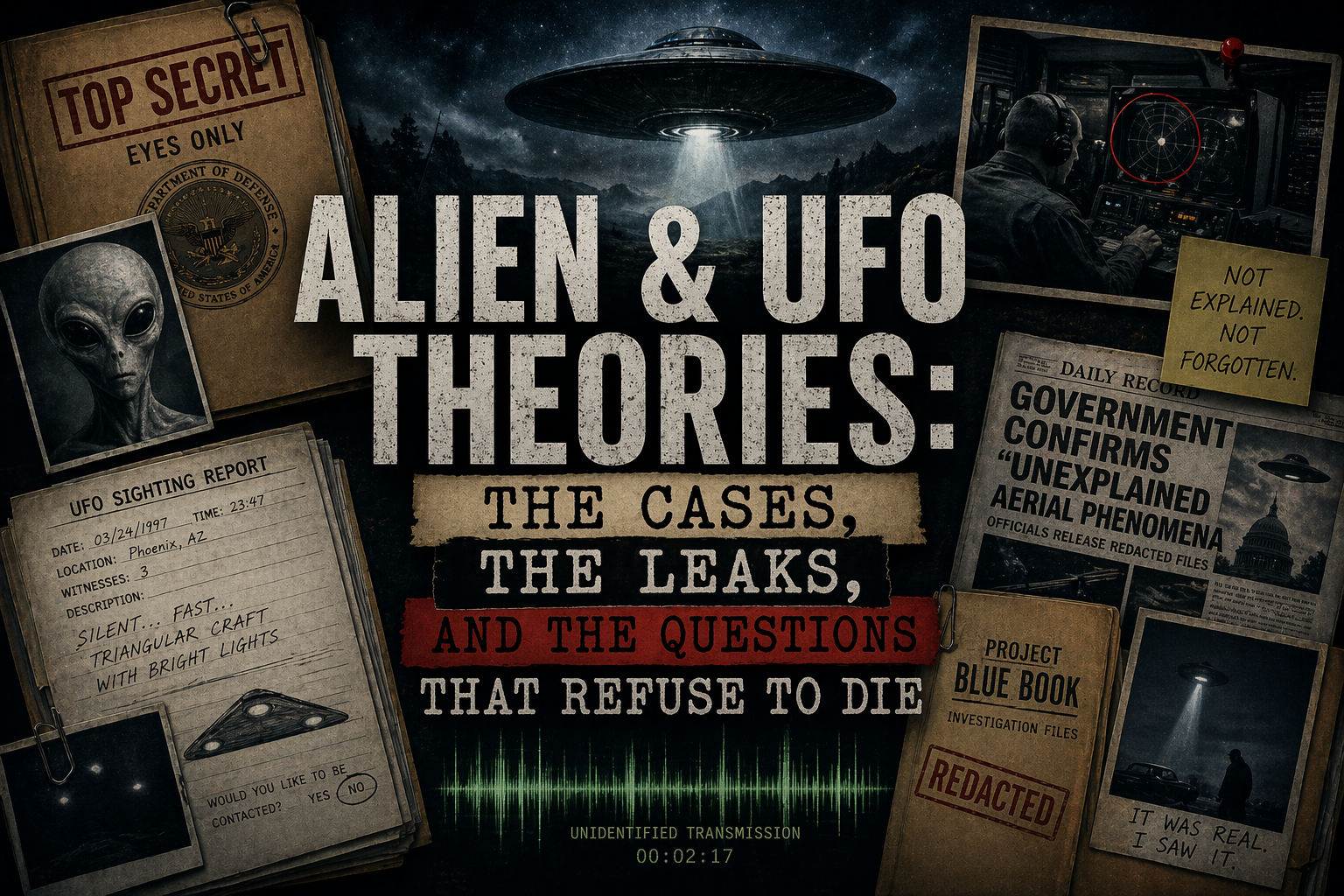
Decades of UFO claims have been debunked, distorted, or absorbed into pop culture, yet a smaller core of cases keeps slipping back into the conversation because they were never completely resolved. That is the strange endurance problem at the heart of alien and UFO theories. The topic survives not because every sighting is persuasive, and not because one dramatic reveal settled the question, but because certain incidents, leaks, witness accounts, and official acknowledgments continue to leave behind unfinished business. The mythology keeps changing, while the mystery underneath it stays stubbornly familiar.
That is why this category works best when read as a cluster rather than as isolated curiosities. A crash story like Roswell UFO Crash does something different from a witness-driven case like Alien Abduction Stories, and both operate differently from institutional timelines like Government UFO Programs or Alien Disclosure Timeline. But taken together, they reveal the same pattern: uncertainty mixed with secrecy has far more staying power than a clean answer ever would.
The strongest UFO narratives tend to survive because each one occupies a different layer of the debate. Some are built on famous incidents. Some are built on testimony. Some are built on military footage, public records, or the behavior of agencies that claimed the subject was exaggerated while continuing to study it anyway. That layered structure matters. It keeps the topic alive across generations, because when one branch weakens, another branch revives the larger story.
Where to Start
If you want the clearest route through this category, start with Roswell UFO Crash for the original cover-up template, then compare it with Pentagon UFO Videos to see how the modern version of the mystery moved from rumor into authenticated military footage. From there, step into Government UFO Programs and Alien Disclosure Timeline to follow the official arc from denial to partial acknowledgment. Then widen the human side of the category through Travis Walton UFO Incident, Alien Abduction Stories, and UFO Sightings. To understand how secrecy keeps expanding the mythology, add NASA Alien Contact Cover-Up and Area 51 Alien Rumors. Read in that order, the category stops looking like a pile of strange claims and starts looking like a recurring argument between evidence, ambiguity, and distrust.
The Cases That Built the UFO Framework
Roswell remains the foundational case because it gave the public a narrative shape that later UFO stories would keep repeating. A startling announcement appears, an authority reverses course, witnesses add new layers over time, and closure never fully arrives. That structure is more important than any one disputed piece of debris. Roswell UFO Crash matters because it taught generations of readers how a possible revelation could become a possible cover-up in a matter of hours. Once that template exists, every later contradiction sounds less like confusion and more like concealment.
The modern military era renewed that template rather than replacing it. The best example is Pentagon UFO Videos, where the footage itself was confirmed as real military material while the larger explanation stayed unresolved. That distinction is why the videos mattered so much. They did not prove extraterrestrial craft. They proved that trained personnel, advanced sensors, and official channels still produced cases that the public could not file away neatly. The mystery survived because the government authenticated the encounter without delivering a satisfying conclusion.
Those two cases sit far apart in time, but they perform similar cultural work. Roswell shows how a sudden reversal can fuel a cover-up narrative for decades. The Pentagon clips show how an official acknowledgment can still leave the central question untouched. One story began with a press release and a retraction; the other began with video and a confirmation. Both became durable because they enlarged the trust gap instead of closing it.
Why Official Interest Keeps Reviving the Subject
The public often assumes UFO belief survives because enthusiasts refuse to let it go. But the category remains alive for a more interesting reason: official institutions repeatedly return to it. Government UFO Programs is essential because it documents the way the subject kept resurfacing under different names, priorities, and bureaucratic frames. Project Blue Book, later defense attention, and more recent offices do not amount to proof of alien visitation. What they do show is that the state never treated all aerial anomalies as meaningless noise.
That repeated institutional attention explains why the disclosure debate never quite dies. Alien Disclosure Timeline captures the long movement from confident dismissal toward something more uneasy and partial. The shift was not a clean admission of hidden truth. It was more complicated than that. Over time, agencies and officials acknowledged enough uncertainty to keep the subject legitimate without ever delivering a final interpretation. This is one of the most powerful engines of UFO endurance: an institution can reject the mythology while still validating the idea that there are unresolved cases worth studying.
The result is a category built on contradiction. Officials often minimize the wildest claims, but their own actions suggest that the underlying phenomenon remains operationally interesting. Readers notice that contradiction immediately. When a government says the topic is overhyped but continues collecting reports, forming offices, or reviewing footage, people naturally assume there is another layer still out of reach. Whether that hidden layer contains classified technology, sensor problems, foreign systems, or something stranger is exactly what keeps the debate open.
The Human Stories That Keep the Mystery Emotional
Institutional ambiguity explains only part of UFO culture. The rest survives because some stories work at a deeply human level. Travis Walton UFO Incident endures because it is not just about a light in the sky. It is about a person disappearing from ordinary life, a group of witnesses facing suspicion, and a return that transformed a local event into a long-running legend. The strength of a case like Walton is not hard proof. It is the lingering force of testimony delivered in a form people remember.
Alien Abduction Stories expands that same emotional structure. The accounts are dramatic, intimate, and often psychologically unsettling. They persist because they blur the line between external event and internal experience. Skeptics see sleep paralysis, memory distortion, and cultural storytelling. Believers see consistency across witnesses who describe fear, missing time, examinations, or encounters that feel too specific to be random invention. The evidence remains weak in a hard scientific sense, but the narratives remain powerful in a human one.
That is also why broader pieces like UFO Sightings matter. Most UFO culture begins not with a file or a hearing, but with a person seeing something they cannot explain. A single sighting proves very little. A long archive of sightings does something else entirely: it creates atmosphere. Even when individual reports collapse under scrutiny, the accumulation keeps the category alive by making unexplained observation feel like a recurring part of modern life rather than a one-off curiosity.
The Leaks, the Bases, and the Expanding Secrecy Myth
Once official contradiction and witness testimony are already in place, secrecy claims multiply quickly. NASA Alien Contact Cover-Up shows how easily public fascination shifts from what was seen to what may have been withheld. A strange transmission, an interrupted feed, a suspicious camera move, or a vague comment can become the seed of a much larger story about selective disclosure. The power of the theory does not come from airtight evidence. It comes from the public sense that institutions controlling extraordinary information would also control how much of it reaches ordinary viewers.
Area 51 Alien Rumors performs the same function through geography rather than broadcast imagery. A real secretive base became the perfect container for alien speculation because secrecy is already built into the site itself. Once a location is known for classified programs, the imagination does not need much help. Experimental aircraft, hidden testing, and restricted access create an ideal stage for claims about recovered craft, reverse engineering, or buried evidence. It is not that the base proves alien contact. It is that the secrecy surrounding it makes almost any hidden possibility feel narratively plausible.
This is what the strongest UFO subtopics share: none of them settle the biggest question, yet each one preserves the conditions that stop the question from disappearing. A famous case leaves ambiguity. A witness story leaves emotion. A government program leaves contradiction. A leak or secret base leaves room for concealment. The pieces support each other without fully confirming each other, which is exactly why the category keeps regenerating instead of resolving.
What Actually Refuses to Die
The thing that refuses to die is not one perfect alien explanation. It is the recurring friction between incomplete evidence and public distrust. That friction is enough to sustain a living category. The archive does not tell us that every claim is credible. It tells us that a narrow band of cases and official behaviors continues to resist neat closure. Some incidents are overstated. Some are probably ordinary once the context is complete. Some are likely products of memory, expectation, or media amplification. But taken together, the record still supports a sober conclusion: the UFO topic survives because a small set of unresolved cases keeps reopening larger questions about secrecy, perception, and how modern institutions manage uncertainty.
That is why this subject remains bigger than old flying-saucer imagery. It is now a long documentary thread about what happens when governments, witnesses, technology, rumor, and belief all collide around events that never receive a universally trusted explanation. The strongest cases do not prove everything. They simply keep the door from closing. And as long as that door stays cracked open, the questions will keep returning.