
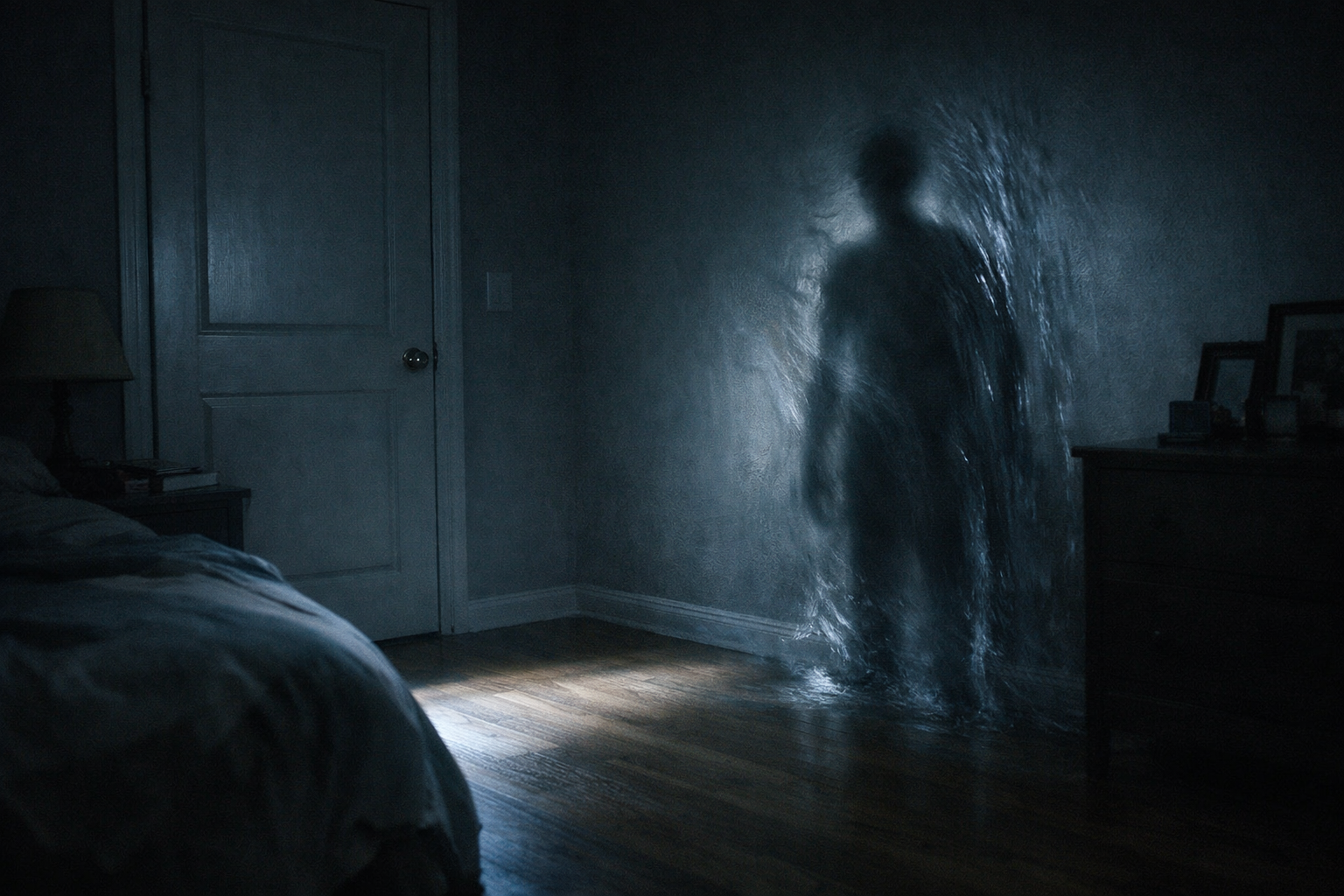
The file was never supposed to be public. It described strange lights, missing time, and witnesses who swore the beings in the room did not arrive in any machine at all—they seemed to step through the air as if a locked door had opened where no door existed. That unsettling image sits at the center of the interdimensional beings theory, a modern idea that tries to explain alien contact as something even stranger than visitors from space.
What Happened
The interdimensional beings theory did not begin with one single case. It grew out of decades of UFO sightings, abduction stories, occult writing, and modern paranormal reports. In many of these accounts, witnesses describe something that does not behave like a normal aircraft, a normal animal, or even a normal physical body.
Instead of landing like a machine from another planet, the presence appears suddenly. A figure is seen standing beside a bed. A glowing shape moves through a wall. A craft seems to blink into existence, hover silently, then disappear without any clear path of travel. For believers, that pattern matters. They argue it feels less like transportation and more like crossing over.
One reason this theory gained attention is that it tries to connect different mysteries that are usually kept apart. UFO encounters, sleep paralysis, visions of spirits, folklore about hidden realms, and modern stories about shadowy entities all seem unrelated at first. But some writers suggest they may be different versions of the same event, filtered through culture and expectation.
There is also a human moment buried in many of these reports. A witness is often not describing a grand sci-fi battle. More often, it is someone alone in a bedroom, frozen with fear, staring at a corner of the room where reality seems to ripple. That scene is one reason the idea stays alive. It feels intimate, terrifying, and hard to dismiss emotionally even when the evidence is weak.
Some UFO researchers argue that older beliefs about angels, demons, fairies, or spirits may have been earlier attempts to describe the same kind of encounter. In that view, the modern alien is not replacing the ancient visitor. It is simply the newest costume worn by an old mystery.
That is why this theory sometimes overlaps with stories about alien disclosure timelines and with reports that sound more personal than mechanical, like alien abduction experiences. The core question is always the same: if something is real here, what exactly is it?
Why People Believe It
People believe the interdimensional beings theory because it seems to solve problems that ordinary alien theories struggle with. If a being can move between dimensions, then sudden appearances, impossible movements, and vanishing objects become easier to explain. The theory gives a kind of structure to events that otherwise sound absurd.
It also fits a deeper emotional pattern. Many people feel that the world contains hidden layers—things just beyond normal sight. The interdimensional idea speaks directly to that feeling. It suggests that reality may be crowded with intelligence we cannot normally detect, and that some encounters happen when that hidden boundary briefly tears open.
Another reason it spreads is that it blends old belief with modern language. In earlier centuries, a person might say they saw a spirit or demon. Today, that same experience may be described in terms of dimensions, frequencies, or altered states. The language changes, but the sense of crossing into forbidden territory remains the same.
The internet has also helped this theory travel fast. A single strange clip, bedroom testimony, or late-night podcast interview can create the feeling that countless unrelated cases are all pointing toward one secret pattern. Once that pattern forms in someone’s mind, every new story can feel like confirmation.
And then there is the cultural influence of fiction. Movies, television, and paranormal media have trained people to think beyond the simple question of “Are aliens real?” They now ask whether reality itself may be layered. That makes the interdimensional theory feel modern, flexible, and strangely hard to pin down.
Claims vs Evidence
Claim: Some witnesses report beings that appear indoors, pass through walls, or vanish instantly, which suggests they are not physical visitors using spacecraft in the normal sense.
Evidence: These claims are almost entirely based on eyewitness testimony. Testimony can be emotionally powerful, but it is also vulnerable to fear, memory distortion, dreams, and misinterpretation—especially during night events or stressful experiences.
Claim: Similar descriptions appear across different cultures and time periods, which suggests people are encountering the same hidden phenomenon under different names.
Evidence: Cross-cultural similarity is interesting, but it is not proof of a real external being. Human beings share common fears, sleep experiences, religious symbols, and storytelling habits. Similar stories can emerge for many reasons besides literal contact.
Claim: Strange craft movements reported in UFO cases—instant stops, sharp turns, silent hovering, and sudden disappearance—make more sense if objects are phasing in and out of our dimension.
Evidence: Some UFO reports do involve unusual observations, but many cases lack high-quality data. Distance, light distortion, camera artifacts, and missing context can make ordinary objects look extraordinary. In the strongest military-related cases, there is still not enough public evidence to jump from “unidentified” to “interdimensional.”
Claim: Sleep paralysis encounters, entity sightings, and abduction stories are all part of the same hidden system.
Evidence: There is overlap in how people describe these experiences, but overlap is not the same as causation. Sleep paralysis alone can produce terrifying sensations: chest pressure, a sensed presence, vivid figures, and the feeling that something entered the room. That explanation does not cover every case, but it does cover many of the most dramatic ones.
Reality Check
This is where the theory becomes both fascinating and fragile. It is fascinating because it offers a bold answer to a real pattern in human experience: people across eras really do report encounters that feel impossible. Some of those moments are so vivid that the people who lived them are clearly not joking.
But the leap from “people report impossible-feeling encounters” to “interdimensional beings are visiting us” is huge. There is no verified physical evidence showing a being crossing dimensions. No publicly accepted instrument record proves that a wall was passed through, that a portal opened, or that a non-human intelligence stepped from another layer of reality into this one.
The theory also has a built-in problem. It can explain almost anything, which makes it hard to test. If a being appears, vanishes, leaves no trace, changes shape, affects memory, and avoids measurement, then the theory becomes difficult to disprove. That may sound powerful, but scientifically it is a weakness. A good explanation should risk being wrong.
There is a simpler possibility that often gets ignored because it feels less dramatic. Human perception is imperfect. Under stress, exhaustion, darkness, grief, or sleep disruption, the brain can produce experiences that feel completely real. Add folklore, religion, media imagery, and online communities, and those private moments can quickly become part of a much larger supernatural story.
That does not mean every witness is lying. It means sincerity is not the same as proof. A person can honestly report what they felt and still be mistaken about what caused it. That distinction matters in any serious investigation.
There is also a middle ground worth mentioning. Some unexplained experiences may remain unexplained for now without requiring a final answer. Not every mystery needs to be forced into “aliens from space” or “hallucination” or “beings from another dimension.” Sometimes the most honest conclusion is that the available evidence is not enough.
That same caution appears in other UFO-related debates, including arguments over government UFO programs. Secrecy can make ordinary uncertainty feel much bigger than it is. Once information is missing, speculation rushes in to fill the gap.
Conclusion
The interdimensional beings theory survives because it sits in a powerful place between fear and imagination. It borrows the language of science, the mood of horror, and the emotional force of firsthand testimony. It turns a strange sighting into something deeper: a hint that reality itself may not be sealed shut.
That is why the idea keeps returning. It does not merely ask whether we are alone. It asks whether we have misunderstood the structure of the world we already live in. And that is a much more unsettling question.
For now, the evidence does not justify a confident claim that interdimensional beings are real. What it does justify is careful attention—to witness psychology, to unexplained reports, and to the way human beings build meaning around the unknown. The mystery is real. The theory remains unproven.
🔎 If this story stayed with you, the author suggests these real cases next:
- Alien Disclosure Timeline: Are We Seeing Revelation or Repackaged Secrecy?
- Alien Abduction Stories: Why So Many Nighttime Encounters Feel Real
- Government UFO Programs: From Project Blue Book to AATIP to AARO
Explore more Alien & UFO Theories stories here: