
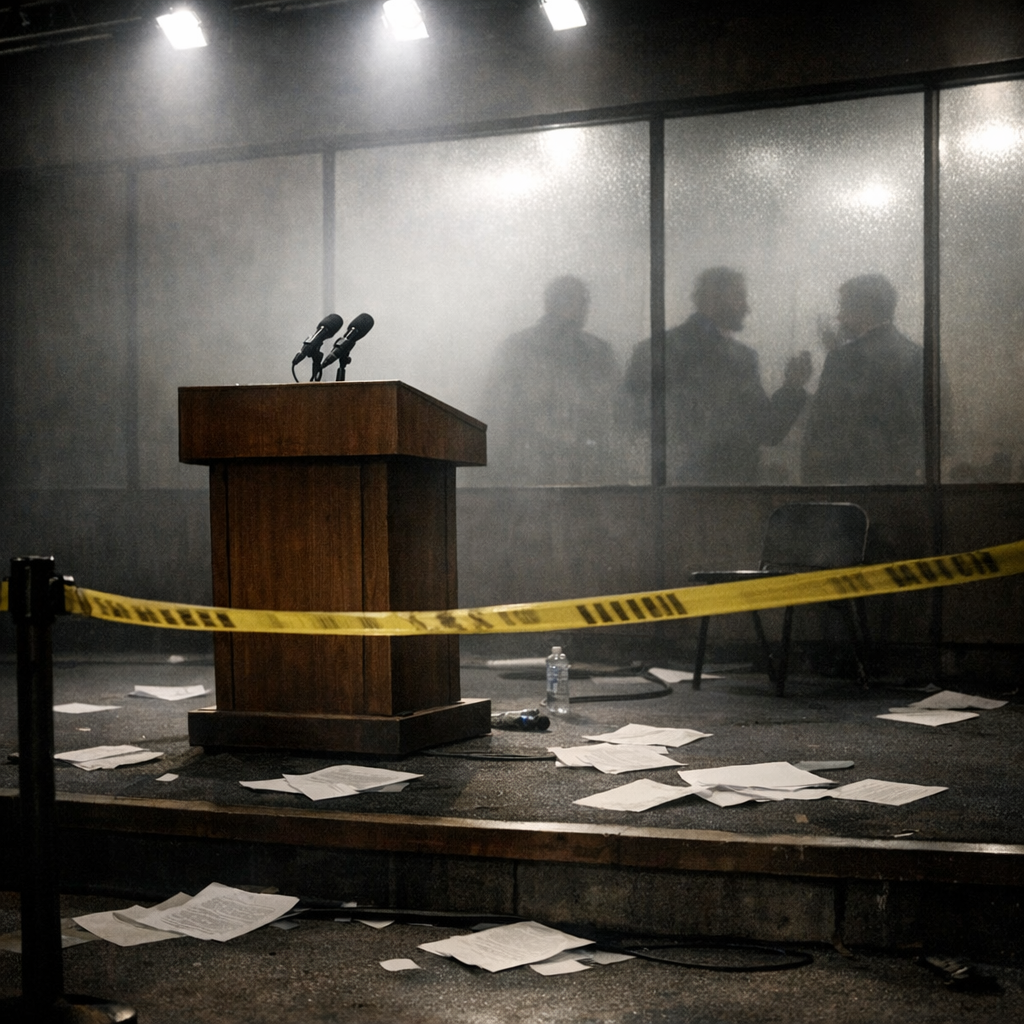
The first crack is never just the gunshot. It is the split second after, when a public scene turns strange: agents moving in different directions, papers vanishing behind locked doors, and a crowd staring at history as if someone just switched off the lights. In that instant, political assassinations stop feeling like isolated crimes and start feeling, to many people, like glimpses of a hidden system.
That is why assassination theories survive for decades. A leader falls in public, but the real battle begins in private, inside sealed files, conflicting witness memories, and the uncomfortable question of who gained from the chaos. The deeper the shock, the easier it is to believe the shot was only the surface of something much larger.
What Happened
History has seen a long list of political killings that quickly grew beyond the act itself. Presidents, reformers, dissidents, prime ministers, civil-rights figures, and anti-corruption voices have all been killed in moments that seemed to split public trust in two. The crime scene may last minutes, but the suspicion can last generations.
The pattern is familiar. A major public figure is attacked. Officials announce a suspect, a motive, and a timeline. But almost immediately, people begin spotting loose threads: security failures, incomplete records, or witness testimony that does not line up neatly. Once those details stack up, the assassination starts to look less like one violent act and more like a puzzle with missing corners.
John F. Kennedy is the most famous example, but he is far from the only one. The killings of Robert F. Kennedy, Martin Luther King Jr., Malcolm X, and many other political figures have all produced claims that the official story was too simple. Sometimes the suspicion points to intelligence agencies, political rivals, or protected interests. Sometimes it is broader: not one mastermind, but a system that makes truth harder to reach.
There is also a human scene that repeats itself after these events. A family sits in front of a television long after midnight. News anchors replay the same footage, and one unanswered detail keeps scratching at the mind. Why was security so weak? Why were records sealed? That is where historical tragedy turns into conspiracy thinking.
Political killings are especially vulnerable to that shift because politics already runs on secrecy. Governments classify documents, agencies protect sources, and parties manage public narratives.
Why People Believe It
People believe assassination conspiracies because random violence feels inadequate when the victim is powerful. When a president, movement leader, or major dissident is killed, the stakes seem too large for chaos alone. The mind starts looking for design.
Another reason is that power leaves shadows. Political systems are full of back channels, private influence, intelligence work, and institutional rivalries. Readers already know governments sometimes lie, hide failures, and release records late. That baseline of real secrecy gives conspiracy theories fertile ground.
Assassinations also create clear questions about motive. Who benefited? Who lost an enemy? Who gained calm, money, votes, leverage, or silence? Those are reasonable questions, but a meaningful benefit does not automatically prove involvement.
There is also the problem of incomplete records. In famous cases, documents are often withheld or released in stages. That vacuum invites interpretation. And in some cases, history gives people a reason to be cautious. Real covert influence campaigns and state deception have shown that governments are capable of more than they first admit, which is part of why stories like CIA Assassination Plots: What Was Declassified – and What Got Added Later? continue to resonate.
Finally, these theories offer emotional order. For many people, it feels easier to believe a hidden plan existed than to accept that history can be redirected by confusion and one violent moment.
Claims vs Evidence
Claim: Repeated political assassinations show a hidden system removing dangerous figures whenever they threaten powerful interests.
What we know: Political violence has often targeted important people, and some killings did benefit powerful groups. But there is no verified pattern proving one coordinated system sits behind major assassination cases across history. Similar outcomes do not automatically mean a shared command structure.
Claim: Security failures before major assassinations are too suspicious to be accidental.
What we know: Some famous cases do contain serious failures, ignored warnings, and procedural gaps. That is real. But bureaucratic weakness, bad communication, and poor preparation are common in large institutions. A terrible failure can look designed even when it came from fragmentation and incompetence.
Claim: Sealed or delayed records prove governments are hiding direct involvement.
What we know: Delayed records can mean many things: embarrassment, source protection, legal caution, intelligence methods, or simple administrative resistance. They absolutely damage trust. But secrecy alone is not proof of murder-for-hire or central planning. It proves opacity, not necessarily orchestration.
Claim: Multiple witnesses, conflicting testimony, and changing stories show the official version is false.
What we know: Confusion is common after traumatic public events. Contradictions may expose real problems, but they do not automatically confirm a larger plot.
Claim: If the victim threatened entrenched interests, then those interests almost certainly arranged the killing.
What we know: Motive matters, but motive is not enough. To move from suspicion to proof, there must be records, reliable testimony, financial trails, communications, or verifiable operational links.
The strongest version of the theory is not that every assassination was random, and it is not that every assassination was centrally controlled. It is that political killings happen in systems already shaped by secrecy and rivalry. That same gap between broad distrust and hard proof also appears in debates around Deep State Explained: Hidden Ruling Network or Just the Machinery of Government?.
Reality Check
The reality check is uncomfortable because it refuses both easy extremes. It is too simple to say every assassination conspiracy is paranoid fantasy. Real governments have concealed operations, lied to the public, and protected institutions ahead of transparency. That history matters. It explains why official accounts do not automatically settle public doubt.
But it is also too simple to say repeated suspicion proves repeated orchestration. High-profile political killings naturally generate the same questions because the same conditions are often present: public trauma, incomplete information, state secrecy, and enormous historical consequences. Similar reactions do not always point to a single hidden hand.
What makes these cases so durable is the mix of two truths. Institutions really do hide things, and people are uncomfortable with randomness at the center of history. Put those together, and even a messy crime can start to look like the edge of a master plan.
Some cases remain partly unresolved because records are incomplete or official conclusions were poorly communicated. In those cases, skepticism is fair.
The most grounded conclusion is that political assassination theories survive because they grow at the intersection of real secrecy and human pattern-seeking. They are strongest when officials hide too much and weakest when believers turn every gap into proof.
So this story lands in the partial category. Not because a hidden structure has been proven, and not because all suspicion is irrational, but because the public pattern is real even when the master explanation is not. Political killings often leave enough darkness behind to keep conspiracy alive, yet not enough verified evidence to confirm a single recurring design.
Conclusion
When a political figure falls in public, people do not just ask who fired the shot. They ask who stood to gain and what stayed hidden after the cameras turned away. That is why assassination theories do not fade easily. They are about trust as much as death.
Some of that distrust is earned. But the search for hidden order can also run ahead of the evidence, turning every inconsistency into a map of invisible control.
In the end, the pattern is real mostly because the conditions keep repeating: power, secrecy, trauma, and unanswered questions. Whether a specific assassination was the work of one attacker, a small conspiracy, or something larger can only be answered case by case. The broader theory becomes convincing when history feels too consequential for chaos — but that feeling, by itself, is never enough to close the case.
🔎 If this story stayed with you, the author suggests these real cases next:
- CIA Assassination Plots: What Was Declassified – and What Got Added Later?
- False Flag Operations: How Real Deception Fuels Bigger Political Theories
- Shadow Governments: Who Really Pulls the Strings Behind Power?
Explore more Political Conspiracies stories here: