
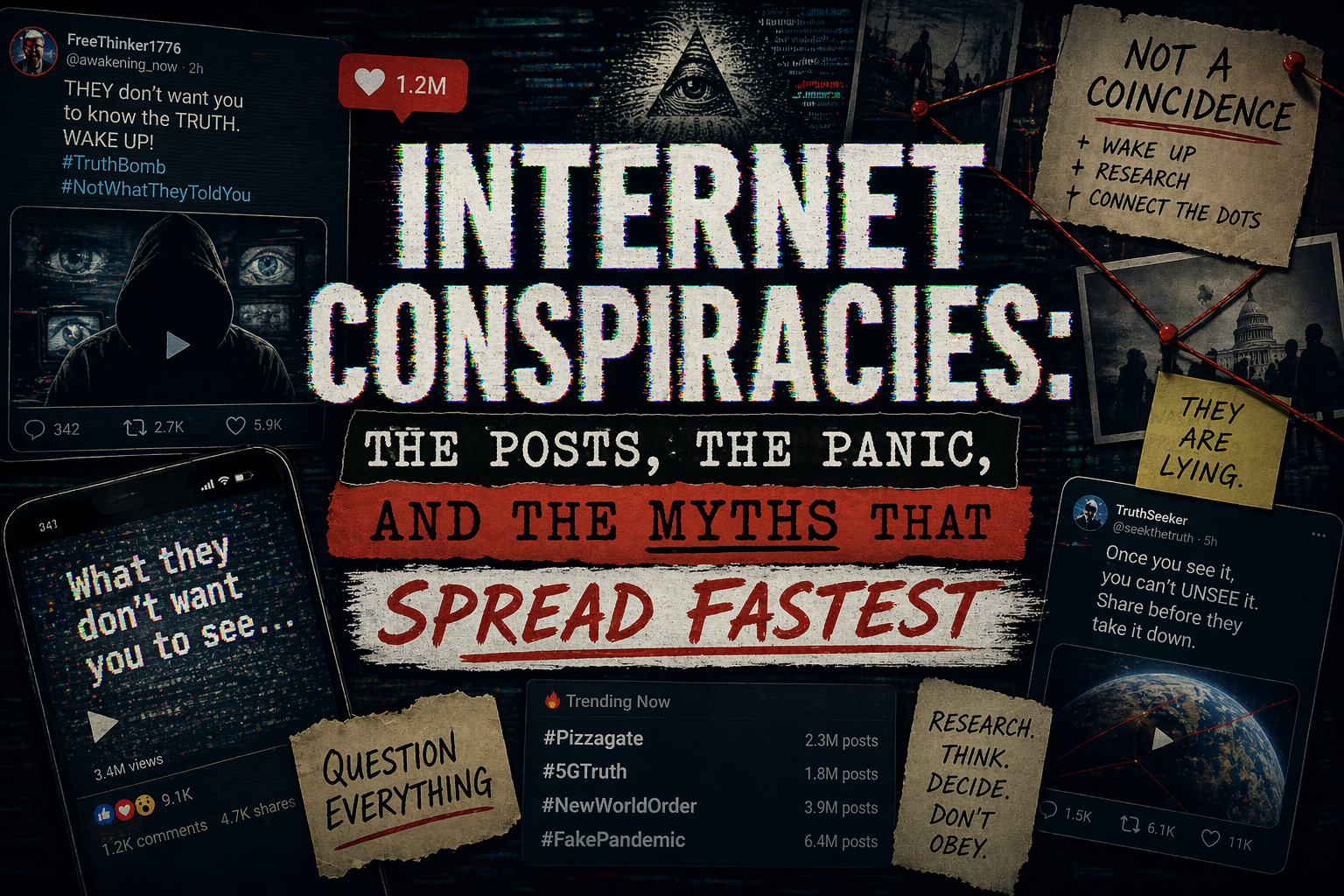
Some of the biggest conspiracy theories on the internet do not begin in secret rooms. They begin in posts, threads, screenshots, and clips that feel like forbidden truth before anyone has verified where they came from. That shift matters. Older conspiracy culture often centered on hidden files, classified programs, or whispered insider claims that traveled slowly. Online conspiracy culture moves faster. It spreads through repetition, aesthetics, algorithmic reward, and communities built around the feeling that noticing patterns is a sign of intelligence. In that environment, a claim can look credible long before it becomes coherent.
This is why Internet Conspiracies deserves its own PowerPost. The web is not just where these theories are discussed. It is the machine that helps build them. Anonymous drops, viral montage videos, forum speculation, meme language, and recommendation systems all turn scattered suspicion into something that feels collective and urgent. A person does not need hard proof to feel pulled in. They only need to encounter the same idea often enough, from enough angles, in enough emotionally charged formats, that doubt starts feeling naive.
The strongest way to read this category is not as a stack of disconnected oddities, but as a study in how belief forms online. QAnon Theory Breakdown: How an Internet Conspiracy Became a Real-World Movement shows how cryptic posting can become a mass movement. Q Clearance Theory: Insider Signal or Internet Roleplay That Escaped Containment? shows how insider-style branding gives internet roleplay the texture of authority. Project Blue Beam: Could a Fake Alien Invasion Ever Be Staged? captures the viral appeal of a theory built to absorb spectacle, fear, and media distrust. Deepfake Conspiracies: Can Fake Video Make Almost Anything Look Real? pushes the category into a newer era where manipulated media threatens the idea of proof itself. And The Mandela Effect: Why So Many People Remember the Same Wrong Detail shows how shared false memory can feel like evidence that reality has been edited. Taken together, these posts reveal something larger than any one claim: online conspiracy theories spread because the internet rewards repetition, performance, and belonging as much as evidence.
Where to Start
If you want the clearest route through this category, start with QAnon Theory Breakdown: How an Internet Conspiracy Became a Real-World Movement, because it shows how anonymous posting turned into a fully networked belief system with real-world consequences. Then read Q Clearance Theory: Insider Signal or Internet Roleplay That Escaped Containment? to see how the language of insider access helps a weak claim survive online. After that, move to Project Blue Beam: Could a Fake Alien Invasion Ever Be Staged? for a classic viral internet theory that thrives on media distrust and apocalypse-flavored spectacle. Follow it with Deepfake Conspiracies: Can Fake Video Make Almost Anything Look Real? to understand how synthetic media makes modern misinformation even harder to untangle. Finish with The Mandela Effect: Why So Many People Remember the Same Wrong Detail, which shows how repetition and social reinforcement can make a false memory feel almost empirical. Read in that order, the pattern becomes hard to miss: internet conspiracies are not only about hidden truth. They are about how online systems teach people what feels true.
How the Internet Turned Fringe Claims Into Durable Belief
Before social platforms shaped everyday attention, conspiracy theories still spread, but they usually required more friction. People found books, documentaries, talk radio, photocopied pamphlets, late-night forums, or small subcultures that operated at the edge of the mainstream. The web changed that by lowering the cost of circulation almost to zero. A dramatic claim could be clipped, reposted, memed, narrated, subtitled, and summarized endlessly by people who were never close to the original source. By the time a claim reached a new reader, what mattered was not origin but momentum.
Momentum is everything online. A theory starts to feel bigger when you encounter it in multiple formats: a thread that sounds investigative, a video that sounds urgent, a meme that turns skepticism into cowardice, and a comments section full of people acting as though the important part has already been settled. This does not create proof, but it does create atmosphere. That atmosphere is one of the central engines of internet conspiracy belief. People are not only evaluating a claim. They are entering a room where the claim already feels socially alive.
That is why online conspiracies often survive factual correction. The theory is not just information. It is a participatory experience. Once someone has invested attention, identity, and community status into “seeing what others miss,” a debunk does not land as neutral clarification. It lands as pressure from the outside. The believer feels less like a mistaken reader and more like a person being asked to abandon a community language they now associate with insight and vigilance.
QAnon and the Performance of Insider Knowledge
QAnon Theory Breakdown: How an Internet Conspiracy Became a Real-World Movement remains one of the clearest examples of how the internet transforms ambiguity into a self-sustaining mythology. The original posts were vague, theatrical, and easy to reinterpret. That flexibility was not a flaw. It was the feature that allowed followers to keep reassembling the story every time a prediction failed. The cryptic style made ordinary users feel like decoders rather than passive readers, and that emotional shift changed the relationship between evidence and belief.
QAnon worked because online communities are especially good at turning participation into conviction. Every drop invited interpretation. Every interpretation invited amplification. Every amplification invited more people to join the hunt. The theory became sticky not because it was well supported, but because it felt collaborative. Solving it became part of the appeal. In that kind of environment, the distinction between reporting, fan labor, and ideological commitment begins to collapse.
Q Clearance Theory: Insider Signal or Internet Roleplay That Escaped Containment? extends the same lesson. The word “clearance” sounds procedural, official, and hidden in a bureaucratic way that flatters the reader’s desire to be close to secret power. Online conspiracy culture constantly borrows that tone. It packages speculation as if it arrived from someone near the center of the machine. The result is a theory that looks less like random internet invention and more like leaked access, even when the underlying evidence is thin.
Project Blue Beam and the Viral Life of Spectacle
Project Blue Beam: Could a Fake Alien Invasion Ever Be Staged? survives for a different reason. It is built for internet circulation because it is visually dramatic and endlessly remixable. A fake alien invasion, holographic deception, media manipulation, and global psychological control all fit perfectly into online culture, where spectacle travels faster than nuance. The theory does not need firm documentation to stay alive. It only needs each new public moment of confusion to look like it could belong inside the script.
This is the pattern the category keeps exposing: internet conspiracies thrive when they can absorb unrelated events into a flexible master frame. A light in the sky, a military headline, a suspicious clip, a government statement, or a glitchy video can all be folded into the same theory because the internet teaches users to connect fragments at speed. That habit is not always irrational. Pattern recognition is a basic human tool. But online environments reward over-connection, and conspiratorial thinking often lives in that overflow.
Project Blue Beam also demonstrates how old distrust becomes new viral fuel. People who already distrust governments, media companies, or major institutions do not need to see airtight proof to feel attracted to a theory about staged spectacle. They only need the theory to resonate with prior assumptions. The web then does the rest by surrounding the theory with clips, explanations, and communities that make the leap feel normal.
Deepfakes, the Collapse of Visual Confidence, and the New Misinformation Problem
Deepfake Conspiracies: Can Fake Video Make Almost Anything Look Real? pushes the category into a newer and more unsettling phase. Earlier internet conspiracies often depended on low-quality evidence that believers upgraded through repetition. Deepfakes create a world where even high-quality seeming evidence can be suspect. That changes the psychology of conspiracy culture because it weakens one of the most basic modern intuitions: that video should count for something.
Once people absorb the idea that convincing media can be fabricated, two things happen at once. First, fake material can be weaponized to support false claims. Second, real material can be dismissed as fake whenever it becomes inconvenient. That double effect is perfect for online conspiracy ecosystems. It increases confusion, lowers confidence, and makes certainty available mainly through group allegiance rather than careful verification. In other words, it creates the exact kind of epistemic fog where conspiracy narratives flourish.
The internet does not merely distribute that fog. It monetizes it. Controversial clips, shocking claims, and fast emotional reactions all outperform slower forms of explanation. That is why deepfake anxiety belongs in the same category as QAnon and Blue Beam even though it looks more technologically modern. The underlying story is still the same: online systems amplify uncertainty faster than they resolve it.
The Mandela Effect and Community Reinforcement
The Mandela Effect: Why So Many People Remember the Same Wrong Detail may seem lighter than the rest of the category, but it reveals one of the deepest mechanisms behind internet conspiracy belief. When large groups of people confidently remember the same wrong detail, the experience feels uncanny. Online discussion intensifies that feeling because it replaces private uncertainty with public confirmation. Suddenly a person is not merely mistaken. They are part of a crowd that feels weirdly synchronized.
That synchronized feeling is powerful because it turns memory error into social evidence. If thousands of people insist they remember the same thing, it becomes emotionally tempting to conclude that reality changed, records were altered, or someone manipulated the archive. The actual cognitive explanation may be more mundane, but the online experience is what gives the strange interpretation its force. Internet conspiracy culture repeatedly converts collective confusion into the feeling of hidden design.
That is the larger lesson of this category. Online repetition does not just spread ideas. It changes how people interpret uncertainty. Instead of seeing confusion as a normal feature of memory, media, and attention, communities begin reading it as proof that something concealed is pressing through the surface.
What the Evidence Really Supports
Read honestly, these posts do not prove that the internet is exposing a secret master truth. They show something both narrower and more important. Online conspiracy theories spread well because digital platforms reward speed, ambiguity, emotional certainty, and insider-style identity. They flatten the distance between speculation and investigation. They make performance look like expertise. And they give believers a sense that joining the theory is itself an act of independent thinking.
The most grounded conclusion is that the web has become one of the strongest engines of modern conspiracy belief precisely because it is built to circulate emotionally potent material faster than it can be checked. QAnon, Q Clearance, Project Blue Beam, deepfake anxiety, and the Mandela Effect are not identical theories. But they all reveal the same structural truth: in online environments, repetition can feel like evidence, participation can feel like expertise, and community reinforcement can make weak claims emotionally hard to abandon.
That is why Internet Conspiracies now works as a real hub category. The web is no longer just the place where conspiracy theories live after they are invented elsewhere. For many modern belief systems, it is the incubator, amplifier, and stage all at once.