
Also covered in: UFO Disclosure: Hearings, Whistleblowers, and the Proof Gap
What Happened
The modern crash-retrieval story did not begin with one witness or one hearing. It grew out of decades of UFO lore, military secrecy, and a simple but powerful idea: if unusual objects have been seen for years, maybe some of them came down somewhere, and maybe someone got there first.
Roswell is still the best-known starting point. In 1947, a military statement about a “flying disc” recovery briefly reached the public before officials changed the explanation. That reversal gave conspiracy culture one of its most durable templates. If a story can shift that fast, people naturally ask what else was moved out of sight before anyone could look closely.
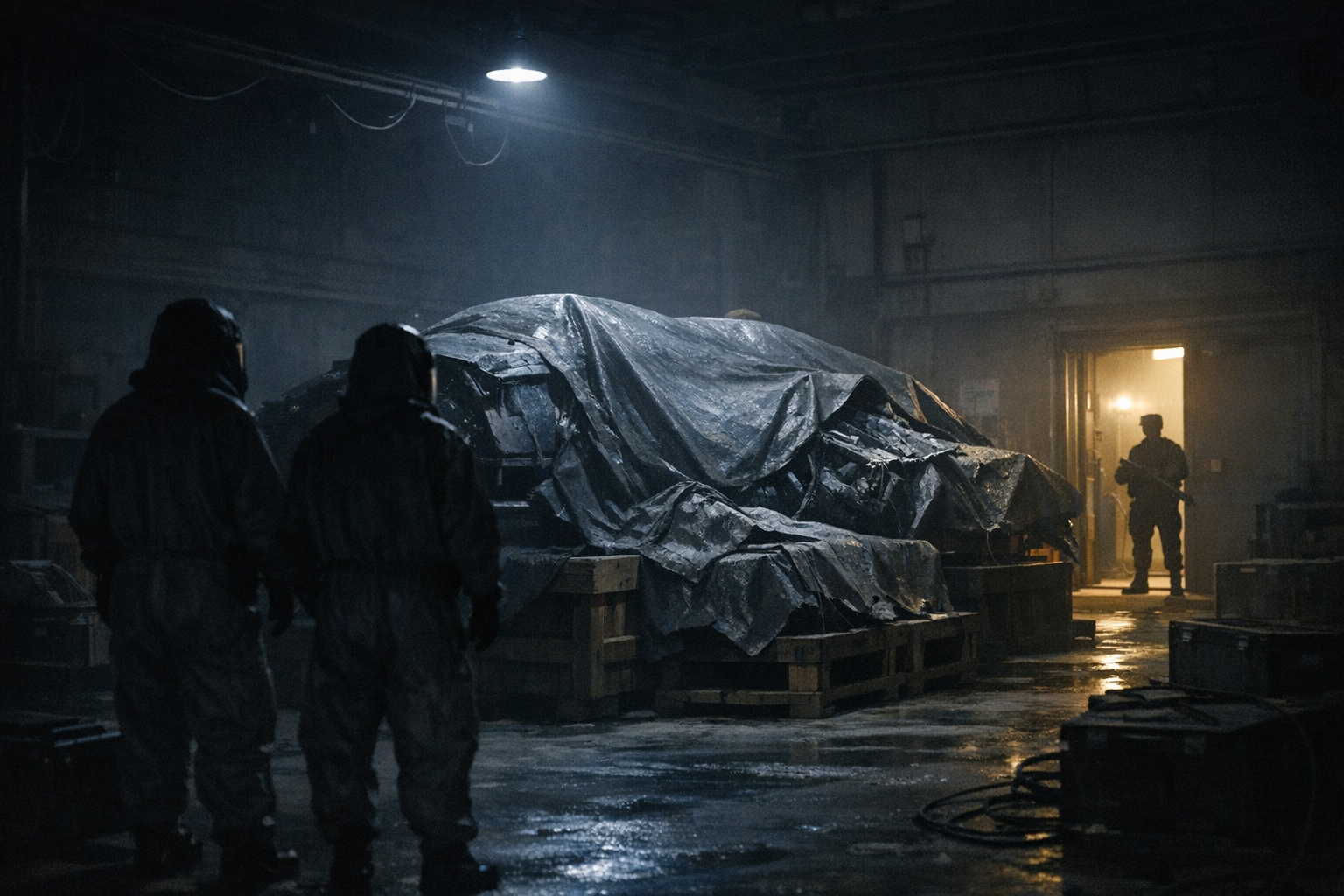
Over time, the claim expanded. It was no longer just about one crash in New Mexico. Supporters began arguing that the United States, and possibly other governments, had recovered multiple unusual craft over many years. In the newer version of the theory, these recoveries were allegedly buried inside highly restricted programs, often hidden within defense contracting systems where classification and compartmentalization already exist.
The idea surged again in the whistleblower era. In July 2023, a House oversight hearing on unidentified anomalous phenomena featured testimony from David Grusch, along with Ryan Graves and retired Navy commander David Fravor. Grusch did not present a recovered craft to the public. What he did offer was a far more explosive allegation: that he had been told, during his official work, that secret programs existed involving retrieved non-human craft and, in some accounts, non-human biological material.
That hearing changed the feel of the story. For many people, the claim no longer sounded like late-night radio. It sounded institutional. The setting mattered: microphones, sworn testimony, government titles, and lawmakers treating the subject as serious enough to investigate.
There was also a human moment buried inside the spectacle. If you imagine someone in that hearing room who already distrusted official secrecy, the emotional arc is obvious. They do not hear, “Here is proof.” They hear, “Someone inside the machine says the hidden door is real.” For believers, that can be enough to make the entire room feel different.
After that, the topic kept bleeding into policy arguments. Supporters pointed to proposed UAP disclosure legislation in Congress, especially language referring to recovered technologies and biological evidence, as a sign that lawmakers were taking retrieval allegations seriously. Skeptics pushed back with a simpler point: serious language in legislation can reflect suspicion, concern, or preparation for disclosure battles, but it is not the same thing as publicly verified proof.
That is where the modern crash-retrieval theory now lives: somewhere between testimony, secrecy, policy pressure, and a public that has learned the government really does keep some extraordinary things hidden for very long stretches of time.
Why People Believe It
People believe crash-retrieval claims because the theory fits a pattern they already recognize. Governments have hidden weapons programs, intelligence operations, surveillance systems, and Cold War projects before. Once that historical fact is accepted, the leap to “they could hide something even bigger” no longer feels absurd.
The UFO field also contains just enough unresolved material to keep the theory alive. Military footage exists. Pilot testimony exists. Official offices exist to study unusual reports. That does not prove retrieval programs. But it does create an atmosphere where the question feels harder to dismiss than it did twenty years ago.
Another reason is how the claim is structured. Crash retrieval is almost perfectly designed to survive scrutiny because the strongest alleged evidence is always inaccessible. If material is classified, buried in a special access program, or held by contractors under strict secrecy, then the absence of public proof can be reinterpreted as part of the cover-up rather than a weakness in the story.
The theory also benefits from overlap with existing UFO narratives. A reader who has already followed Government UFO Programs: Why the Files Never Really Closed can easily see how official interest in strange incidents might lead people to wonder whether the most important evidence never reached public reports at all. From there, the next question almost asks itself: if something was tracked, filmed, or studied, was anything ever physically recovered?
And then there is the emotional force of insider testimony. Many people are not reading classified files themselves. They are judging credibility. A former official speaking carefully, under oath, carries more weight than a random internet post. Even if that testimony is secondhand, it feels closer to the center of power than most conspiracy material ever gets.
Claims vs Evidence
Claim: secret U.S. programs have recovered non-human craft from crashes or forced landings.
Evidence: public evidence remains indirect. Supporters point to insider accounts, long-running rumors, fragments of leaked reporting, and the history of official secrecy around UAP investigations. But no piece of recovered hardware has been publicly authenticated as extraterrestrial by verifiable open evidence.
Claim: defense contractors may be holding recovered materials outside normal public oversight.
Evidence: this idea is plausible in the narrow sense that contractors do handle classified aerospace work. But “plausible” is not the same as “proven.” Publicly available records show a world full of black-budget secrecy, not a confirmed chain of custody for alien wreckage.
Claim: reverse-engineering efforts prove recovered craft exist.
Evidence: this is where the retrieval story often merges with existing rumors about hidden technology programs. But as explored in Alien Technology Reverse Engineering: Secret Breakthroughs or Stories Built on Fragments?, the argument usually depends on inference rather than publicly testable proof. Extraordinary technological secrecy can exist without requiring an extraterrestrial source.
Claim: recent government attention confirms the retrieval story is true.
Evidence: government attention confirms that unusual aerial reports are treated as a real national-security and aviation issue. It does not automatically confirm crashed alien craft. Those are two very different claims, and they are often blurred together in public discussion.
One of the strongest skeptical counterpoints came from the Pentagon’s All-domain Anomaly Resolution Office, or AARO. Its historical review said it found no verifiable evidence that the U.S. government or private companies possessed extraterrestrial material or had run confirmed reverse-engineering programs based on it. Believers often answer that AARO may not have reached the deepest compartments, but that reply still leaves the public in the same place: hearing competing institutional claims without an open body of proof to examine.
Reality Check
The most important thing to separate here is possibility from demonstration. Could a government hide an extraordinary recovery program? In principle, yes. States have hidden major programs before, and national-security systems are built to compartmentalize sensitive information.
But the crash-retrieval theory asks for something much bigger than ordinary secrecy. It asks us to believe that physical proof of non-human technology may have existed for decades without producing a piece of evidence the public can independently test. That is not impossible. It is just a much higher bar than many conversations about the topic admit.
There is also a pattern problem. The theory often gains power from stacking suggestive elements: whistleblower testimony, older crash legends, classified budgets, strange military encounters, and legislative language. Each piece may be interesting on its own. But stacking interesting pieces does not automatically create a confirmed whole.
At the same time, a full dismissal would be too easy. The public has real reasons to distrust neat official endings, especially in a field shaped by changing statements, withheld records, and years of ridicule followed by sudden seriousness. That distrust is not irrational. It is the background condition that makes the crash-retrieval story feel durable.
So where does that leave us? In a narrow middle ground. There is enough smoke to keep the subject alive, enough secrecy to prevent clean closure, and not enough public evidence to say the central claim has been proved. That combination is exactly why the theory keeps regenerating.
Conclusion
UFO crash retrieval claims survive because they sit at the most powerful point in the entire UFO debate. They promise the one thing that would change everything: physical confirmation hidden behind security barriers. It is a story with all the right ingredients-authority, secrecy, fear, fragments, and just enough official attention to keep people leaning forward.
But the cleanest conclusion is still the hardest one for both believers and debunkers to live with. There is no confirmed public evidence proving that recovered non-human craft are sitting inside secret programs. There is also a long record of secrecy around the wider UAP issue that prevents easy trust. For now, the retrieval story remains what it has been for decades: one of the most compelling claims in the UFO world, and one of the least publicly settled.
🔎 If this story stayed with you, the author suggests these real cases next:
- Roswell UFO Crash: What the Original Witnesses Claimed and What the Records Actually Show
- Alien Disclosure Timeline: Are We Seeing Revelation or Repackaged Secrecy?
- Pentagon UFO Videos: What the Navy Footage Confirmed – and What It Didn’t
Explore more Alien & UFO Theories stories here: