
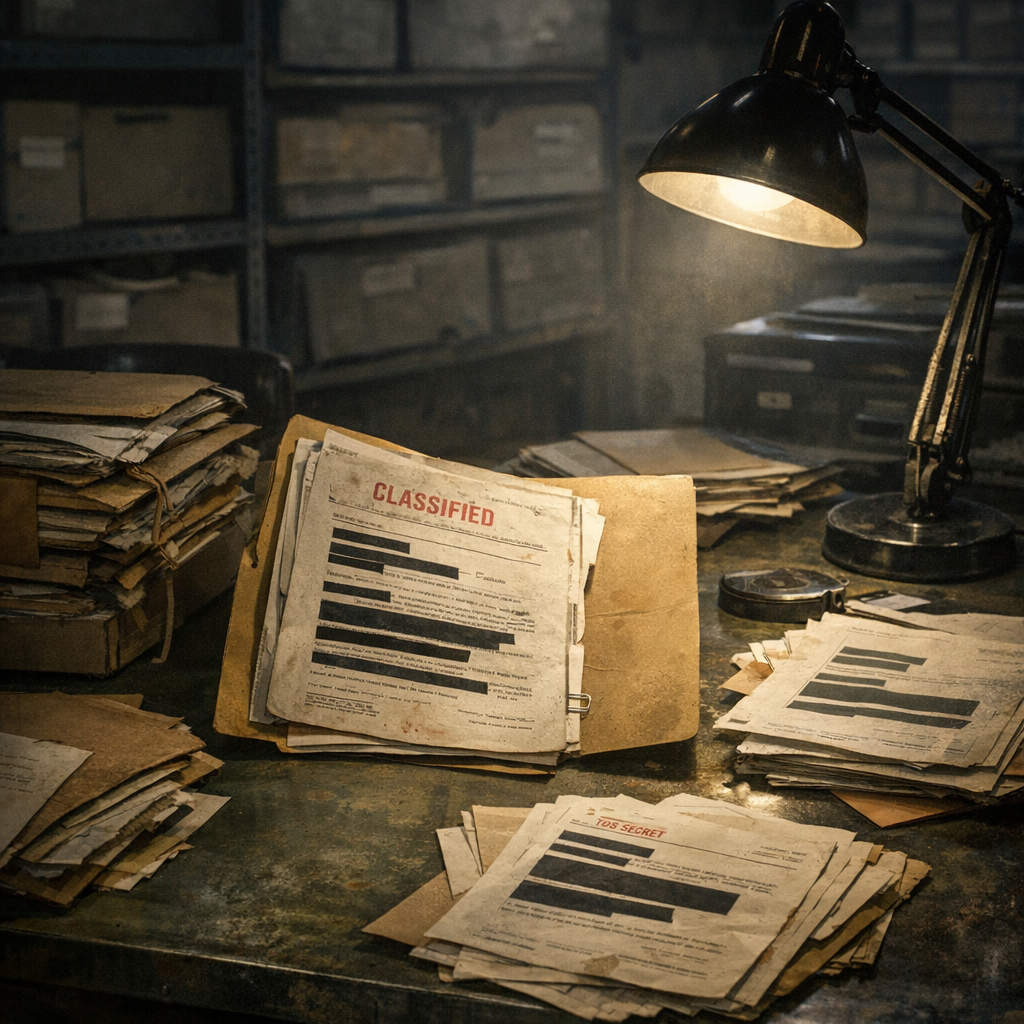
The paper is old, the ink is fading, and whole lines are still blacked out. By the time a sealed file finally reaches the public, the people in it may be dead, the damage may be done, and the silence itself may have become part of the story.
Declassification delays are the long gaps between when governments create secret records and when those records are finally released. Supporters of conspiracy theories often point to those delays as proof that officials are hiding something huge. The reality is more complicated: some secrecy is routine and legal, but long delays also create the perfect vacuum for suspicion, guesswork, and myths to grow.
What Happened
The basic idea is simple. Governments classify documents when officials believe release could harm national security, intelligence sources, military plans, or diplomatic relationships. In theory, those secrets do not stay locked away forever. Records can be reviewed, partially released, or fully declassified years later.
But in practice, the process often moves painfully slowly. Files are delayed, heavily redacted, reviewed again, and sometimes re-released in pieces. A citizen, journalist, or historian may wait years for records that arrive looking like a puzzle with half the pieces missing.
That gap between event and disclosure has shaped some of the most stubborn public suspicions in modern history. The JFK assassination is one of the clearest examples. Each new document release has drawn intense attention not because every file changes the case, but because the long wait taught people to expect hidden answers. On Crack the Conspiracy’s own JFK assassination explainer, that pattern sits right at the center: delay itself becomes evidence in many readers’ minds.
The same thing happened with intelligence scandals. When the public later learned more about real abuses through hearings, leaks, and declassified files, old trust did not quietly return. It broke further. The Church Committee hearings exposed serious misconduct by intelligence agencies, and that mattered far beyond the 1970s. It showed that some suspicions were not fantasies. Some were late-arriving facts.
Picture a reporter sitting at a long table in an archive reading room. The box is finally there. The label promises answers. But page after page comes out covered in black bars, missing names, missing dates, missing context. That is the human moment at the heart of this issue. Even before any theory begins, frustration is already in the room.
From there, the pattern repeats across many subjects: assassination records, covert operations, surveillance programs, foreign policy files, and military incidents. A delay may begin as bureaucracy or caution. Years later, it feels like proof of intent.
Why People Believe It
People do not start with the paperwork. They start with a feeling: if there is nothing explosive in the file, why hide it for so long? That question is emotionally powerful because it sounds reasonable. And sometimes it is reasonable.
Public distrust grows fastest when delayed records connect to events that already feel morally loaded. A political killing, a secret war plan, or domestic surveillance program does not feel neutral. It already carries stakes. So every delay looks less like administration and more like protection.
Real history also keeps feeding that instinct. Documents related to covert action, surveillance, and official deception have, at times, revealed conduct that governments did not want the public to understand in real time. That is why a post like WikiLeaks Revelations hits such a nerve. Once people see proof that powerful institutions sometimes hide embarrassing or harmful truths, they stop treating secrecy as a neutral act.
There is also a psychological effect. Mystery rarely stays empty. People fill it. A long silence invites the imagination to do work that facts have not yet done. If one missing file could explain everything, then every missing file begins to look like the key.
Another reason belief spreads is that delay feels uneven. Official statements often arrive quickly. Full records do not. So the public hears the confident version first and the complicated version much later. When later documents reveal mistakes, contradictions, or omissions, even small ones, the original trust can collapse fast.
This is where declassification delays become more than a records issue. They become a story about power. On the site’s Government Transparency Myth article, that tension is obvious: people are not just asking whether a document exists. They are asking whether openness is real or mostly a performance.
Claims vs Evidence
Claim: If files stay secret for decades, they must contain proof of a massive cover-up.
Evidence: Not necessarily. There are many reasons records stay classified: source protection, foreign intelligence partnerships, legal caution, bureaucratic backlog, and simple institutional habit. Long delays can signal sensitivity without proving a giant hidden plot.
Claim: Heavy redactions prove the government is still hiding the core truth.
Evidence: Sometimes redactions protect names, methods, or unrelated operations rather than the headline event people care about. But redactions also damage credibility because the public cannot easily tell which blacked-out lines are routine and which are meaningful. That uncertainty does real cultural work.
Claim: Late releases always reveal something explosive.
Evidence: Sometimes they reveal major facts. Sometimes they mostly confirm what was already known, while adding useful detail around the edges. The problem is that the wait itself raises expectations so high that any release gets interpreted through suspicion first.
Claim: Because some conspiracies were real, the biggest suspected ones are probably real too.
Evidence: This is where logic matters most. Confirmed abuses do justify caution, but they do not automatically validate every later theory. The existence of real covert behavior tells us governments can deceive. It does not tell us that every unsolved event hides the darkest possible answer.
A good comparison is the site’s piece on CIA assassination plots. That case has documented material. There is real evidence. But even there, public conversation often stretches beyond what the records actually prove. Declassification can illuminate the truth while also inspiring theories that run far past the file.
The strongest evidence in this whole subject is not that every delayed document hides a bombshell. It is that delay changes how people interpret institutions. Once secrecy lasts long enough, public trust is no longer the default setting. Suspicion is.
Reality Check
The most honest answer is that declassification delays are both ordinary and dangerous. They are ordinary because states really do manage sensitive information over long periods. Intelligence agencies, militaries, and diplomats are built to protect information. That part is not surprising.
They are dangerous because delay changes meaning. A secret held for six months feels tactical. A secret held for fifty years feels moral. Even if the original reason was narrow, the long silence creates its own message. It tells the public that information about power is released on power’s timetable, not theirs.
That is exactly why delayed disclosure fuels conspiracy culture so well. It does not need to prove the theory. It only needs to prove that the institution is not fully open. Once that point lands, people begin connecting dots far beyond the evidence.
There is also a contradiction worth slowing down on. Governments sometimes argue that secrecy prevents public misunderstanding. But excessive secrecy often produces the misunderstanding they fear. A blank space is rarely read as neutral. It gets read as ominous.
We have seen this pattern repeatedly in the modern information age. A partial release sparks online threads. The threads highlight one unexplained phrase or one withheld name. Video creators and posters turn that fragment into a larger narrative. Soon the delay matters more than the document itself.
Still, skepticism has to stay disciplined. There is no confirmed evidence that every long-delayed file contains proof of a hidden conspiracy. What we do know is more subtle and, in some ways, more important: slow disclosure trains the public to assume the official story may be incomplete. In cases where real abuses later emerge, that instinct hardens.
So the truth is not that declassification delays prove every theory. The truth is that they help build the emotional and logical environment where those theories thrive. They are less like a smoking gun and more like dry brush waiting for a spark.
Conclusion
Declassification delays matter because they sit at the intersection of secrecy, memory, and trust. People are not wrong to notice that long-hidden records can deepen suspicion. History gives them reasons to notice.
But suspicion is not the same thing as proof. Some files are delayed for reasons that are mundane, defensive, or bureaucratic rather than sinister. Others do expose real misconduct. The job is to separate those cases carefully instead of treating every blacked-out page as a confession.
That is the real lesson. Delayed disclosure does not automatically confirm conspiracy theories, but it absolutely helps them survive. When power keeps records closed for too long, the silence starts writing its own story.
🔎 If this story stayed with you, the author suggests these real cases next:
- Government Transparency Myth: How Open Is Power When So Much Stays Hidden?
- CIA Assassination Plots: What Was Declassified — and What Got Added Later?
- WikiLeaks Revelations: Transparency Breakthrough or Conspiracy Fuel Machine?
Explore more Political Conspiracies stories here: