
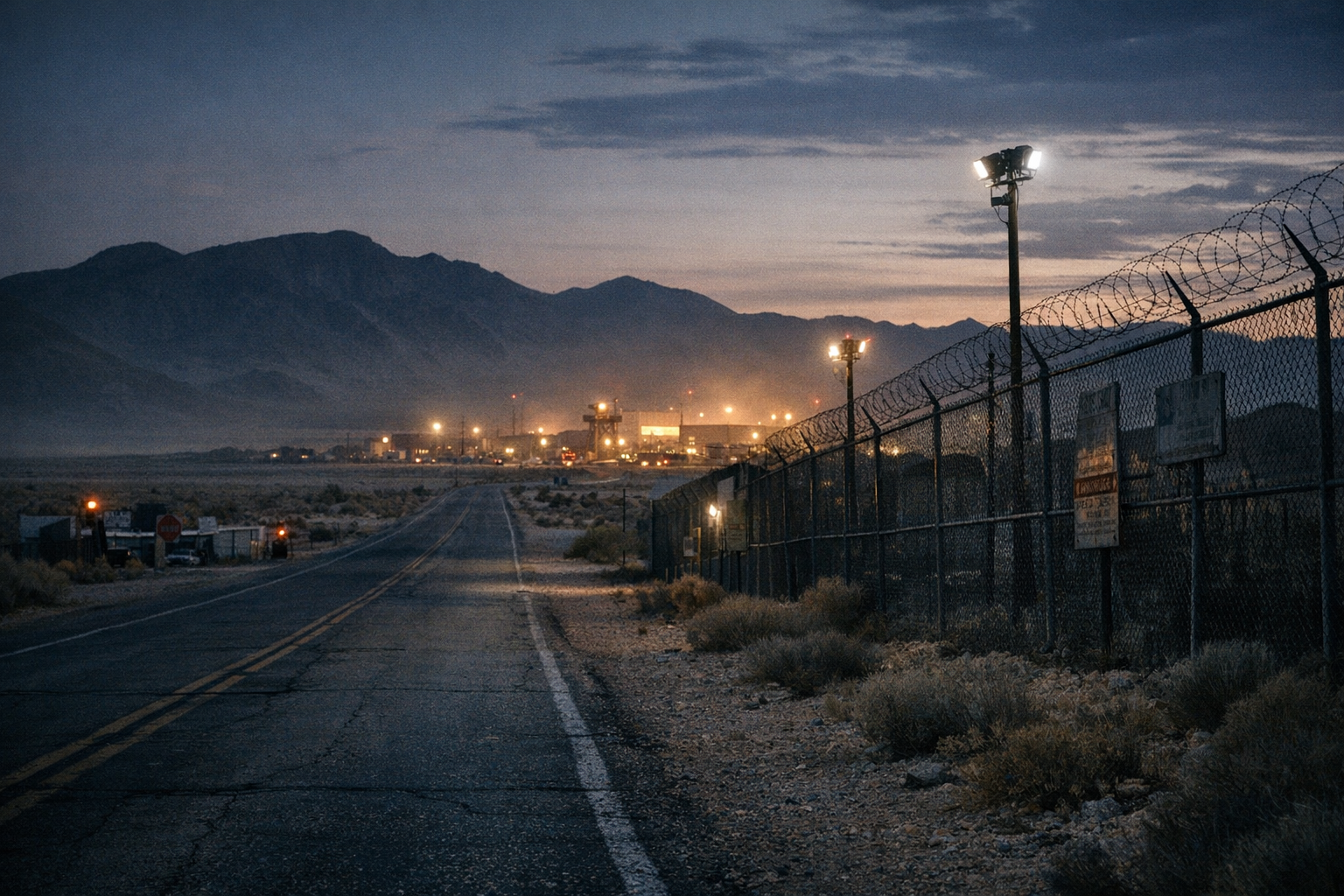
The story was never supposed to sound this clean. A man steps out of the Nevada shadows, says he worked near Area 51, and claims the government was trying to reverse-engineer alien craft inside a place most people only knew as a rumor. In that instant, the Bob Lazar explained mystery stopped being just another UFO tale and became something more dangerous: a story that made hidden hangars, missing records, and secret technology feel almost touchable.
Bob Lazar is the man who, in 1989, claimed he worked at a site called S-4 near Area 51 and saw efforts to study alien spacecraft. Supporters say he was the insider who connected military secrecy to UFO crash lore. But the most likely reality is more complicated: Lazar helped turn real government secrecy into a powerful public myth, while the evidence for his specific insider claims remains thin, disputed, and incomplete.
What Happened
Before Bob Lazar became one of the most famous names in UFO culture, Area 51 already carried a strange kind of gravity. People knew the U.S. government tested aircraft in the Nevada desert. They also knew the base was wrapped in secrecy. That was enough to make almost any rumor feel possible.
Then Lazar arrived with details. In interviews beginning in 1989, he said he had worked at a hidden facility called S-4 near Papoose Lake, south of the main Area 51 complex. According to Lazar, the job was not about ordinary aircraft at all. He claimed he had been brought in to help examine propulsion systems from craft that were not made by human beings.
That was the part that changed everything. UFO stories had existed for decades, but Lazar gave them a workplace setting. He talked about briefings, security procedures, technical diagrams, compartmentalized access, and engines that allegedly used an exotic fuel source often described as element 115. It sounded less like campfire folklore and more like a leak from inside a locked room.
There is a reason that mattered so much. Picture the late-1980s version of the story: a dark desert road, a ridge line, and a few people parked at night hoping to catch a glimpse of secret test flights. Lazar became connected to those outings too, saying he knew when unusual flight tests would happen. That detail gave his claims a dramatic, human shape. He was not just saying hidden things existed. He was acting like someone who knew when the hidden world would briefly crack open.
Over time, Lazar’s story fused with the broader mythology around Area 51 alien rumors. The base stopped being only a real military test site and became, in the public imagination, the place where the government might store crashed craft, secret materials, and maybe even answers it would never share. Lazar did not invent every part of that mythology, but he gave it a central character.
That is the key angle here. Bob Lazar matters less as a simple biography than as a bridge. He connected two ideas that had often floated separately: the known reality of extreme black-budget secrecy and the much harder-to-prove claim that the secrecy involved nonhuman technology.
Why People Believe It
People believe Lazar for a few different reasons, and none of them are hard to understand. First, he tells the story in a way that feels unusually controlled. He does not always sound like a preacher or a showman. To supporters, that calm delivery reads as credibility.
Second, the setting around his claims was already believable in one important sense. The government really did hide advanced aerospace projects for years. Secret aircraft programs, restricted testing areas, and misleading public cover stories are not science fiction. When a person drops an extraordinary claim inside a frame of real secrecy, the claim gains traction fast.
Third, Lazar appeared to offer technical specifics. Supporters point to his references to a concealed work site, unusual propulsion ideas, and element 115 as signs that he knew something before the wider public did. They argue that people do not usually invent a story with that much mechanical texture unless they are drawing from something real.
There is also the cultural timing. By the time newer whistleblower-era debates arrived, including stories tied to government UFO programs and later testimony such as David Grusch’s UFO claims, Lazar looked less like a one-off curiosity and more like an early chapter in a larger disclosure saga. Even if the cases are very different, people often read them as a chain.
And finally, Lazar’s story is culturally sticky because it solves a narrative problem. UFO believers long wanted a figure who could explain how Roswell-style crash stories, reverse-engineering rumors, and Area 51 secrecy all fit together. Lazar gave them a structure. Once a story explains other stories, it becomes much harder to shake loose.
Claims vs Evidence
Claim: Lazar worked at S-4 near Area 51 and directly saw efforts to reverse-engineer alien spacecraft.
What supports the claim: Lazar has repeated the core story for decades, and supporters argue that his consistency matters. Some also point to scattered indications that he had at least some connection to scientific or technical environments, even if not in the exact form he claimed.
What the evidence does not show: There is no confirmed public documentation proving that Lazar worked in the role he described at a hidden reverse-engineering site. The strongest problem is not that the government denied the story. Governments deny many things. The problem is that independent proof for the central job claim has remained weak for decades.
Claim: Missing records prove a cover-up erased Lazar’s background.
What supports the claim: Supporters often point to disputed educational and employment history as evidence that someone scrubbed him from official systems. In conspiracy logic, absence itself becomes proof of suppression.
What the evidence suggests instead: Missing, inconsistent, or unsupported records can also point to exaggeration, confusion, or false claims. A record gap is not automatically evidence of an intelligence cleanup. It can mean many things. That ambiguity is one reason Lazar’s story survives. The holes are real, but the cause of the holes is not established.
Claim: His mention of element 115 shows insider knowledge.
What supports the claim: For believers, Lazar seemed to be discussing a then-unconfirmed element before it was synthesized in laboratories years later.
What the evidence shows: Predicting that heavier elements might exist was not the same as proving a stable alien fuel source existed. Element 115 was later created, but that did not validate Lazar’s account of a usable, stable material powering nonhuman craft. This is a classic example of a detail sounding predictive while not actually confirming the larger story.
Claim: If parts of his timeline line up with secret testing activity, then the whole account is likely true.
What supports the claim: Area 51 was absolutely a place where the government ran hidden programs, flew unusual aircraft, and kept the public in the dark.
What the evidence shows: That is exactly why the story is powerful. Real secrecy can make almost any attached theory feel stronger than it is. But a true secret base does not automatically mean alien craft were stored there. That leap is the heart of the debate.
Reality Check
The most grounded reading of Bob Lazar is not that he was simply right or simply lying. It is that he landed on a perfect fault line in American culture. On one side was real classified aerospace secrecy. On the other was decades of UFO suspicion, crash-retrieval rumors, and public distrust. Lazar stood in the middle and gave both sides a single dramatic shape.
That helps explain why his legacy has lasted longer than many cleaner debunkings or cleaner witness stories. He offered just enough specifics to feel concrete, but not enough verifiable proof to close the case. In mystery terms, that is almost the ideal formula for survival.
It also explains why later discussions about alien technology reverse engineering and UFO crash retrieval claims so often circle back to him. Even when newer allegations come from different people, Lazar still functions as a prototype. He is the figure who made the reverse-engineering storyline emotionally legible to the public.
But when you strip the legend back to evidence, the core problem remains stubborn. There is still no confirmed public proof that Lazar saw alien craft, worked where he said he worked, or handled technology from a nonhuman source. That does not make the broader UFO secrecy story false. It does mean Lazar’s most famous claims remain claims.
And that may be the clearest conclusion of all. Bob Lazar became legendary not because he proved Area 51 hid alien machines, but because he told the first modern story that made millions of people feel as if that possibility had finally stepped into the light. The bridge he built was cultural before it was evidentiary.
Conclusion
So, is Bob Lazar an insider whistleblower or the architect of the story that made Area 51 legendary? Based on the evidence available in public, he looks more like the second than the first. His claims helped define the modern language of UFO secrecy, but the proof needed to treat his account as established fact still is not there.
That does not reduce his importance. If anything, it explains it. Lazar matters because he turned a hidden military landscape into a myth people could picture in detail: hangars cut into desert rock, engineers reading impossible diagrams, and a government forever one layer away from disclosure.
In the end, the Bob Lazar story says as much about public trust as it does about UFOs. When institutions hide real things for long enough, people become ready to believe almost anything might be inside the next locked door. Lazar gave that suspicion a face, a voice, and a blueprint. The evidence never fully caught up, but the legend never needed it to spread.
🔎 If this story stayed with you, the author suggests these real cases next:
- Area 51 Alien Rumors: Why a Real Secret Base Became the Center of UFO Lore
- Government UFO Programs: Why the Files Never Really Closed
- UFO Crash Retrieval Claims: Hidden Recovery Program or Testimony Without Proof?
Explore more Alien & UFO Theories stories here: