
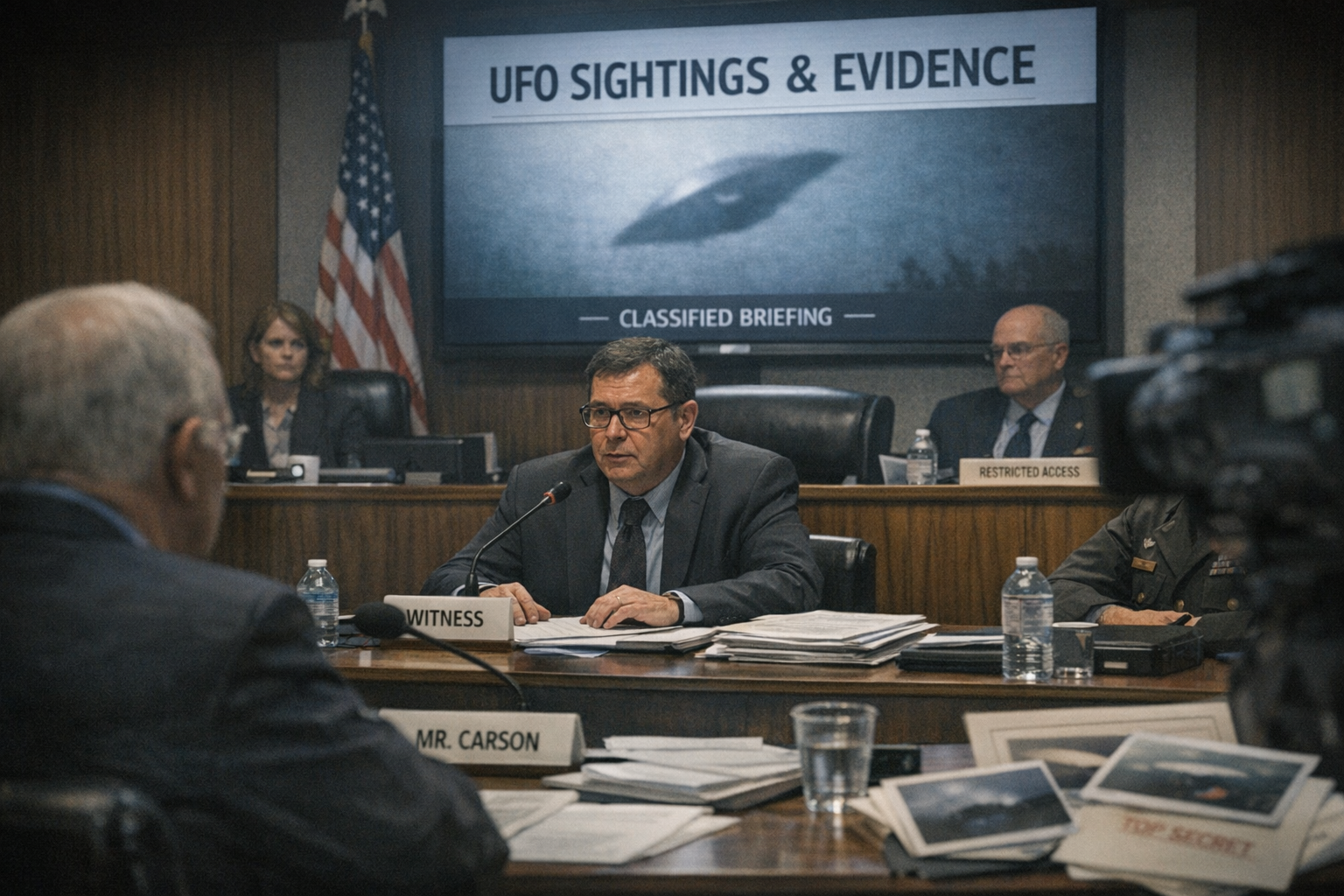
The file is always said to be just one room away. A hearing ends, a spokesperson chooses their words with surgical care, and somewhere behind the polished language the same old feeling returns: maybe the public is closer than ever to something it was never supposed to fully see. That is what gives the alien disclosure timeline 2026 its strange pull. It looks like movement, sounds like revelation, and still leaves the biggest answer hanging in the air.
The alien disclosure timeline 2026 is the current stage of the long-running public debate over UFOs, UAPs, government secrecy, and whether recent developments actually changed what we know. Supporters argue that new hearings, whistleblower stories, and ongoing official reviews show disclosure is entering a more serious phase. The more grounded reality is that 2026 added visibility and pressure, but the core evidence problem remains much the same: the conversation keeps advancing faster than the publicly testable proof.
What Happened
The easiest mistake in this topic is to imagine 2026 as a clean break from the past. It is not. It is better understood as another checkpoint in a story that has been building for years through military footage, official reviews, insider claims, congressional attention, and repeated public suspicion that the full picture still sits behind classification walls.
That is why the broader alien disclosure timeline still matters. The earlier phases of this story already established the basic pattern: a new document appears, a hearing gets headlines, an agency admits only part of what it can confirm, and the public once again wonders whether the next reveal will finally turn mystery into proof.
In 2026, that pattern did not disappear. It sharpened. The year kept attention on the disclosure era through public argument over recent testimony, official review language, and whether lawmakers were actually getting closer to the truth or simply replaying the same oversight struggle in a newer political moment.
One scene captures the year well. A hearing room is bright, formal, and carefully controlled. Cameras are live. Members ask blunt questions. Witnesses answer in measured phrases, often sounding like people trying to point toward a locked door without opening it. For a few minutes, the whole subject feels like it is about to tip into clarity. Then the familiar limit appears: some details belong in closed session, some claims remain secondhand, and the public is left with seriousness but not closure.
That is where 2026 connects directly to UAP Hearing 2026 Claims: New Disclosure or the Same Proof Gap Again?. The year brought fresh packaging, fresh pressure, and a fresh round of attention. But it also showed that the structure of the debate had not fundamentally changed. Official acknowledgment expanded the conversation. It did not settle the extraordinary claims at the center of it.
The same tension appears in ongoing interest around government UFO programs and the AARO UAP report. Each piece tells readers something real: agencies have taken unusual aerial incidents seriously enough to organize, review, classify, and defend. But none of those developments, by themselves, proves the largest public interpretation people most want confirmed.
Why People Believe It
People believe 2026 marks a new phase because disclosure stories are strongest when they feel official. A rumor online is easy to dismiss. A formal hearing, a government office, or a witness tied to national security feels different. Even before any new proof appears, the setting itself raises the temperature.
There is also a memory effect at work. By now, many readers have lived through enough disclosure moments to feel that the pieces are accumulating. A hearing points back to a whistleblower. A whistleblower points back to a hidden-program claim. A report points back to unexplained incidents. A timeline post points back to years of partial admissions. The story starts to feel less like isolated news and more like a mosaic slowly filling in.
That is why 2026 feels bigger than a normal update cycle. It lands after the topic has already crossed an important line. The question is no longer whether governments ever paid attention to UFO reports. They clearly did. The question now is whether this newer phase changes the evidence picture in a meaningful way, or simply keeps the public watching the same unresolved puzzle from a closer angle.
Another reason belief grows is that secrecy language sounds believable here. Words like compartmented access, restricted records, oversight barriers, and classified testimony are not fantasy language. They are normal parts of how real institutions handle sensitive information. Once that tone is established, many people naturally assume the hidden material must be dramatic enough to justify the secrecy.
There is also a simple human reason. People hate standing in front of an unfinished story. If officials admit that something remains unexplained, many readers do not rest at “unexplained.” They move quickly to “withheld” or “covered up,” because that gives the uncertainty a shape. It is emotionally easier to believe there is a secret than to accept that there may still be an unresolved mess of claims, classifications, and incomplete evidence.
Claims vs Evidence
Claim: 2026 represents a major new phase of disclosure.
Evidence: In one sense, yes. The year continued to formalize the topic through public debate, official attention, and ongoing scrutiny. But if “new phase” means the public now has clearly stronger proof of hidden nonhuman craft or confirmed extraordinary programs, the evidence is much thinner. 2026 advanced the discussion more than it transformed the proof.
Claim: Hearings and whistleblowers prove the government is getting close to admitting more than it says publicly.
Evidence: Hearings and whistleblower testimony can show that oversight conflict is real and that some claims are taken seriously inside the system. But testimony is not the same thing as public verification. This is why pages like Pentagon UFO Videos: What the Navy Footage Confirmed – and What It Didn’t matter so much. Public evidence and institutional seriousness can overlap without becoming the same thing.
Claim: The timeline itself proves momentum toward revelation.
Evidence: Timelines can create a strong feeling of inevitability. When events are stacked in sequence, they appear to be moving toward a finish line. But a timeline can also hide repetition. In this subject, many milestones repeat the same structure: claim, response, official caution, renewed suspicion, unresolved proof gap. Movement is real, but it is not always the same as progress.
Claim: If the biggest details remain classified, that absence is itself evidence something extraordinary is being hidden.
Evidence: This is where the topic becomes most slippery. Real secrecy does exist in defense systems. So some missing information may genuinely be hidden. But if every missing piece is treated as confirmation, the burden of proof quietly disappears. A classified gap may point to a secret. It does not automatically prove the most dramatic version of that secret.
A misunderstood detail in this debate is the difference between process evidence and object evidence. Process evidence shows that officials argue, classify, investigate, or restrict access. That matters. It tells us the subject is not empty theater. But object evidence would mean something the public or qualified outside experts could test directly: authenticated documents, physical material, complete data chains, or first-hand evidence that can survive independent review. 2026 brought more of the first category than the second.
Reality Check
The cleanest way to read the alien disclosure timeline 2026 is through one question: what changed, and what did not change? What changed is that the topic stayed politically and culturally alive. It became harder to wave away. The public has more language, more reference points, and more official material to discuss than it did in earlier eras.
What did not change is the central weakness of the whole disclosure story. The biggest claims still depend on a chain that often breaks before the public can inspect it. A witness may sound credible. A hearing may feel historic. A report may confirm that unusual incidents exist. But the leap from that reality to confirmed extraordinary conclusions still has not been completed in a way the public can directly test.
That does not mean 2026 was empty. It means the year clarified the shape of the conflict rather than resolving it. The conflict is not really between believers and skeptics alone. It is between testimony and verification, secrecy and transparency, momentum and proof.
There is a contradiction worth noticing here. Every new stage of disclosure is presented as if it may finally break the pattern. Yet the pattern is exactly what keeps surviving. Public interest rises. New names and claims circulate. Official attention confirms that the subject is not trivial. And still, the final evidentiary leap remains unfinished. The story evolves without fully graduating into settled knowledge.
So if someone asks what the 2026 disclosure timeline actually shows, the most honest answer is this: it shows a subject that is becoming harder to ignore, but not easier to prove. That may sound less dramatic than the headline version, but it is probably closer to the truth.
Conclusion
The alien disclosure timeline 2026 matters because it gives the public a present-day checkpoint instead of another vague promise that revelation is always just around the corner. It shows that the topic has real momentum, real institutional friction, and real staying power.
But the unique angle of 2026 is not that everything suddenly changed. It is that the same story returned in newer packaging and forced a sharper question: are we watching disclosure advance in substance, or are we watching the narrative become more organized while the proof gap stays in place?
For now, the fairest answer is somewhere in the middle. The year moved the conversation forward. It did not close the case. And that is exactly why the disclosure story still holds people so tightly: the door looks more official than ever, but it still has not opened all the way.
🔎 If this story stayed with you, the author suggests these real cases next:
- UAP Hearing 2026 Claims: New Disclosure or the Same Proof Gap Again?
- AARO UAP Report: Clear Answers or a Review That Left the Biggest Claims Open?
- Alien Disclosure Timeline: Are We Seeing Revelation or Repackaged Secrecy?
Explore more Alien & UFO Theories stories here: