
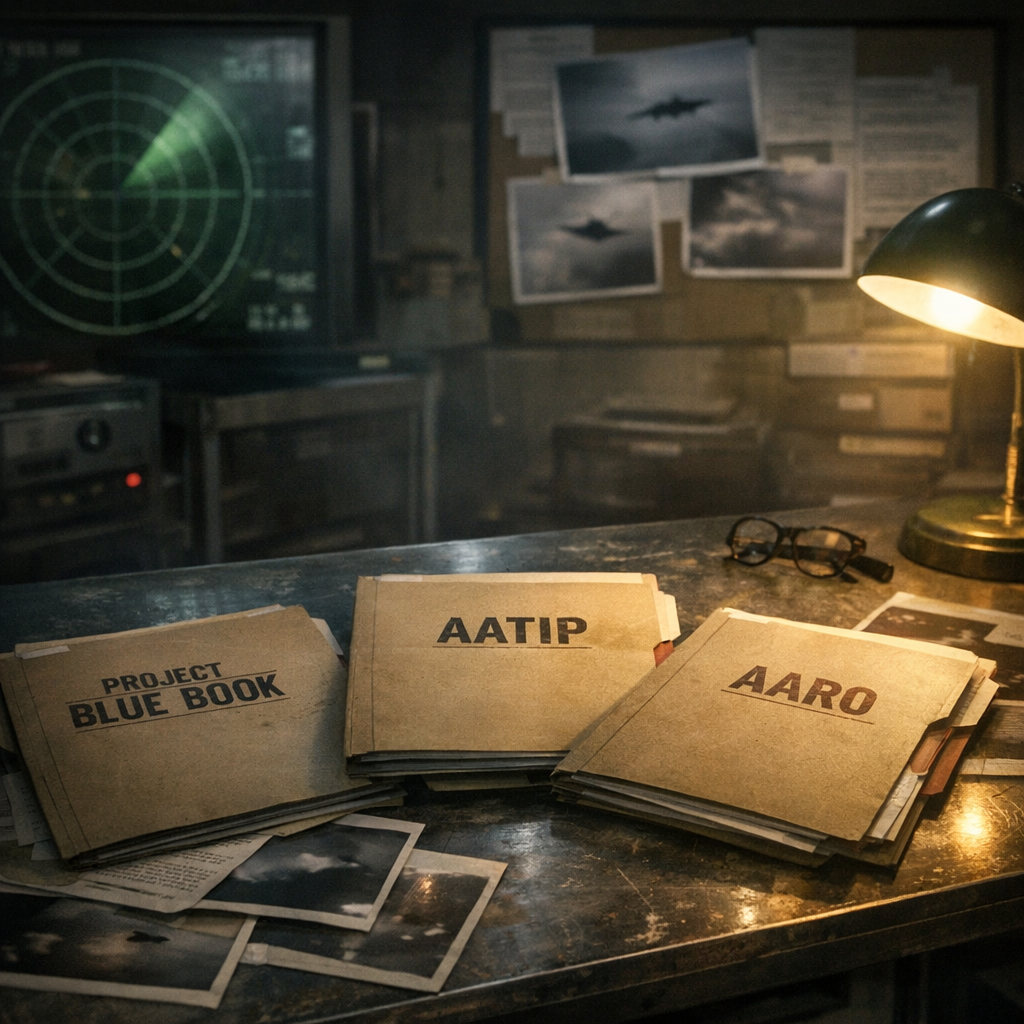
The file was supposed to be closed decades ago. Instead, every time the government seemed ready to bury the UFO question under a new acronym or office, another memo, hearing, or program pulled it back into view. That repeated return is exactly why government UFO programs still draw so much suspicion.
Government UFO programs were official efforts to track, study, or manage unusual aerial reports, from Project Blue Book to newer UAP offices. What people claim is that these programs prove the government has known far more than it admits, possibly including evidence of nonhuman craft. The more likely reality is narrower but still important: the record shows real continuity of official concern, real secrecy, and real inconsistency, but not public proof that these programs secretly solved the UFO mystery.
What Happened With Government UFO Programs
The history of government UFO programs starts long before modern hearings and whistleblower headlines. In the late 1940s, the United States was dealing with early Cold War fear, new aircraft technology, and a rising flood of strange reports from pilots, civilians, and military observers. That atmosphere pushed the Air Force into formal study. First came Project Sign, then Project Grudge, and eventually Project Blue Book, the best-known official UFO investigation in American history.
Blue Book matters because it established a pattern that never really went away. Officially, the program existed to collect reports, sort stronger cases from weaker ones, and decide whether unexplained sightings posed a scientific or national-security problem. But it also served a second purpose: calming the public. Those goals can overlap, yet they are not identical. A program can investigate honestly while still feeling pressure to keep panic, embarrassment, or speculation under control.
By 1969, Blue Book was shut down after the Condon Report concluded that further broad study was unlikely to deliver major scientific value. On paper, that looked like the end. In public memory, though, it became the start of a much longer suspicion. If the best-known UFO office had closed, people naturally asked whether the subject had really ended or simply gone somewhere less visible.
That question became harder to dismiss decades later. Reporting around AATIP, the Advanced Aerospace Threat Identification Program, showed that unusual aerial incidents had continued drawing attention inside the defense world long after Blue Book was supposedly history. Then came the UAP Task Force and later AARO, the All-domain Anomaly Resolution Office. The labels changed. The bureaucracy changed. But the basic fact remained: official interest in unexplained incidents never fully vanished.
That continuity is the real center of this story. The strongest case for suspicion is not one giant leaked confession. It is the repeated return of structured government attention. If the matter was trivial, why did it keep resurfacing under new names? At the same time, continuity of attention is not the same thing as continuity of extraordinary proof. That distinction is where most of the confusion lives.
If you want the modern public-facing side of that continuity, it helps to compare this page with UFO Disclosure: Hearings, Whistleblowers, and the Proof Gap. The hearings made the subject feel newly open, but they also showed how much of the argument still depends on what the public cannot directly inspect.
Why People Believe It
People believe government UFO programs hide bigger truths because the foundation is real. This is not a theory built from nothing. Blue Book was real. AATIP was real. AARO is real. There are memos, offices, budget trails, testimony, and official language that prove the state took unusual aerial reports seriously in multiple eras.
That matters psychologically. Once the public learns that officials really did investigate the topic, the next leap becomes much easier: maybe they found more than they admitted. Secrecy does the rest. A fully open archive would settle some arguments. A fully closed system would starve others. But partial access is the perfect fuel source. A few documents, a few interviews, a few unexplained cases, and a lot of missing context create a story that never quite finishes.
There is also a cultural reason this subject keeps rebuilding itself. UFO belief rarely lives inside one case anymore. It works like a network. The official-program story connects military footage, witness cases, and modern review offices into one larger narrative. A reader who sees unresolved tension in the Pentagon UFO Videos or mixed conclusions in the AARO UAP Report can easily start viewing each new office as another chapter in a long-running management strategy rather than a fresh evaluation.
Language change made the theory stronger, not weaker. “UFO” sounds like pop culture. “UAP” sounds technical, serious, and bureaucratic. To some people, that shift looked like progress. To others, it looked like narrative control: the same mystery rebranded into safer language. When institutions rename a controversial topic instead of resolving it, many readers assume the renaming itself is part of the cover story.
And then there is trust. Governments have hidden real things before, especially around defense and intelligence. That does not prove alien contact. But it does mean public suspicion is not irrational on its face. When people already know that states classify, compartmentalize, and delay disclosure, a program about unidentified objects near sensitive airspace will almost automatically attract bigger theories.
Claims vs Evidence
Claim: Government UFO programs prove officials know UFOs are nonhuman craft.
Evidence: The record does not go that far. It shows official study of unusual incidents, not a public conclusion that those incidents involved alien technology. Real investigation is not the same thing as confirmed extraterrestrial origin.
Claim: Project Blue Book was just a fake public-facing cover while the real investigation moved deeper underground.
Evidence: Blue Book absolutely had a public-relations dimension, and critics have long argued that some cases felt too quickly flattened into ordinary explanations. But the surviving record also shows genuine cataloging and analysis of thousands of reports. The strongest supported conclusion is not that Blue Book was purely fake. It is that it mixed real investigation with institutional pressure to reduce alarm.
Claim: Later programs like AATIP and AARO prove the government never stopped taking the issue seriously.
Evidence: This claim is largely supported, with an important limit. Yes, the continuity of programs shows the subject retained official importance. But seriousness alone does not tell us why. Military and intelligence agencies may study an anomaly because it is unexplained, because it might involve foreign technology, or because it affects airspace safety. Continued attention proves concern, not necessarily an extraordinary answer.
Claim: Because officials changed terms from UFO to UAP, they were trying to hide the same old truth under a cleaner label.
Evidence: The language shift clearly changed how the topic is discussed. “UAP” lets officials frame incidents in operational terms and avoid some of the stigma around “UFO.” That may reflect message control, but it can also reflect a practical attempt to widen reporting and make pilots more willing to speak. The renaming is real. The strongest motive behind it is harder to prove.
Claim: If programs kept returning, the files must contain something major that the public has not seen.
Evidence: Maybe something significant remains classified, but that possibility is not the same as proof of nonhuman craft. The known record supports a narrower conclusion: officials repeatedly faced incidents they did not want to ignore, yet the public evidence still falls short of confirming the biggest online versions of the story.
This is why historical references such as Project Blue Book remain so important inside the piece. They show continuity. But continuity should not be mistaken for closure. A repeating institutional pattern can prove unresolved concern without proving the most dramatic interpretation attached to that concern.
Reality Check
The most grounded reading of government UFO programs is that the government’s posture has been inconsistent enough to create lasting distrust. Officials studied the subject, downplayed it, reopened it, renamed it, and re-explained it across different decades. That inconsistency is documented. It is also enough to explain why the public keeps assuming a deeper layer exists.
What the evidence clearly supports is this: the UFO question was never treated as meaningless noise by every part of government. Some reports were ordinary. Some were unresolved. Some were important enough to trigger real bureaucratic attention. That alone undercuts the old idea that the entire matter was simply laughed off and forgotten after the 1960s.
But there is a second truth running alongside it. Public confirmation of official concern is not the same thing as public proof of alien visitation, recovered craft, or secret disclosure planning. The gap between those two ideas is where most conspiracy inflation happens. People see continuity of study and mentally upgrade it into continuity of revelation. The record does not justify that jump yet.
So the topic remains compelling for a simple reason: it sits in the middle zone between dismissal and disclosure. The files never really closed, but they also never delivered the clean answer many people want. That leaves us with a narrower, more honest conclusion. Government UFO programs are real. The secrecy around them is real. The unresolved tension is real. The strongest extraordinary claims are still unproven.
Conclusion
Government UFO programs continue to matter because they expose something deeper than a single unexplained sighting. They show how official attention, partial disclosure, and bureaucratic rebranding can keep one mystery alive across generations without ever fully settling it.
If people still search for official UFO investigations explained, that is the answer they are really chasing: not whether one office existed, but why the question kept surviving after every supposed ending. From Blue Book to AARO, the pattern is continuity, not closure.
The best-supported conclusion is not that the government has publicly proved alien contact and hidden it in plain sight. It is that the government repeatedly encountered enough uncertainty to keep building structures around the problem while revealing only part of what it knew. That is less cinematic than a full disclosure story, but it is also more firmly grounded in the record.
🔎 If this story stayed with you, the author suggests these real cases next:
- UFO Disclosure: Hearings, Whistleblowers, and the Proof Gap
- AARO UAP Report: Clear Answers or a Review That Left the Biggest Claims Open?
- Pentagon UFO Videos: What the Navy Footage Confirmed — and What It Didn’t
Explore more Alien & UFO Theories stories here: