
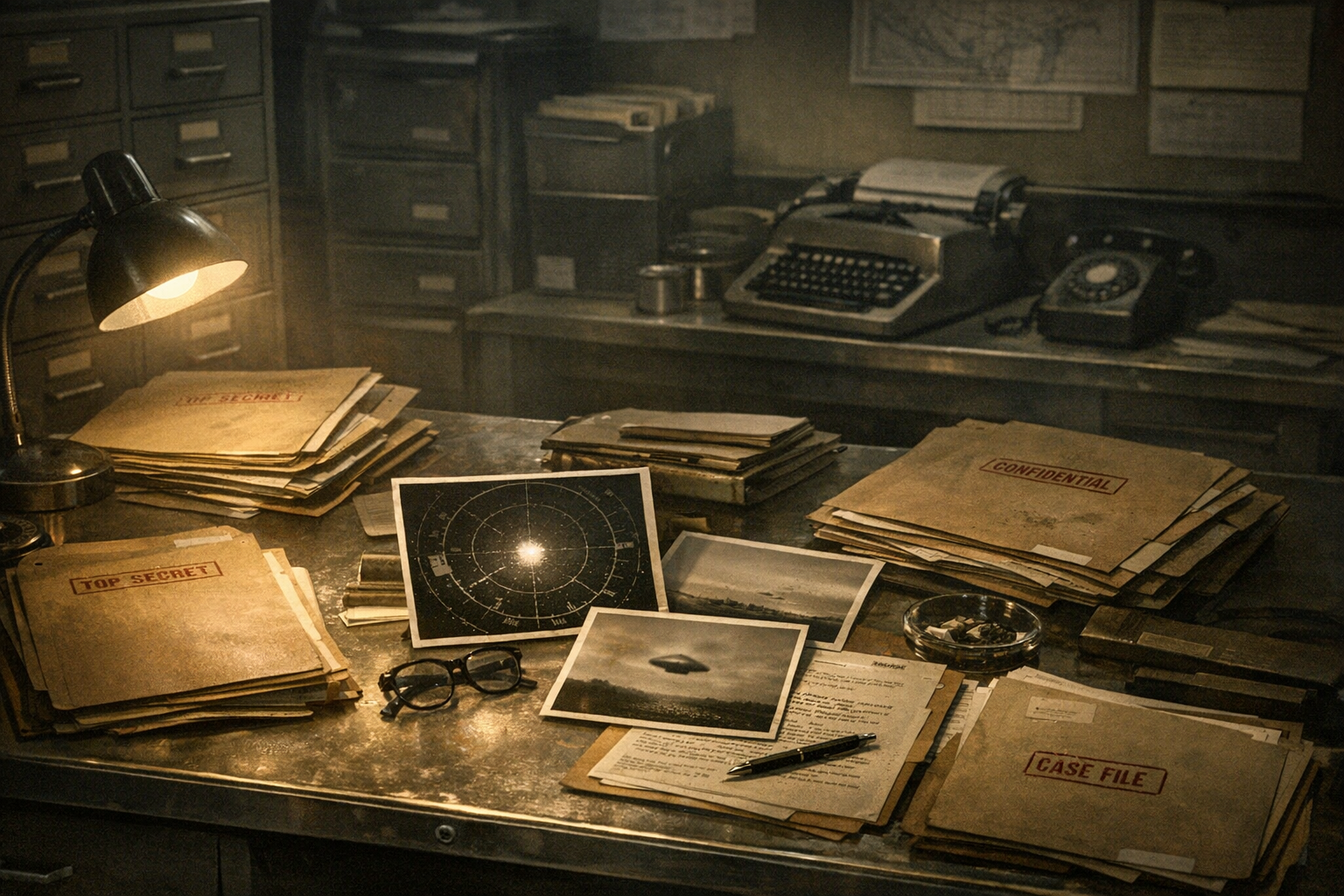
The files were supposed to lower the temperature. Instead, they left behind a colder feeling: stamped reports, clipped Air Force language, and case summaries that seemed to close the door without fully closing the question. That uneasy gap is why Project Blue Book still matters today—not just as a UFO investigation, but as one of the first official systems that taught the public to wonder whether the government was explaining mysteries or managing them.
Project Blue Book was the U.S. Air Force program that investigated UFO reports from 1952 to 1969. People who distrust it argue that it was less about finding the truth than shaping what the public would accept. The more grounded reality is that Blue Book was a real investigative program that explained many sightings, but its limits, its public-facing role, and the way it handled uncertainty helped create the lasting belief that official UFO reviews often protect institutions as much as they pursue answers.
What Happened
This article’s angle is deliberate: Blue Book matters less as a giant list of strange sightings and more as the institutional origin story for modern UFO distrust. The most important question is not whether every case was solved. It is why an official program designed to reassure people ended up deepening suspicion instead.
To see why, you have to go back to the early Cold War. Reports of strange things in the sky were not just tabloid bait. Pilots, radar operators, police officers, and ordinary civilians were filing sightings at a time when American air defense was already nervous. The government was trying to sort out a crowded sky filled with new aircraft, radar limits, spy fears, and a public increasingly fascinated by flying saucers.
Before Blue Book, the Air Force had already tried earlier efforts like Project Sign and Project Grudge. Blue Book became the best-known version of that official response. Its public mission sounded straightforward: collect reports, investigate them, and determine whether they posed a threat to national security.
But even that mission carried tension. Blue Book had to do several things at once. It had to look scientific. It had to sound calm. It had to avoid public panic. And it had to operate inside a national-security system that was not built to share everything openly. Those pressures matter because they help explain why the program’s legacy became so complicated.
At its height, Blue Book reviewed thousands of sightings. Many were eventually explained as aircraft, balloons, planets, stars, weather effects, hoaxes, or bad observation. That part is real, and it is important. Blue Book was not a vault full of nothing but impossible cases. A large amount of what reached the program appears to have been ordinary confusion filtered through a tense era.
Still, the cases people remember were never the ordinary ones. They were the episodes with trained observers, multiple witnesses, radar returns, military settings, or details that refused to settle cleanly. Once an official Air Force office touched those stories, the cases took on new weight. They were no longer just rumors in the dark. They became government files.
You can imagine the human moment that made the distrust stick. A citizen reads that the military opened a case. The event sounds serious, maybe even alarming. Then the official answer arrives sounding thin, abrupt, or oddly confident. Even if the explanation is possible, the experience can leave the reader with a hard question: was the government trying to understand the event, or trying to put a lid on it?
That is where Blue Book stops being only a history topic and starts becoming a template. It taught the public what official ambiguity feels like. That is also why it connects so naturally to later pages about government UFO programs and modern reviews like the AARO UAP Report. The names changed, the decades changed, and the technology changed, but the trust problem stayed strangely familiar.
Why People Believe It
People believe Blue Book was part investigation and part containment system because the program sat in the worst possible place for public trust: between honest uncertainty and institutional message control. That does not mean every investigator was acting in bad faith. It means the structure of the program made suspicion almost inevitable.
The first reason is simple. Official programs do not get judged only by what they find. They get judged by how they sound when they explain it. If a witness report feels vivid and messy, but the government answer feels clipped and final, people often read the difference as concealment rather than caution.
The second reason is historical atmosphere. Blue Book operated during the Cold War, when secrecy was not abstract. Classified aircraft programs were real. Intelligence operations were real. Information control was real. In that environment, citizens did not have to invent the idea that governments hide things. They already knew governments sometimes did.
There is also a storytelling problem built into UFO culture. An unexplained case does not stay still. It grows in retellings. The official conclusion becomes one story, the witness memory becomes another, and the gap between them starts to feel meaningful. Over time, the case is remembered less as a technical problem and more as a scene of tension between the public and authority.
Blue Book became especially powerful because it offered believers an origin point. Instead of vaguely claiming that “the government always covers this stuff up,” they could point to one famous institution and say: that is where the pattern became visible. In that sense, Blue Book became less about individual flying-saucer cases and more about the birth of a worldview.
That worldview still shapes how later stories are received. When readers encounter debates over the Roswell UFO Crash, newer military videos, or even contrast cases like Project Blue Beam, they often bring the same suspicion with them: official narratives may reveal some truth, but never the whole thing. Blue Book helped make that reflex feel reasonable to a lot of people.
Another reason belief lasts is that Blue Book never fully erased the mystery it was meant to contain. If a long-running official program really solved the UFO issue in a satisfying way, it should have reduced distrust over time. Instead, its closure in 1969 did not end the argument. In some ways, it hardened it. That alone does not prove deception, but it does explain why the program still lives in conspiracy culture.
Claims vs Evidence
Claim: Project Blue Book was secretly created to hide proof of extraterrestrial craft.
Evidence: Blue Book was a real Air Force program with a documented public mission to evaluate UFO reports and assess any national-security risk. It reviewed thousands of cases, and many were given ordinary explanations. There is no publicly confirmed evidence showing that Blue Book officially held proven alien craft, alien bodies, or direct proof of non-human visitors. That stronger claim goes beyond what the record supports.
Claim: Blue Book was less interested in truth than in calming the public.
Evidence: This claim is harder to dismiss because it does not require secret spaceships. It only requires a bureaucracy under pressure to keep public anxiety under control. That is plausible. An official office can investigate and still lean toward closure, narrow framing, or reassuring language. Those are not the same as a grand cover-up, but they can still shape public understanding in ways that feel managed.
Claim: Unexplained Blue Book cases prove something extraordinary was being hidden.
Evidence: Unexplained does not automatically mean extraterrestrial. It can mean the data was incomplete, the witnesses disagreed, the records were weak, or investigators simply could not reach a confident conclusion. What unexplained cases do prove is that Blue Book had limits. The program could sort many reports, but it could not force neat answers out of every messy event.
A misunderstood detail here is the difference between “not explained” and “suppressed.” Those are not the same thing. A case can remain unresolved because the evidence is poor. But from a reader’s point of view, an unresolved government case can feel like a locked drawer. That emotional effect matters because it helps explain how public suspicion survived long after the official paperwork was filed away.
There is also a contradiction sitting inside Blue Book’s legacy. If the program was purely a sham, why preserve such a large paper trail that later critics could inspect? But if it was a clean and transparent scientific effort, why did so many readers come away feeling that the institution had explained less than it claimed? The most realistic answer is messier than either side likes. Blue Book appears to have been a genuine official effort operating inside a system that also had strong incentives to reduce uncertainty quickly and protect institutional credibility.
That contradiction is exactly why the program became such a powerful cultural symbol. It was official enough to feel important, but imperfect enough to leave room for suspicion. It gave both skeptics and believers something to point at, which is why its legacy remains larger than any single sighting on its files.
Reality Check
The strongest reality check is this: Project Blue Book did not need to hide alien craft to change the public permanently. It only needed to make people feel that official investigation and official explanation were not always the same thing.
That distinction is the real engine of Blue Book’s importance. The program investigated a huge volume of reports and likely helped prevent many ordinary sightings from becoming permanent myths. But it also showed how easily trust breaks when an institution appears more confident than its evidence, more polished than its reasoning, or more focused on closure than clarity.
In other words, Blue Book’s deepest impact may have been psychological and institutional, not extraterrestrial. It trained generations of readers to interpret later government UFO efforts through a familiar script. When a modern office says it found no proof of alien technology, one part of the public hears responsible caution. Another hears the echo of Blue Book.
This is why the article’s angle matters. If you treat Blue Book as only a catalog of strange sightings, you miss the bigger story. Its true legacy is that it became an early lesson in managed uncertainty. The government looked at the mystery, but the process left many people feeling that the public was being guided toward acceptable conclusions rather than invited into full understanding.
Still, that does not justify every later conspiracy built on its name. There is a difference between saying Blue Book contributed to distrust and saying it proves decades of hidden alien contact. The first claim fits the history much better. The second jumps far beyond it.
The cleanest conclusion is also the least dramatic one. Project Blue Book was probably neither the full truth nor a total fraud. It was an imperfect Cold War institution trying to manage a difficult subject inside a culture of secrecy. That was enough to solve some cases, fail others, and leave behind the exact pattern of doubt that still drives modern disclosure arguments.
Conclusion
Project Blue Book still pulls people back because it touched the most sensitive part of any mystery: not just what happened in the sky, but who gets to define the meaning afterward. The Air Force wanted an official system that could examine reports, reduce panic, and maintain credibility. In many cases, it likely did exactly that.
But the same system also taught the public a harder lesson. Once people suspect that official investigations may be designed to manage uncertainty instead of fully resolve it, every later UFO office inherits that doubt. That is why Blue Book remains bigger than its old files. It became the moment institutional trust itself entered the UFO story.
So was Project Blue Book a secret alien cover-up? There is no confirmed public evidence that it held decisive proof of non-human craft. But was it one of the main reasons people came to distrust official UFO answers? Yes. And that may be the most important thing it ever produced.
🔎 If this story stayed with you, the author suggests these real cases next:
- Government UFO Programs: Why the Files Never Really Closed
- Roswell UFO Crash: What the Original Witnesses Claimed and What the Records Actually Show
- Alien Disclosure Timeline: Are We Seeing Revelation or Repackaged Secrecy?
Explore more Alien & UFO Theories stories here: