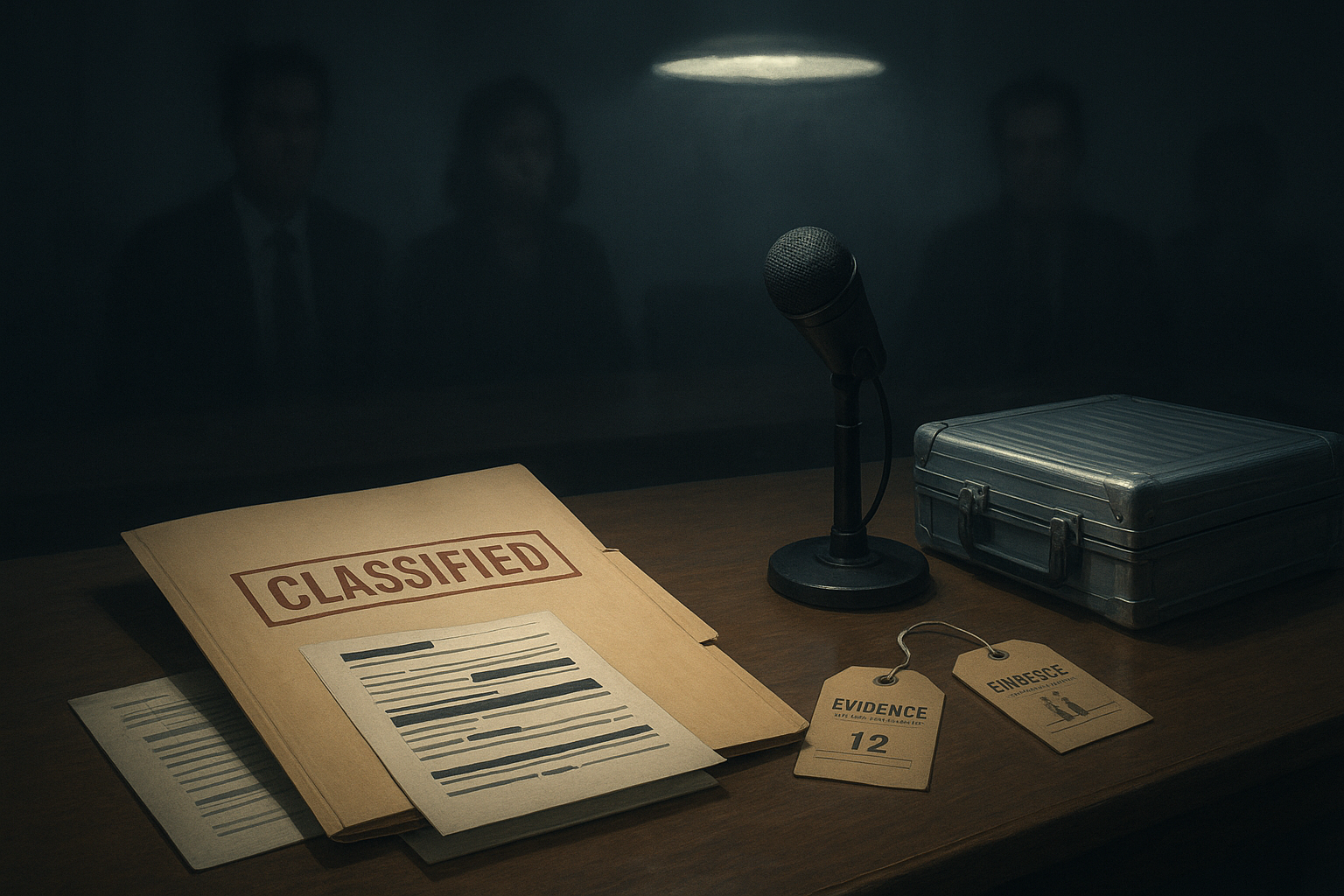
Behind the most talked-about UFO hearings, the real mystery is not the claim itself but the missing file, sample, or record that never appears on camera. A witness can lean toward the microphone, hint at hidden programs, and leave the room sounding credible. But when the clips spread and the noise dies down, the same question remains: what would count as UFO whistleblower evidence strong enough to turn a dramatic allegation into proof?
UFO whistleblower evidence usually means testimony from insiders who say they learned about hidden UAP programs, recovered materials, or buried records. Supporters argue that credible witnesses point to something real behind the secrecy. The more cautious reality is that testimony can matter a lot, but real public proof would need corroboration, authenticated records, physical evidence, and verification that survives scrutiny.
What Happened
The modern UFO disclosure wave did not arrive through one photograph or one crashed-object reveal. It built itself through hearings, leaked claims, military sensor debates, and a set of insiders saying the government knew more than it admitted in public.
That matters because many readers arrive expecting a simple verdict: either a whistleblower proved everything, or the whole story collapsed. What actually happened is more bureaucratic and more slippery. Several people with serious credentials said hidden information existed, some spoke under oath, and some described programs or materials the public still cannot inspect directly.
Picture the scene that keeps repeating in this topic. A former official sits upright under oath. Their voice stays careful. They are not describing a glowing object over a highway. They are describing compartments, access barriers, retaliation, document trails, and names that can only be discussed in secure settings. That tone makes the story feel more believable, but it also creates a trap: serious language can sound like proof even when the proof itself is still out of reach.
This is why the topic works best as a standards-of-proof page instead of another recap. The core question is not whether one insider sounds compelling. It is what kind of evidence would actually have to accompany a whistleblower for the public to say the case has crossed from allegation into proof.
That same proof gap runs through broader pages like UFO Disclosure: Hearings, Whistleblowers, and the Proof Gap. Public hearings can show that officials take allegations seriously enough to review. They do not automatically reveal the underlying evidence in a form that outside readers, reporters, or researchers can independently test.
Why People Believe It
People believe UFO whistleblower stories for understandable reasons. First, the witnesses often sound unlike classic fringe storytellers. They may have government backgrounds, security clearances, or roles that seem close to sensitive information. That changes how people hear the claim before any hard evidence is shown.
Second, secrecy has emotional force. If a person says, “I know more, but I cannot show you here,” the missing details can make the story feel bigger, not weaker. Human beings often read restriction as confirmation. If access is blocked, many listeners assume something explosive must be hidden behind the barrier.
Third, these claims do not land in empty space anymore. They land inside a disclosure cluster already shaped by names, hearings, leaked files, and old rumors. That is one reason pages like David Grusch UFO Claims: What Was Alleged, What Was Verified? hit so hard: they connect fresh allegations to an older belief that some deeper truth has been circling just outside public reach for decades.
Credibility and proof, though, are not the same thing. A credible witness can honestly report what they were told and still leave the public with weak evidence. That does not mean they are lying. It means they may be one step removed from the core material, and in UFO cases that distance is often everything.
The psychology becomes even stronger once stories of pressure and silence enter the picture. A page like UFO Whistleblower Retaliation: Silenced Witnesses or the Story That Makes Claims Feel True? shows why that happens: a suppression narrative can make missing evidence feel meaningful, even when the main claim is still unverified.
Once a witness seems credible, many readers flatten different evidence types into one emotional bundle. Testimony, rumors of documents, hints about classified photos, stories of metal fragments, and official silence begin to feel like one giant mountain. But those are separate layers, and each one has to be checked differently.
Claims vs Evidence
The clearest way to judge whistleblower stories is to think in levels of proof. Testimony is the first level. Testimony matters because it can point investigators toward hidden records, hidden personnel, or hidden systems. A firsthand witness who says, “I saw this object,” or “I was briefed into this program,” is not nothing. But testimony alone is still a human report. Memory can be limited. Access can be partial. Even honest witnesses can misunderstand what they saw or what they were told.
The next level is corroboration. If multiple independent witnesses with documented access describe the same thing without obviously copying each other, the claim grows stronger. This is part of what makes debates around UFO Insider Testimony: Why Credible Witnesses Still Leave a Proof Gap so persistent. Credible people can still leave a gap if their stories do not lock together with records or material evidence.
Then come documents. On paper, this sounds stronger, and sometimes it is. A memo, briefing record, procurement trail, access list, or audit note can move the story forward. But a document only becomes strong evidence when its origin is clear. Where did it come from? Who handled it? Has it been authenticated? Is it complete, or is it one fragment with missing context? UFO history is full of papers that looked important before provenance problems weakened them.
After that comes chain of custody, which is where many dramatic claims begin to wobble. If someone says a sample, photograph, fragment, or report proves nonhuman technology, you need a traceable path from source to storage to testing. Who collected it? When? Under what conditions? Was it sealed? Who examined it? Without that chain, even a strange object stays stuck in limbo.
Physical material would be stronger still, but only under strict conditions. A metallic fragment or device is not meaningful just because it is unusual. The real question is whether independent labs can test it, reproduce findings, and rule out known explanations. Extraordinary composition, manufacturing features, or isotopic anomalies would attract attention, but they would still need clean sourcing, transparent methods, and repeatable results.
Then there is public verification, which is the part many cases still never reach. For a whistleblower claim to become real proof in the public arena, it cannot rely only on secure briefings or private assurances. It needs evidence that survives adversarial review. That means other experts can inspect it, journalists can trace it, and skeptics can challenge it without the whole case vanishing behind classified language.
This is why stories around UAP Whistleblower Laws: Real Protection or a System Built to Filter Claims? matter but still do not settle the larger issue. Legal channels can help insiders report concerns. They do not automatically transform allegations into confirmed public evidence.
You can see the same pattern in UFO Crash Retrieval Claims: Hidden Recovery Program or Testimony Without Proof?. The stories may be detailed. The witnesses may sound sincere. But public-facing evidence often stops just before the level needed to close the case.
So what would real proof actually look like? Not one viral clip. Not one emotional hearing moment. It would look more like a boring case file that survives every challenge thrown at it: authenticated records, direct witnesses with documented access, physical material with a secure chain of custody, lab results open to scrutiny, and multiple independent confirmations pointing to the same conclusion.
Reality Check
The cleanest way to think about UFO whistleblower evidence is this: a whistleblower can open a door, but they usually cannot finish the case by themselves. Their role is often to point toward hidden records or hidden systems. That can be valuable. It can even be historically important. But it is not identical to proving the central claim.
This is where people often overcorrect in both directions. Believers may treat any credentialed insider as near-confirmation. Skeptics may act as if testimony counts for nothing at all. Both reactions miss the point. Testimony matters. It simply belongs at an earlier stage of proof than many people want.
There is also a practical problem. If real programs are compartmented, a witness may only see one slice of the picture. They may know retaliation is real, that reporting channels exist, or that unusual material was discussed. But even strong knowledge of the system does not automatically equal direct possession of final proof.
Another contradiction worth noticing is that secrecy cuts both ways. It can protect real information, but it can also protect weak claims from being fully tested. Once a claim moves behind closed doors, the public cannot easily tell whether it is explosive, partial, mistaken, or inflated. That uncertainty is exactly why whistleblower stories can stay alive for years without resolution.
If the public ever gets real proof, it will probably arrive through accumulation, not theater. It may come from a verified archive release, a documented sample, a clean inspector general trail, or a cluster of evidence sources that lock together so tightly there is little room left for guesswork. Until then, the honest answer is narrower and less dramatic: some whistleblower claims may deserve serious attention, but attention is not proof.
Conclusion
UFO whistleblower evidence becomes convincing only when it climbs past testimony and into verification. This page works best as a standards-of-proof explainer for the disclosure cluster, not as another broad retelling of who said what.
So when the next insider steps forward, the key question is not just whether the person sounds credible. The key question is what kind of evidence comes with them, what can be independently checked, and whether the claim survives real scrutiny. In the UFO world, that is the difference between a story that expands the mystery and a case that finally closes it.
If this story stayed with you, these related investigations are worth reading next:
- David Grusch UFO Claims: What Was Alleged, What Was Verified?
- UFO Insider Testimony: Why Credible Witnesses Still Leave a Proof Gap
- UFO Crash Retrieval Claims: Hidden Recovery Program or Testimony Without Proof?
Explore more Alien & UFO Theories stories here: