
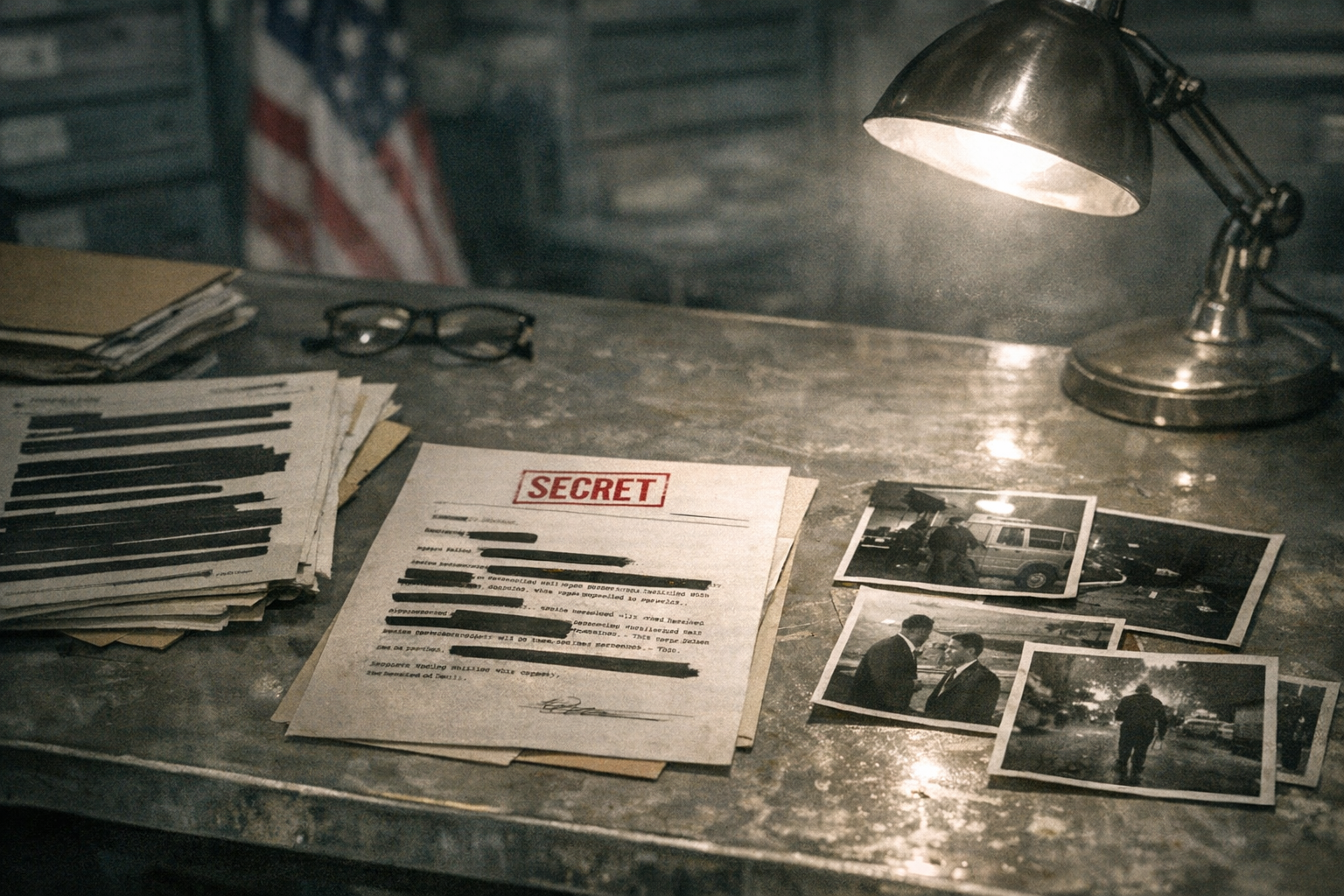
The memo was marked secret, the kind of paper meant for a closed room and a locked cabinet. On the page was a cold idea: create fear, shape the story, and make the public believe the threat came from somewhere else. That is why false flag operations still carry so much force today. The phrase does not survive because people imagine deception out of nowhere. It survives because history contains real moments when governments, militaries, and covert actors seriously considered using staged blame as a political weapon.
That hidden history matters. Once people learn that some deceptive plans were real, even if they were limited or never fully carried out, every later crisis starts to look darker. A bombing, a shooting, a sudden war, a shocking attack: for some, the first question becomes whether the event was what it seemed or whether someone wanted the public to see a mask instead of a face.
What Happened
A false flag operation is a deceptive act designed to make it look like someone else is responsible. The term originally came from naval warfare, when a ship might fly another country’s flag to confuse an enemy before revealing its true identity. Over time, the idea expanded into politics, espionage, and conspiracy culture.
The reason this theory feels stronger than many others is simple: history offers real examples of deception, propaganda, and staged justification. One of the most discussed cases is the 1962 Operation Northwoods proposal. Declassified records show that top U.S. military officials discussed plans involving staged or manipulated incidents that could be used to build support for action against Cuba. The plan was not carried out, but the fact that it was written down at all changed how many people viewed government secrecy.
🔎 Related Investigation:
There are older examples too. In 1939, Nazi Germany staged the Gleiwitz incident near the Polish border and blamed Poland. Historians widely treat it as one of the manufactured pretexts used to help justify invasion. Earlier still, political systems had long used planted evidence, covert sabotage, and manipulated public stories to build support for force.
Then there are the murkier cases. The Gulf of Tonkin incident in 1964 was not a classic false flag in the pure sense, but it became an example of how confusing, incomplete, or exaggerated reporting can drive a nation toward war. The public was told a clear story. Later records made that story look much less certain. That gap between first explanation and later evidence is exactly where suspicion grows.
Imagine the human side of that. A citizen hears on the radio that an attack has happened. Leaders speak with total confidence. Flags go up. Fear moves fast. Years later, documents appear showing the truth was more complicated, or that officials privately knew more than they admitted. That is the moment when public trust starts to crack. And once it cracks, it rarely breaks in only one direction.
So the modern false flag theory was not built from fantasy alone. It was built from a mix of real covert proposals, documented propaganda, manipulated pretexts, and a long public memory of being told one thing before learning another.
Why People Believe It
People believe false flag theories because the concept has a real historical foundation. If powerful institutions have used deception before, then new claims do not sound impossible. They sound familiar. That does not make every claim true, but it does explain why the theory keeps returning.
Another reason is speed. In the first hours after a shocking event, facts are often incomplete. Officials give partial statements. Witnesses contradict one another. News coverage races ahead of certainty. In that confusion, people start looking for motives instead of waiting for evidence. A false flag theory offers a neat answer: the chaos was planned.
There is also a psychological pull to the idea. Random violence is hard to accept. Bureaucratic failure is unsatisfying. A planned deception, however dark, gives the event structure. It turns fear into a plot with authors, targets, and purpose. That is one reason these stories overlap so easily with broader suspicions about hidden control, media influence, and permanent state power, themes that also appear in Mass Surveillance State.
The internet made this stronger. Old declassified records, real scandals, new cellphone clips, and unsupported theories all travel together now. A document about a genuine Cold War proposal can be posted right next to a modern claim with no proof at all. To a tired or angry reader, both can feel equally convincing because they share the same emotional message: you are being lied to.
That emotional message has power because it is not always irrational. Governments really have hidden programs. Intelligence agencies really have shaped narratives. Media organizations really have repeated early claims that later collapsed. Once those facts are in the public mind, the false flag label becomes sticky. People do not need full proof to keep it alive. They only need enough distrust to think it could happen again.
Claims vs Evidence
Claim: Governments regularly stage major attacks on their own people and blame others to justify war or control.
Evidence: There is confirmed evidence that some governments and military actors have used deception, staged incidents, or seriously considered doing so. But there is no blanket proof that every major modern attack described this way was staged by the state behind the scenes.
Claim: Operation Northwoods proves modern false flag claims should be treated as true by default.
Evidence: Operation Northwoods proves that senior officials once discussed shocking deceptive tactics. It does not prove those plans were carried out, and it does not automatically validate later claims attached to unrelated events. It is evidence of possibility and mindset, not universal proof.
Claim: Whenever official explanations change, it means the original event was a false flag.
Evidence: Not necessarily. Early reporting often changes because investigations uncover new facts, witnesses are mistaken, or leaders speak too confidently before the record is complete. A revised timeline can show confusion, incompetence, or political spin without proving a staged operation.
Claim: The existence of propaganda and disinformation campaigns means public events are usually scripted deceptions.
Evidence: Propaganda is real, and governments do shape narratives. But narrative control is not the same thing as physically staging an entire attack. This is where many false flag arguments stretch too far. They move from “officials manipulated the story” to “officials manufactured the event,” and those are not the same claim.
The strongest evidence in this topic points to something narrower but still serious: states sometimes use secrecy, selective truth, and deceptive planning in moments of crisis. The weaker part is the leap from that documented history to total certainty about modern events with little direct proof.
Reality Check
The reality check is that false flag operations are neither pure myth nor a master key that explains every public tragedy. Some deceptive acts and proposals are real. That is not speculation. Historians, declassified archives, and official investigations show that states have sometimes lied, manipulated, or discussed using staged blame to reach political goals.
But the broad online version of the theory often outruns the evidence. In many modern cases, the label appears within minutes, long before investigators can establish basic facts. It becomes a reflex. A dramatic event happens, distrust is already high, and the false flag explanation moves in before the record has had any chance to form.
That reflex matters because it can flatten important differences. A real covert proposal like Operation Northwoods is not the same thing as every viral claim that appears after a school shooting, bombing, or mass casualty event. One belongs to documented history. The other may rest on clipped video, anonymous posts, and assumptions about motive.
What we do know is that real deception has trained the public to look for hidden hands. What we do not know, in many famous modern cases, is whether there is any verified evidence beyond suspicion. Sometimes there is proof of narrative manipulation. Sometimes there is proof that officials were careless, misleading, or politically opportunistic. But that still falls short of proving a staged attack.
The smartest way to approach this subject is to separate three different ideas. First, did deception happen in history? Yes. Second, have governments used fear and confusion to push policy? Also yes. Third, does that mean any shocking event can be declared a false flag without hard evidence? No. That final jump is where the theory often becomes less about investigation and more about instinct.
In other words, the truth is uncomfortable in both directions. Blind trust fails here. But so does automatic suspicion. Real secrecy fuels the theory. Weak evidence limits it.
Conclusion
False flag operations remain powerful in conspiracy culture because the core idea is rooted in real history. People are not inventing the concept from thin air. They are reacting to documented cases where deception, staged blame, or manipulated public narratives were genuine tools of power.
At the same time, that history can become a trap. Once the label feels available for every frightening event, it stops being a careful claim and starts becoming a habit. The result is a theory that often begins with legitimate suspicion but grows beyond what the evidence can carry.
The most honest conclusion is that false flag operations are partly explained. The world has seen real deception, real pretexts, and real state secrecy. But each new accusation still has to be proved on its own. Otherwise, history stops serving as a warning and starts being used as a shortcut.
🔎 If this story stayed with you, the author suggests these real cases next:
- Operation Mockingbird: Did the CIA Really Shape the News?
- Deep State Explained: Hidden Ruling Network or Just the Machinery of Government?
- Shadow Governments: Who Really Pulls the Strings Behind Power?
Explore more Political Conspiracies stories here: