
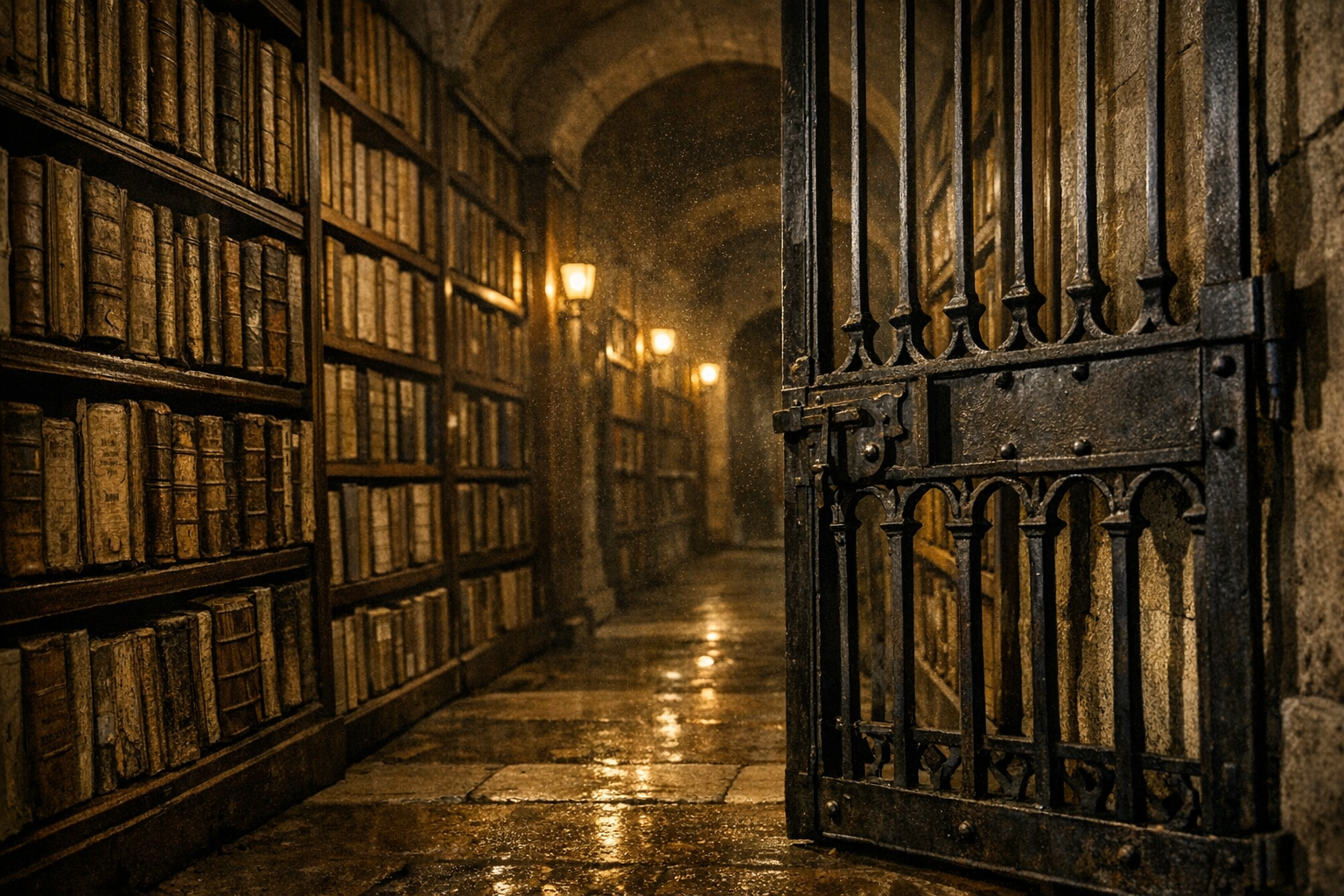
Behind thick stone walls and guarded doors in Vatican City, miles of shelves hold letters, trial records, and private reports most people will never touch. That image alone has helped turn one of the world’s most famous research collections into a legend of hidden truth. The phrase Vatican Secret Archives sounds less like a library and more like a vault built to keep history under lock and key.
What Happened
For years, the name itself did half the work. To many people, “secret archives” sounded like a place where the Catholic Church stored forbidden gospels, proof of alien life, political blackmail, or records that could shake the foundations of history. Once that idea took hold, every closed door and access rule seemed to confirm it.
But the story starts with language. The collection long known as the Vatican Secret Archives was officially called the Archivum Secretum Apostolicum Vaticanum. In older Latin, the word secretum did not simply mean hidden from the world. It often meant private, personal, or belonging directly to the pope. In other words, the name pointed to ownership and control, not necessarily to a chamber full of explosive truths.
That does not mean the archive is open in the casual sense. It has always been tightly managed. Scholars cannot just wander in because they are curious. Researchers usually need credentials, a clear reason for access, and approval. Large parts of the collection are handled under strict archival rules, and some materials remain restricted for practical, legal, or institutional reasons.
Those limits matter because they create the human moment that keeps this theory alive. Picture a researcher flying across the world, standing in line with paperwork, then being told that access is limited to certain collections and that some files are unavailable. Even if the reason is ordinary bureaucracy, the experience can feel like standing inches away from a locked answer.
The Vatican itself has tried to soften the mystery. In 2019, Pope Francis approved a name change from the Vatican Secret Archives to the Vatican Apostolic Archives. The move did not transform public imagination overnight, but it was a clear sign that the old label had created more suspicion than clarity. A misleading name had become part of the myth.
Why People Believe It
People believe the theory for a simple reason: powerful institutions with long histories naturally attract suspicion. The Vatican is ancient, wealthy, global, and deeply connected to politics, war, diplomacy, and religion. When an institution like that keeps records private, many people assume the privacy must protect something enormous.
There is also the pull of forbidden access. Most people will never enter the archive rooms, request a document, or watch the slow, careful process of historical handling. That gap invites imagination. If the public cannot easily see inside, the mind fills the empty space with the most dramatic possibility.
Stories tied to religion carry extra force because they touch identity and belief. Claims about suppressed gospels, rewritten doctrine, hidden prophecies, or evidence against official church teachings feel bigger than ordinary historical arguments. They seem to promise not just new facts, but a complete reversal of what millions of people think they know.
Pop culture adds fuel. Films, novels, documentaries, and online videos love the image of a sealed underground archive containing the one document nobody was supposed to find. That image is stronger than reality because it is visual, simple, and emotionally satisfying. A controlled reading room does not compete well with a hidden-vault fantasy.
Finally, there is the truth underneath the theory: the Church really does have a long history of secrecy, internal politics, and selective disclosure. That is not the same as proof of world-shaking concealment, but it gives conspiracy stories a believable starting point. When a theory begins with a real pattern of institutional caution, it becomes much easier for people to accept larger claims built on top of it.
Claims vs Evidence
Supporters of the theory usually make several big claims. One claim says the archives contain lost biblical texts that would overturn core Christian teachings. Another says they hold proof of contact with nonhuman intelligence, ancient advanced civilizations, or miracles explained away for political reasons. A third says the Vatican keeps records that reveal direct manipulation of world events across centuries.
There is no confirmed public evidence that the archives contain any single document with that kind of explosive effect. What we do know is that the Vatican preserves enormous amounts of historical material, including diplomatic correspondence, administrative files, legal records, and papers related to major church events. That alone makes the collection important, but importance is not the same as hidden proof of every rumor attached to it.
Some theorists point to restricted access as evidence in itself. Their argument is simple: if there were nothing shocking inside, why limit entry at all? The problem with that logic is that archives everywhere restrict access. Fragile documents, incomplete cataloging, legal concerns, privacy issues, and staffing limits all shape who can see what and when. Closed access can signal preservation or bureaucracy just as easily as concealment.
Others point to genuine historical controversies involving the Church. These include disputes over wartime records, internal decision-making, and the pace at which sensitive materials become available. Those debates are real. They show that institutions may manage information carefully and sometimes defensively. But they still do not prove that the archive hides a single master secret that would rewrite history in one stroke.
The strongest evidence against the wildest versions of the theory is also the least dramatic: historians have used Vatican archival material for decades. Research based on those collections has shaped serious scholarship on medieval politics, diplomacy, inquisitions, papal administration, and relations between church and state. If the archive were nothing but a forbidden vault sealed against all scrutiny, that long record of academic use would be hard to explain.
That said, believers are not wrong about one thing. Access is selective, and selectivity creates blind spots. The public does not get a full live feed of everything inside. Some materials remain difficult to reach, and outsiders must trust a system run by the same institution whose history is being studied. That tension is real. It just does not automatically confirm the most extreme claims.
For readers who want a broader look at how elite groups attract suspicion, the site’s pieces on the Freemasons and the Bilderberg meetings show the same pattern: limited visibility, symbolic power, and public uncertainty often create stories much larger than the available evidence.
Reality Check
The most likely reality is less cinematic and more interesting. The Vatican Apostolic Archives are a major institutional archive with real historical value, real access controls, and real reasons for public suspicion. They are not simply an open library. But they are also not proven to be a vault of hidden revelations waiting to destroy the official story of religion, science, or world politics.
This matters because conspiracy thinking often mistakes opacity for proof. When an institution is old, guarded, and difficult to access, people naturally assume the barrier exists to protect a dramatic truth. Sometimes the barrier protects power. Sometimes it protects fragile records. Sometimes it protects privacy, reputation, or process. Often it is a mix of all four.
The Vatican’s archive story is powerful because it lives in that uncomfortable middle ground. The Church has enough history, authority, and secrecy to make the suspicion feel reasonable. At the same time, the leap from “controlled archive” to “hidden truth vault” is much larger than many storytellers admit.
A good rule here is to separate what feels suspicious from what is proven. It is fair to ask why some records remain hard to access. It is fair to debate how transparent the Vatican should be. It is not fair to claim that every unanswered question is evidence of suppressed world-changing knowledge.
If anything, the deeper lesson is about naming and perception. A single phrase—“secret archives”—helped build decades of myth because it sounded forbidden before anyone examined what it really meant. Once people imagine hidden shelves and sealed boxes, the legend can survive even after the name changes and the facts become clearer.
If you are interested in another case where secrecy itself becomes the engine of belief, the article on Bohemian Grove explores how restricted spaces and elite rituals can create stories that feel larger than the evidence behind them.
Conclusion
The Vatican Secret Archives theory survives because it blends three things people find irresistible: old power, limited access, and the possibility that history has been edited behind closed doors. That combination makes the story feel plausible before any evidence is even presented.
What we do know is that the Vatican holds a huge and important archive, that access is controlled, and that the old name helped feed public misunderstanding. What we do not know is any verified fact showing the archive contains a hidden cache of revelations that would overturn religion or expose a buried master plot.
So is it a hidden truth vault or history locked behind a misleading name? Based on the public evidence, the second answer fits much better. The mystery is real mostly because the institution is private, powerful, and symbolically loaded—not because the strongest conspiracy claims have been proven true.
🔎 If this story stayed with you, the author suggests these real cases next:
- Freemasons Explained: Brotherhood, Symbolism, or Hidden Influence?
- Bilderberg Meetings: Private Networking or Elite Control Behind Closed Doors?
- Bohemian Grove Conspiracy: Strange Ritual or Proof of Hidden Power?
Explore more Secret Societies stories here: