
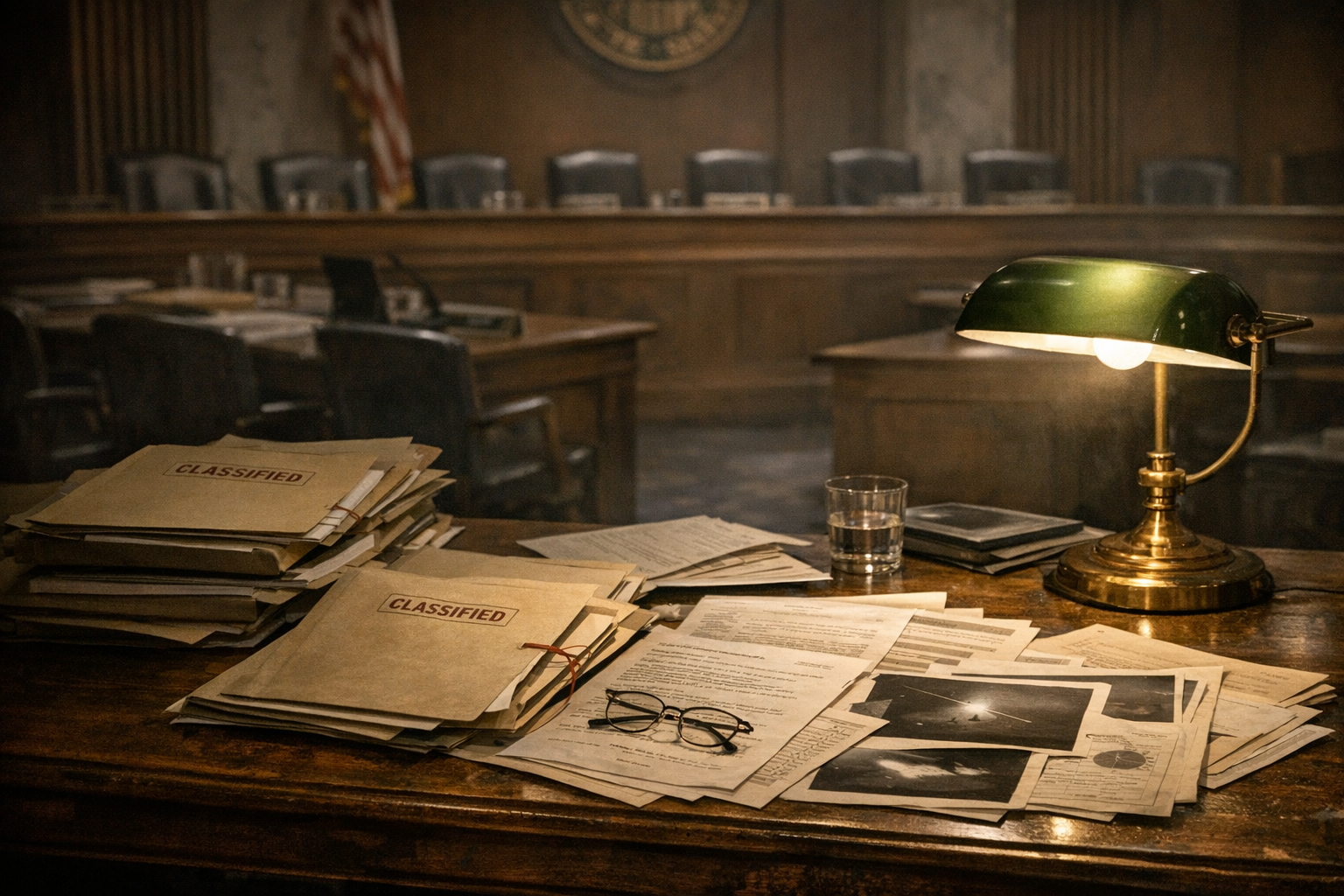
Late in 2023, buried inside one of Washington’s biggest annual defense bills, a strange piece of language slipped into public view. It talked about hidden records, unknown technologies, and even “non-human intelligence” in the careful, cold tone lawmakers use when they do not want to sound excited—but also do not want to look away.
The Schumer UAP Disclosure Act was a proposed transparency law tied to the 2024 National Defense Authorization Act. Supporters saw it as a serious push to gather and release government records about unidentified anomalous phenomena, while critics saw something else: lawmakers acting as if buried programs and records might really exist. The reality is more grounded and more interesting. The act did not prove aliens were real, but it did show that some members of Congress believed the records question was serious enough to demand its own legal machinery.
What Happened
To understand why this bill caught so much attention, you have to picture the mood around UAPs in 2023. Hearings had already pushed the topic back into the open. Former intelligence officer David Grusch had made explosive public claims about secret crash-retrieval programs. The Pentagon had its own offices and reports trying to sort signal from noise. And all of it sat inside the same uneasy question: if the government really had more on this subject, where was it?
That is the space the Schumer-Rounds amendment stepped into. Instead of asking the public to trust rumors, it tried to build a paper trail. The proposal, often called the UAP Disclosure Act, was modeled in part on the JFK records framework. The basic idea was simple enough for anyone to follow: force agencies to identify UAP-related records, move them into a central collection, and create a process that leaned toward eventual public release.
But the details were what made people stop and stare. The original language did not just mention unidentified phenomena in the abstract. It referred to records about “technologies of unknown origin” and “non-human intelligence.” It proposed an independent review board. It included a disclosure presumption rather than ordinary passive archiving. And, in its strongest form, it even included eminent-domain language touching alleged privately held material.
For believers, that sounded like a quiet confirmation that Congress had seen enough smoke to assume there might be a fire. For skeptics, it sounded like lawmakers responding to a storm of claims without having proof of what sat behind them.
Then came the part that matters most. The full version did not survive intact. During negotiations over the final defense bill, some of the strongest provisions were stripped out. What made it into law was narrower: a framework for identifying and transferring qualifying UAP records to the National Archives, not the full aggressive disclosure system many readers now imagine.
That narrowing is the whole story in miniature. The legislation began like a spotlight sweeping through a locked room. By the time it became law, the spotlight was still there—but weaker, lower, and aimed mostly at filing cabinets.
Why People Believe It
The belief around this act does not come only from UFO culture. It comes from pattern recognition. People know governments keep secrets. They know classified programs exist. They know strange things can stay buried for years, then surface in fragments. So when Senate leaders use language that sounds far more serious than the usual eye-roll treatment of UFOs, people naturally ask whether they were responding to more than internet noise.
There is also a human moment at the center of this. Imagine reading a dry piece of legislation late at night and suddenly hitting phrases that sound like they were lifted from a secret memo, not a standard records bill. That emotional jolt matters. It makes the text feel like an accidental glimpse through a door that was supposed to stay shut.
Another reason people lean hard into the act is that it arrived after a long build-up. The site’s own coverage of government UFO programs shows how this topic never fully disappeared. It changed names, moved between offices, and returned whenever a witness, a leaked video, or a hearing forced it back into view. By the time the Schumer language appeared, many readers were primed to see it not as a starting point, but as the latest clue in a much older chain.
The act also connected neatly with the claims around David Grusch’s allegations. Grusch talked about hidden programs and information being kept from proper oversight. A law built to gather records and review secrecy decisions felt, to many, like Congress reacting to exactly that kind of warning. Even if the law never named his claims as proven fact, the timing made the overlap impossible to ignore.
And then there is the deeper psychology of secrecy. People do not need proof of extraterrestrials to become fascinated by a records fight. The possibility that officials might be protecting old compartments, hiding embarrassing failures, or shielding special access programs is already enough to create lasting suspicion. In other words, this story works even before anyone says the word alien out loud.
Claims vs Evidence
Claim: The Schumer UAP Disclosure Act proves Congress knew hidden alien programs existed.
Evidence: It proves no such thing. A law can be written to collect and review records without confirming the claims behind those records. Legislators often build procedures around allegations precisely because the facts are disputed.
Claim: The act was just a boring filing exercise and means nothing.
Evidence: That also goes too far. The original proposal was not just clerical housekeeping. The review-board concept, disclosure presumption, and unusually direct terminology showed that at least some lawmakers believed the normal records process was not enough.
Claim: The final law delivered full UAP disclosure.
Evidence: No. The final 2024 NDAA language kept a records-collection framework and required agencies to identify, organize, and transfer qualifying UAP records to the National Archives. But the tougher parts of the original proposal were stripped away. That means centralization and preservation moved forward more clearly than forced public revelation.
Claim: If lawmakers used terms like “non-human intelligence,” they must have seen proof.
Evidence: Not necessarily. Lawmakers can use broad language because they are trying to cover allegations already circulating inside oversight channels. Broad legal wording can reflect caution, scope, or political pressure—not confirmation.
This is where the contradiction gets interesting. If Congress thought the topic was nonsense, why create a specialized disclosure structure at all? But if Congress had solid proof, why did the process stop short of a stronger release system? The answer may be that lawmakers were operating in the middle zone: serious enough to investigate, not proven enough to declare solved.
That same middle zone appears in the wider disclosure cluster. Pieces like UFO crash retrieval claims show the same tension over and over. The stories are dramatic. The testimony is real. The public appetite is huge. But the hard evidence available to ordinary readers remains incomplete, contested, or locked behind systems they cannot independently inspect.
Reality Check
The cleanest way to read the Schumer UAP Disclosure Act is not as a confession, and not as a meaningless stunt. It is better understood as a stress test. What happens when lawmakers are told that important records may be scattered, overclassified, or stuck inside compartments that normal oversight cannot easily penetrate?
The original answer was ambitious: create a structure that acts almost like an outside referee. Gather the records. Put them in one place. Force delay decisions to justify themselves. Build a public-release path that does not rely entirely on the same institutions being questioned. That is a much stronger posture than simply saying, “the agencies can handle it internally.”
But the final bill tells a second story. When the strongest tools disappeared in conference, it suggested there were still limits—political limits, bureaucratic limits, and maybe national-security limits—on how far Congress was willing or able to go. That matters. It shows this was not a straight-line march toward total openness. It was a compromise.
There is also a practical truth people sometimes miss. Records laws do not magically create evidence that was never preserved, never shared upward, or was described in vague ways from the start. Even a perfect disclosure framework can only surface what exists, what is identified, and what can legally be released. That means the act could matter a lot for transparency while still leaving the biggest existential questions unresolved.
So did lawmakers behave as if hidden records might exist? Yes, that is the most reasonable reading. Did they behave as if alien visitation had been proven? No, that goes beyond the evidence. Their behavior makes more sense as institutional caution meeting extraordinary allegations. They were not certifying the story. They were acknowledging that the records problem itself had become serious.
If anything, that is why the act keeps lingering in public memory. It lives in a narrow but powerful space between ridicule and revelation. Not a smoking gun. Not a joke. A signal that some people in high office thought the archive deserved a closer look than the public had been getting.
Conclusion
The Schumer UAP Disclosure Act matters because it turned a wild-sounding subject into a legal and archival fight. It did not prove hidden programs existed, and it certainly did not prove extraterrestrial claims. What it showed was something subtler: Congress was willing to build special disclosure tools because ordinary explanations no longer seemed sufficient to some of the people closest to the oversight process.
That is why the act still resonates. It is less a revelation than a measure of institutional seriousness. The strongest version suggested lawmakers wanted a system robust enough to test secrecy claims from the outside. The weaker final version showed how hard that is to achieve in the real world.
So if you came here asking what the Schumer UAP Disclosure Act actually was, the short answer is this: it was a transparency push shaped by extraordinary allegations, then narrowed before becoming law. And that narrowing may be the most revealing part of the story.
🔎 If this story stayed with you, the author suggests these real cases next:
- Government UFO Programs: Why the Files Never Really Closed
- David Grusch UFO Claims: What Was Alleged, What Was Verified?
- UFO Crash Retrieval Claims: Hidden Recovery Program or Testimony Without Proof?
Explore more Alien & UFO Theories stories here: