
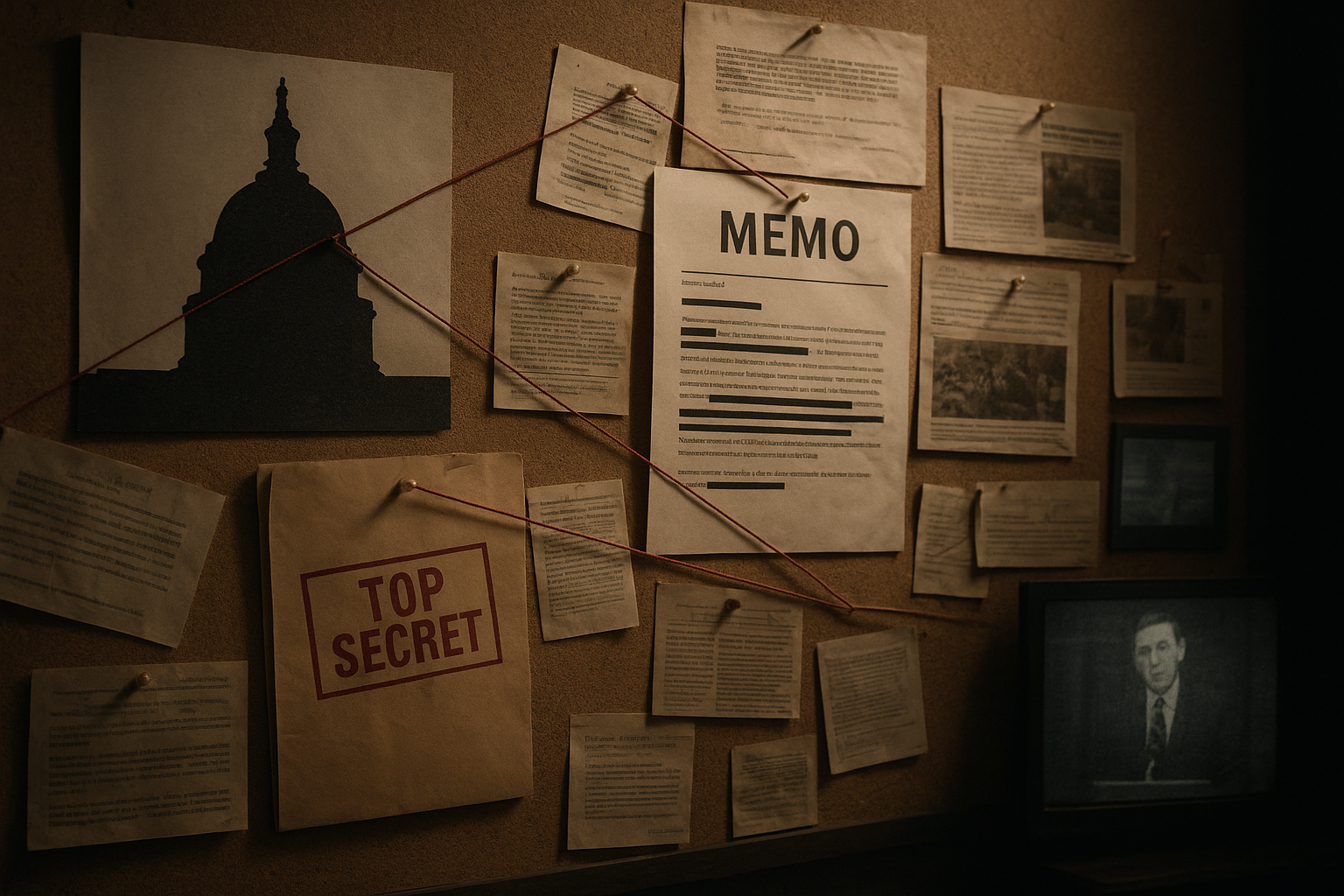
Political conspiracy theories in America rarely start with pure fantasy. They usually start where real secrecy, real institutional failure, or real deception left enough space for suspicion to grow faster than the evidence.
Setup
Political conspiracy stories thrive in the gap between what the public is told and what the public later learns. That gap matters. When officials mislead, when documents surface years after the fact, or when institutions protect themselves instead of explaining themselves, people stop treating uncertainty as uncertainty. They start treating it as proof that something bigger must be hidden.
That is why this article works best as a gateway rather than a grand theory. The goal is not to argue that one invisible force controls American politics. It is to show why some political conspiracy narratives keep returning, which parts of them are rooted in real history, and where the leap from suspicion to certainty usually outruns the record.
Across this category, the same pattern appears again and again. A documented abuse, secrecy program, or information failure creates a durable wound in public trust. Later claims then borrow credibility from that wound, even when the new evidence is much thinner than the older scandal that made people receptive in the first place.
What People Claim
The broadest political conspiracy claims tend to circle the same fears: elections are quietly manipulated, media narratives are coordinated from above, intelligence agencies shape events beyond public oversight, and elected leaders are less powerful than the hidden systems around them. Sometimes those claims are framed through the language of elite networks. Sometimes they are framed through bureaucratic permanence, covert influence, or a supposed ruling class that survives every election cycle.
These narratives endure because they simplify a complicated reality into a recognizable story. Instead of messy competition between agencies, parties, donors, media incentives, security institutions, and administrative systems, conspiracy culture offers a cleaner explanation: someone is steering the outcome. That is emotionally satisfying. It can also be misleading.
Take Election Fraud Theories. The strongest versions of the claim argue that large outcomes can be manipulated while the public sees only the official result. The evidence standard for that kind of claim has to be high, because the claim itself is high-impact. The same logic applies to hidden-power narratives around Shadow Governments, where the suspicion often begins with a real observation – permanent institutions outlast elected personalities – and then expands into something much harder to prove.
Why It Spread
Political conspiracy theories spread because the United States has produced enough real examples of secrecy and manipulation to make public distrust feel earned. That does not validate every later theory. It does explain why many of them never fully disappear.
People do not need to invent the idea of hidden influence from scratch. They can point to propaganda efforts, intelligence abuses, classified programs, selective leaks, redactions, legal opacity, and strategic messaging. A story like Operation Mockingbird remains influential for exactly that reason. It keeps attention because it touches a fear that is historically grounded: governments have tried to shape information environments before. Once that possibility feels real, audiences become more willing to assume that broad coordination is always happening, even where the proof is limited or absent.
The digital environment makes the effect stronger. Contradictions travel faster than corrections. Partial documents are treated as complete explanations. Screenshots and clips circulate without their full context. And once a community forms around the belief that official accounts are fundamentally unreliable, every missing detail starts to look like a deliberate omission rather than an ordinary limit of what can currently be shown.
What Evidence Shows
The documentary record supports a serious but narrower conclusion than most sweeping political conspiracy claims prefer. Institutions do conceal things. Governments do manage information. Intelligence and security systems do operate with a level of opacity that ordinary voters cannot easily monitor in real time. Media ecosystems can be influenced by access, incentives, patriotic framing, selective sourcing, and strategic disclosure.
What the record does not automatically support is the idea that every election dispute, every media failure, every policy continuity, and every national controversy can be traced back to one central hidden command structure. In reality, power is often fragmented. Agencies compete. Interests overlap without fully aligning. Errors, incentives, and bureaucratic inertia can produce outcomes that feel coordinated without requiring a single mastermind.
That distinction matters for political topics especially. Neutral analysis has to separate claims from verified evidence. A claim may sound plausible because related misconduct has happened before. But plausibility is not confirmation. The question is always whether this specific allegation is backed by documents, verifiable testimony, consistent data, or credible investigative reporting – not whether it feels like the kind of thing institutions might do.
Where Confusion Came From
The confusion usually starts when three different realities get blurred together. The first is documented misconduct: events where officials misled the public, hid information, or acted deceptively. The second is structural opacity: the ordinary fact that large political systems are complex, slow, and difficult to see from the outside. The third is speculative storytelling: the assumption that unexplained patterns must point to intentional secret control.
Those categories are not the same, but political conspiracy culture often treats them as interchangeable. If one agency lied in one era, then every later contradiction becomes evidence of a lie. If one covert operation was declassified, then every secretive policy process becomes proof of another covert operation. If an institution cannot fully explain itself on demand, the lack of clarity is recast as confirmation of hidden design.
That is also why gateway articles like this one matter. The useful reading habit is not to dismiss suspicion automatically or to reward it automatically. It is to ask what kind of thing is actually being alleged. Is the claim about influence, manipulation, incompetence, secrecy, coordination, or total control? Those are different propositions. They require different evidence.
Modern political anxiety makes that sorting harder. Institutional trust is low, information is abundant, and people often encounter claims through communities that already assume the answer. Once distrust becomes identity, evidence can stop functioning as a test and start functioning as a prop. At that point, even uncertainty gets interpreted in only one direction.
Reality Check
The strongest reality check is simple: America has plenty of documented reasons for citizens to be skeptical, but skepticism becomes unreliable when it starts treating every unresolved question as proof of a hidden system.
Some political conspiracy theories survive because they are built near real pressure points – secrecy, influence, intelligence activity, media management, and institutional self-protection. That is the part worth taking seriously. The weaker move is turning those pressure points into one universal explanation for every contested event. The evidence usually supports something more limited, more fragmented, and less cinematic than the viral version suggests.
If this category is useful, it is because it helps readers hold two ideas at once: distrust can be understandable, and overclaiming can still be wrong. That tension is where the clearest reading usually lives.
?? If this story made you think, here are more conspiracy investigations worth exploring next:
- Operation Mockingbird: Did the CIA Really Shape the News?
- Shadow Governments: Who Really Pulls the Strings Behind Power?
- Election Fraud Theories: What the Claims Said vs What the Evidence Actually Showed
?? Explore more in this category:
Political Conspiracies