
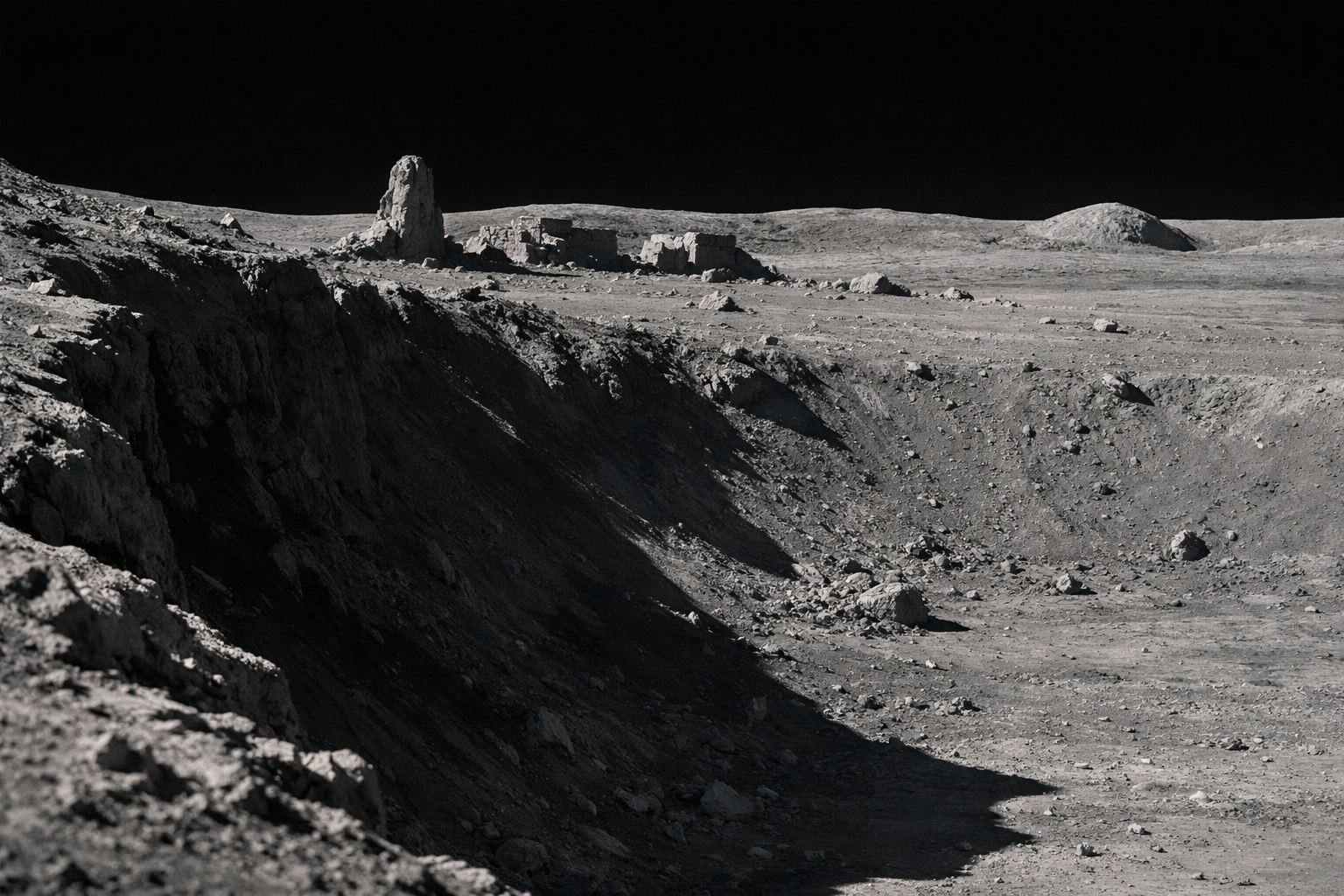
The image looked wrong the moment people enlarged it. In a gray stretch of lunar dust, under hard black shadow and harsh white sunlight, believers said they could see lines that should not exist—ridges that looked like walls, shapes that felt too clean, and shadows that seemed to belong to towers no one was supposed to find. That is where the moon base conspiracy took root: in the uneasy feeling that a place this empty might not be empty at all.
The theory did not begin with one official confession or one perfect photo. It grew from blurry space images, old astronaut chatter, and a powerful suspicion that if the Moon ever held something artificial, the public would be the last to know. For decades, that mix of secrecy and pattern-seeking turned ordinary lunar features into one of the strangest branches of UFO culture.
What Happened
The core claim is simple. Supporters say NASA missions, telescope images, and later satellite photographs captured strange structures on the Moon—domes, towers, long bridges, geometric ruins, and even active installations. In some versions, the base is alien. In others, it is human, hidden by governments or international agencies under layers of classification.
The idea gained traction in the late twentieth century, when copies of lunar photographs began circulating in books, magazines, and later on internet forums. A crater wall might be enlarged until a bright line looked like a pipeline. A ridge inside a shadowed region might seem like a rectangular building. Once these images were shared with arrows and captions, they stopped looking like random terrain and started looking like clues.
There was also a human element that made the theory more persuasive. People remembered the Moon landings as a time of intense national competition, military secrecy, and selective information. If rockets, satellite programs, and defense technology were guarded so carefully, some readers asked a natural follow-up question: what else might have been kept out of view?
One reason the theory lasted is that the Moon already feels eerie in photographs. The surface is silent, overexposed, and strangely flat in some frames. Distances are hard to judge. A shallow ridge can look enormous. A boulder can seem like a tower. For someone staring at a grainy image late at night, it does not take much to slip from “that is unusual” to “that looks engineered.”
A mini-scene appears again and again in old conspiracy discussions. Someone prints a black-and-white lunar image, spreads it across a desk, and traces the odd parts with a finger: a sharp angle here, a dark opening there, a line cutting across dust like a road. In that moment, the picture feels less like science data and more like forbidden evidence. That emotional experience is a big part of why the theory survived.
Modern versions of the story added more fuel. Higher-resolution images from lunar orbiters were supposed to settle the question, but instead they produced new circles of interpretation. Believers said improved detail finally revealed ruins and hidden patterns. Skeptics said the opposite: better images showed that earlier claims came from poor resolution, harsh lighting, and wishful reading.
That debate pushed the theory into the wider UFO world. It was no longer just about a strange photograph. It became part of a bigger belief that governments already know far more about extraterrestrial life than they admit. Readers who already distrusted official silence around government UFO programs were more likely to see lunar secrecy as part of the same pattern.
Why People Believe It
People believe the Moon base story for several understandable reasons. First, it sits at the perfect meeting point of mystery and distance. Most people will never examine lunar geology for themselves, and very few can judge whether a strange feature in a photograph is ordinary or impossible. That knowledge gap creates room for dramatic interpretations.
Second, the Moon already carries a mythic weight in human culture. It is close enough to feel familiar and far enough to remain unsettling. Unlike a distant galaxy, it is a place we can see from the ground. That makes the idea of hidden structures feel weirdly personal, as if the secret has been hanging over humanity every night in plain sight.
Third, the theory borrows credibility from real history. Governments did keep major space and military projects secret. Officials have changed explanations before, especially when early information was incomplete or politically sensitive. For conspiracy-minded readers, that history creates a habit of suspicion. If institutions were cautious or selective once, they might be doing it again.
Another reason is visual psychology. Human brains are built to recognize patterns quickly. That skill helps us identify faces, roads, and shelter, but it also makes us see design where there is none. A hill can look like a pyramid. A crater edge can look like a dome. In low-quality lunar imagery, this effect becomes even stronger because the missing detail allows imagination to fill the gap.
The theory also benefits from the way old rumors travel online. A single cropped image can be reposted for years with new captions, stripped of context, and presented as freshly uncovered evidence. By the time it reaches a new audience, it no longer looks like an ambiguous photo. It looks like a hidden discovery being passed from person to person.
And then there is the larger UFO framework. If someone already believes there are unexplained craft, secret retrieval programs, or hidden contact cases, a lunar outpost does not feel like a giant leap. It feels like the next logical step. Stories about Area 51 alien rumors and buried official secrecy make the Moon base theory feel less isolated and more connected to a familiar map of hidden knowledge.
Claims vs Evidence
Claim: Lunar photographs show artificial towers, domes, roads, or buildings. Evidence: Supporters usually point to enlarged images with highlighted shapes and straight-looking lines. However, there is no confirmed image set accepted by lunar scientists as showing artificial construction. In most cases, the features can be explained by natural rock formations, crater rims, compression artifacts, or the extreme contrast of sunlight and shadow.
Claim: Astronauts hinted that they saw structures or were being watched. Evidence: This idea often comes from recycled transcripts, misquoted radio chatter, or secondhand retellings that grew more dramatic over time. There is no verified mission transcript confirming that Apollo crews reported alien bases on the Moon. What we do know is that mission communications were technical, heavily recorded, and frequently reinterpreted later by conspiracy communities.
Claim: NASA removed or altered lunar images to hide evidence. Evidence: There is no confirmed public record proving a systematic cover-up of Moon base photographs. Image quality differences, missing context, and archival confusion do exist, especially across older collections, but those problems are not the same as proof of deliberate erasure. Supporters often treat any inconsistency as evidence of suppression, even when routine formatting or scanning issues are enough to explain it.
Claim: The Moon is the perfect location for a hidden alien outpost because it is close, silent, and easy to monitor from a distance. Evidence: This is speculative rather than evidential. It may sound plausible in fiction, but plausibility is not proof. There is no confirmed physical evidence of structures, traffic, energy output, or engineered materials on the Moon that requires an artificial-base explanation.
Claim: Later high-resolution lunar imagery exposed geometric anomalies too precise to be natural. Evidence: High-resolution data can make some features look sharper, but it also gives experts more context for geology, scale, and terrain. When the wider landscape is examined, many “perfect” shapes stop looking perfect. A cropped section can feel shocking; the full frame often makes it ordinary.
This is the key split in the story. The claims rely heavily on interpretation. The evidence relies on documented imagery, mission records, and what specialists know about how light behaves on the Moon. That does not make every strange image boring. It does mean the jump from “unusual” to “artificial base” remains unsupported.
Reality Check
The Moon base conspiracy is compelling because it uses a real weakness in human judgment: we are not very good at reading distant landscapes from ambiguous photos. Add secrecy, old Cold War distrust, and the emotional pull of space exploration, and ordinary features can start to look loaded with meaning.
There is also a deeper psychological hook here. The theory offers a dramatic answer to a quiet discomfort many people feel about space. The Moon looks close enough to know, yet far enough to hide anything. That makes it a perfect screen for projection. People do not just see rocks and shadows there. They see the possibility that humanity was never alone, and that someone kept the file closed.
But when the theory is tested against confirmed evidence, it weakens quickly. There is no verified photograph of an artificial lunar installation. There is no confirmed astronaut testimony proving a Moon base. There is no public record showing that official agencies discovered structures and then hid them from the world. The strongest support comes from visual ambiguity, not from hard documentation.
What we do know is that lunar photography is easy to misread. Harsh lighting creates sharp contrasts. Scale is deceptive. Compression and enlargement can manufacture false clarity. And once a suspicious label is attached to an image, the human brain tends to keep seeing the label instead of the landscape.
That leaves the story in a more grounded place. The Moon base conspiracy tells us less about hidden towers on the lunar surface and more about how secrecy and uncertainty work together. When institutions control information and the public already expects concealment, even ordinary shadows can start to feel like evidence.
The likely outcome here is debunked. Not because the Moon is fully boring, and not because every question about space exploration has been answered, but because this specific claim has never crossed the line from intriguing interpretation to confirmed fact.
Conclusion
The Moon base conspiracy survives because it turns a silent landscape into a locked room. A few strange images, a few recycled rumors, and a long history of distrust are enough to make that locked room feel occupied. For readers, that is a powerful story.
But the better explanation is still the simpler one. Blurry photos, dramatic crops, and the human habit of finding design in chaos created a mystery bigger than the evidence could support. The Moon remains fascinating. It just has not given us confirmed proof that anyone built something there before we arrived.
What remains is not a hidden base, but a revealing pattern. When people feel they are looking at forbidden knowledge, even shadows can become architecture. And that may be the real lesson of this case: the most durable conspiracy stories often grow not from solid proof, but from the places where uncertainty looks just sharp enough to fool us.
🔎 If this story stayed with you, the author suggests these real cases next:
- Roswell UFO Crash: What the Original Witnesses Claimed and What the Records Actually Show
- Pentagon UFO Videos: What the Navy Footage Confirmed – and What It Didn’t
- Travis Walton UFO Incident: The 5 Days That Turned a Logger Into a Legend
Explore more Alien & UFO Theories stories here: