
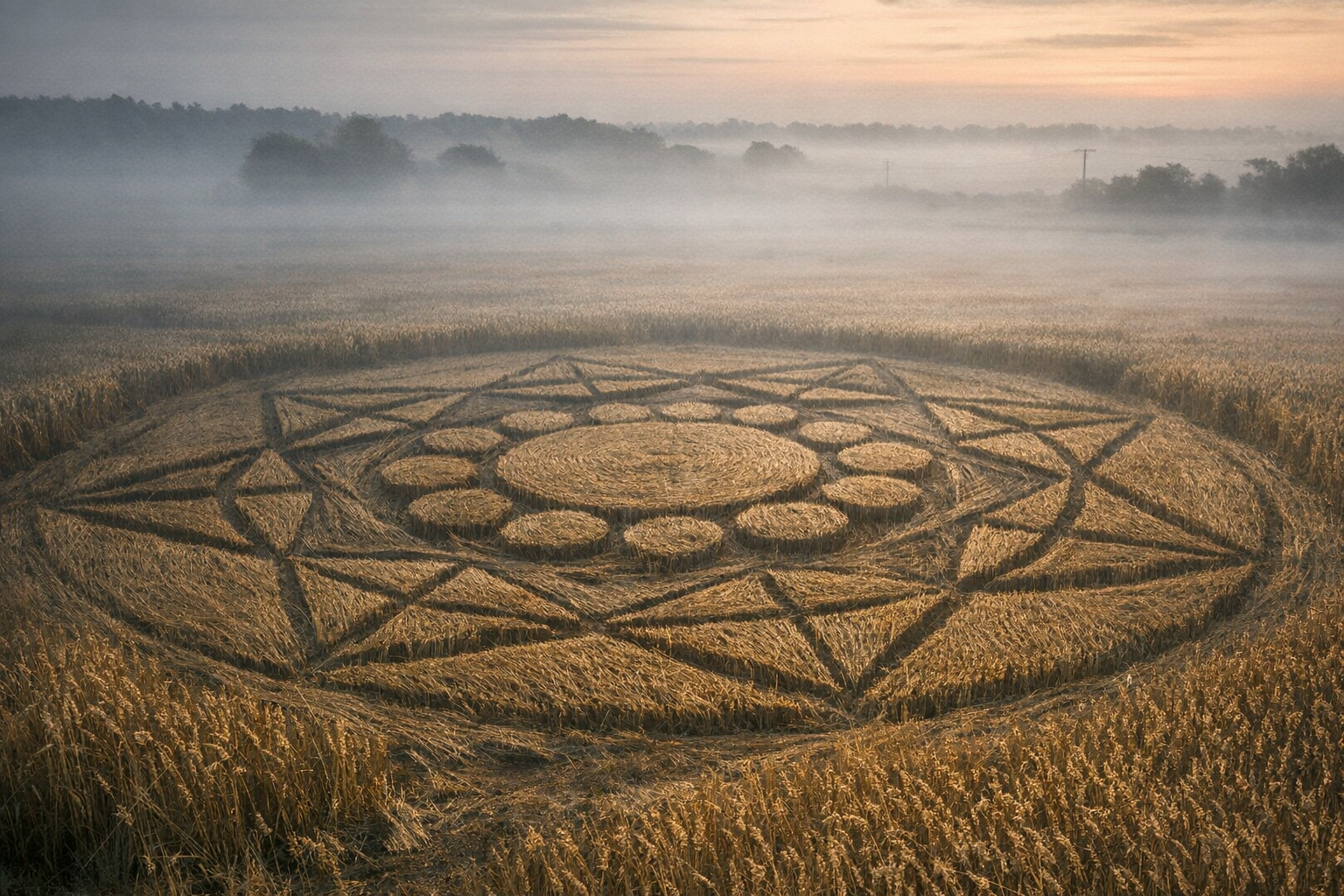
Before sunrise, the field looked ordinary—just damp wheat, low mist, and long shadows stretching toward a narrow country road. Then the farmer walked deeper into the crop and found a perfect circle pressed into the stalks, followed by another, and another, until the ground seemed to hold a message no one remembered writing. For decades, the crop circles mystery has lived in that uneasy space between prank, pattern, and forbidden possibility.
What Happened
Reports of unusual shapes in fields have appeared for centuries in different forms, but the modern crop-circle era took off in England in the late 1970s and 1980s. At first, many formations were simple circles. Then they became more complex—rings inside rings, straight pathways, spirals, and giant geometric patterns that looked almost too clean to be made overnight.
The timing mattered. This was the same cultural period that gave new life to UFO stories, government secrecy fears, and the idea that official explanations never told the whole story. A strange pattern in a field was no longer just odd damage to crops. To many people, it looked like a sign that something hidden had touched the ground and disappeared before morning.
Part of the mystery came from how the formations were discovered. A farmer might go to bed with a normal field and wake up to a design large enough to be seen clearly only from above. In some cases, locals claimed there had been no noise, no vehicle tracks, and no easy way for a group of pranksters to work in darkness without being seen.
That gap between the result and the imagined method gave the story power. It is one thing to hear that a circle exists. It is another to stand at the edge of one, looking down at bent stalks arranged with unnerving symmetry, while strangers gather with cameras and everyone asks the same question: who did this, and how fast did they do it?
There was also a human moment that helped keep the legend alive. Farmers were often frustrated because the designs damaged crops and attracted crowds. Tourists, meanwhile, treated the same fields like open-air mystery scenes. Believers walked the patterns slowly, as if the ground itself might reveal a secret if they paid close enough attention.
Why People Believe It
People believe in mysterious explanations for crop circles because the visuals are powerful. A blurry light in the sky can be doubted. A shape in a field feels physical. You can touch the stalks, measure the diameter, and photograph the pattern. That makes the event feel more real, even before anyone proves what caused it.
Another reason is that crop circles seem to combine two different kinds of mystery at once. On one level, they look artistic and intelligent, as if they were designed with intention. On another, they often appear in isolated places and are discovered after the fact, which creates the feeling of secret access. Something entered, left a mark, and was gone before witnesses could catch it.
Supporters of unusual explanations often point to details inside the formations. Some claim the stalks are bent rather than broken, suggesting a process more advanced than boards and rope. Others argue that certain patterns are so large and precise that ordinary people could not have finished them in a single night without visible mistakes.
The theory also grew because crop circles arrived during a wider wave of UFO fascination. If people already believed governments were hiding contact, hidden bases, or unexplained aerial events, then field formations felt like one more piece of the same puzzle. The shapes became less about agriculture and more about the possibility that nonhuman intelligence was leaving symbols on the landscape.
And then there is pattern-seeking, a very human habit. When people see geometry in nature, they often assume agency. We are built to notice order and connect it to intention. A perfect circle in a wheat field feels less like weather and more like a signature, even when no one can agree on who signed it.
Claims vs Evidence
Claim: Crop circles are evidence of alien visitation or a nonhuman intelligence. Supporters of this idea argue that some formations appear too sophisticated to be made by human hoaxers. They also point to stories about glowing lights, strange sounds, or equipment malfunctions near certain sites.
Evidence: There is no confirmed evidence that any crop circle was created by aliens or any nonhuman force. No verified physical sample, official investigation, or repeatable scientific test has established an extraterrestrial origin. What we do know is that many crop circles have been admitted hoaxes, and artists have publicly explained how they made complex patterns using simple planning tools.
Claim: The bent crops show signs of unusual energy rather than mechanical force. Some believers say the stems are heated, twisted, or altered in ways ordinary trampling cannot explain.
Evidence: Some researchers and enthusiasts have reported unusual observations, but these claims remain disputed and are not accepted as proof of a nonhuman event. Crop behavior can be affected by moisture, plant growth stage, pressure, weather, and later handling by visitors. Even when a formation looks strange up close, that does not automatically establish an extraordinary cause.
Claim: The scale and precision of certain formations make human creation unrealistic. Supporters argue that large, intricate designs appearing overnight would require impossible speed and coordination.
Evidence: Human teams have repeatedly shown that large formations can be planned and built in limited time, especially with surveying methods, ropes, boards, measuring lines, and prior design work. A formation can feel impossible if you imagine random people improvising in darkness. It feels much less impossible if skilled creators scout the field, sketch the layout, and work deliberately.
That matters because the strongest crop-circle argument is often emotional rather than technical: “It looks too perfect.” But perfection is not proof. Humans are very good at making things that seem impossible until the method is shown. That same lesson appears in stage magic, architecture, and visual design. Surprise alone is not evidence of aliens.
At the same time, it would be too simple to wave everything away with one word: hoax. The real story is more layered than that. Some formations clearly were hoaxes. Some claims around them grew larger after the fact. Some eyewitness stories are impossible to verify. And some people experienced genuine awe because they encountered something visually striking without knowing its origin in the moment.
That mix is part of why the subject lasts. It is not only about what happened in the fields. It is also about how uncertainty works in public. Once a mystery reaches newspapers, television, and now social media, the story becomes bigger than the original event. A pattern in crops turns into a debate about trust, perception, and whether experts are missing something important.
That is also why crop circles fit naturally beside other UFO-era mysteries like Roswell UFO Crash: What the Original Witnesses Claimed and What the Records Actually Show and Pentagon UFO Videos: What the Navy Footage Proves. In each case, public imagination rushes in where evidence feels incomplete.
Reality Check
The reality check is not that crop circles are boring. It is that they are a powerful example of how mystery can grow from a real visual event without that event proving the biggest theory attached to it. A crop circle can be impressive, strange, and worth examining while still being human-made.
Official records and public reporting show that admitted hoaxers played a major role in the crop-circle phenomenon. Two of the most famous figures linked to early modern crop circles, Doug Bower and Dave Chorley, said they made many of the designs themselves. Their confessions did not explain every single case, but they changed the baseline. After that, the burden of proof became much higher for anyone claiming a nonhuman source.
What we do know is that human imitation also changed the landscape. Once crop circles became famous, more people had reason to create them—artists seeking attention, pranksters chasing headlines, and promoters feeding a growing mystery economy of books, tours, and documentaries. That does not automatically make every case fake, but it does mean later cases happened inside a culture already primed to reproduce the effect.
There is also no confirmed chain of evidence linking crop circles to UFO landings, secret technology tests, or communication from elsewhere. The claims are dramatic, but the verified proof is thin. Most of the strongest material consists of witness impressions, unusual anecdotes, and visual impact rather than hard evidence that points clearly in one direction.
The more grounded conclusion is that crop circles sit in the “partially explained” category. Many cases are best understood as deliberate human creations. A smaller number remain unsettled in the softer sense that no one can fully reconstruct who made a specific pattern or exactly when it happened. But “unsettled” is not the same as “alien.” It often just means the evidence is incomplete.
If anything, the enduring lesson is about how quickly a mystery can harden into mythology. Once the first circles became famous, every new formation arrived with a ready-made script: hidden visitors, coded messages, suppressed truth. That script was compelling enough that it sometimes mattered more than the field itself.
Conclusion
The crop circles mystery survives because it offers a perfect conspiracy shape. It begins with secrecy, leaves behind something visual and physical, and invites people to fill the silence with the biggest story they can imagine. That is why it never fully disappears.
But when claims are separated from facts, the picture becomes clearer. There is no confirmed evidence that crop circles prove alien contact or any nonhuman intelligence. There is strong reason to believe many were made by people, and strong reason to be cautious with stories that rely more on awe than proof.
Even so, the fascination makes sense. A silent field transformed overnight feels like the opening scene of a documentary no one was meant to watch. And maybe that is the real power of crop circles: not that they prove something impossible, but that they show how easily mystery, craftsmanship, and belief can blur together before daylight catches up.
🔎 If this story stayed with you, the author suggests these real cases next:
- Roswell UFO Crash: What the Original Witnesses Claimed and What the Records Actually Show
- Pentagon UFO Videos: What the Navy Footage Proves
- Travis Walton UFO Incident: The 5 Days That Turned a Logger Into a Legend
Explore more Alien & UFO Theories stories here: