
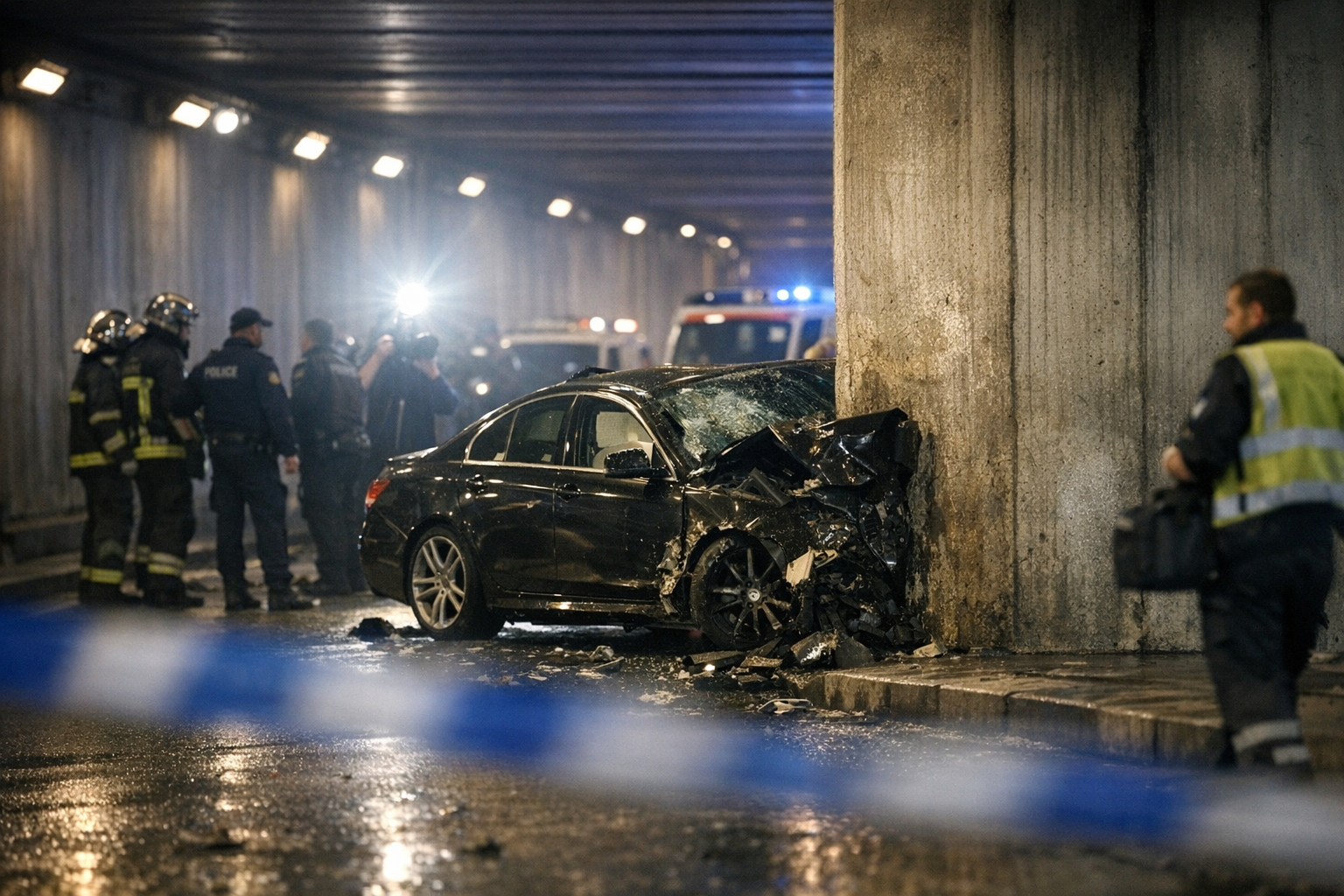
The first photos from the Paris tunnel looked like something the public was never meant to study this closely: shattered metal, camera flashes cutting through the dark, and police tape around one of the most watched women on Earth. Within hours, the death of Princess Diana stopped feeling like a private tragedy and started to feel like a locked room full of missing answers. That is where the Princess Diana death theory took hold.
What Happened
In the early hours of August 31, 1997, Diana, Princess of Wales, was riding through Paris with Dodi Fayed. Their car entered the Pont de l’Alma tunnel at high speed while paparazzi followed behind on motorcycles and in cars. The Mercedes crashed into a pillar, and the scene became global news almost instantly.
Dodi Fayed and driver Henri Paul died at the scene. Diana was still alive when emergency workers reached the car, but her injuries were severe. She was taken to the hospital and later died. The speed of the crash, the presence of photographers, and the fact that one of the most famous people in the world had died in such a chaotic way created a wave of suspicion before the official story had even settled.
🔎 Related Investigation:
That human moment is important. Millions of people woke up to breaking reports, changed channels over and over, and watched rumor spread faster than facts. It was the kind of event that makes the public feel as if the truth must be bigger than the first explanation, especially when the person at the center had spent years under intense media pressure and public scrutiny.
Official investigations in France and later in the UK concluded that the crash was caused mainly by driver impairment and dangerous speed, with the chasing paparazzi contributing to the reckless situation. Henri Paul was found to have alcohol in his system, and the investigation did not find evidence of an assassination plot. But for many people, that answer never felt complete.
Why People Believe It
Supporters of a cover-up theory usually point to one thing first: Diana was not an ordinary public figure. She was one of the most recognized women in the world, connected to the British royal family, under constant press attention, and often described as independent in ways that made institutions uncomfortable. When someone that visible dies suddenly, people search for intention, not just bad luck.
Another reason the theory survives is the emotional vacuum left behind. Diana’s death was not just a news event. It felt personal to many people who had followed her life, her charity work, her marriage, and her conflict with the palace and tabloids. In that kind of emotional atmosphere, accidental death can seem too small an answer for such a large public loss.
Then there is Mohamed Al-Fayed’s long campaign to argue that Diana and Dodi were murdered. He claimed powerful people wanted to stop their relationship and prevent a possible future that would embarrass the establishment. Those claims gave the theory a clear villain and a simple structure, which is often why conspiracy stories spread. A messy crash becomes a planned operation. Silence becomes evidence. Missing certainty becomes proof of a hidden hand.
There is also a pattern seen in many other famous cover-up claims. Once trust in officials is weak, every gap looks deliberate. People have seen real secrecy before, whether in cases like Operation Northwoods or in the very real betrayal behind the Tuskegee Syphilis Study. Because governments and institutions have hidden the truth in other cases, some readers assume they could be doing it again here.
🔎 Related Investigation:
Claims vs Evidence
Claim: Diana and Dodi were deliberately killed because their relationship threatened powerful interests. Supporters often connect this to claims about the royal family, British intelligence, or a broader establishment network. Evidence: There is no confirmed evidence showing an order to kill Diana or a verified operational plan tied to her death.
Claim: The crash involved suspicious vehicle movements, unusual tunnel activity, or a staged interference event. Some versions mention a white Fiat Uno, blinding lights, or coordinated chasing. Evidence: Investigators reviewed witness statements, vehicle evidence, and scene details. Some details remained incomplete, which is common in chaotic events, but incomplete details are not the same thing as proof of conspiracy.
Claim: Henri Paul was set up or his toxicology results were manipulated. Evidence: This claim became central because if the driver was not impaired, then the official explanation looked weaker. However, inquiries examined toxicology and related records extensively. Critics challenged the results, but no alternative body of verified evidence replaced the official findings with a stronger, proven account.
Claim: Diana was about to reveal sensitive information or take a life path that certain people needed to stop. Evidence: This idea depends heavily on motive speculation. It assumes powerful people had reason, reach, and a clean plan. Yet motive alone does not establish action, and no confirmed documents or credible operational witnesses have proven that such an order existed.
What makes the case sticky is that some questions feel emotionally unresolved even when the factual record is more settled. Diana’s status, the frenzy around her, and the speed with which the story broke made ordinary investigative uncertainty seem sinister. In public memory, unanswered details often grow larger than answered ones.
Reality Check
What we do know is that the crash happened in a highly unstable situation: a fast-moving car, a driver found to be impaired by official investigation, relentless paparazzi pursuit, and a level of celebrity pressure that had already made Diana’s life feel almost unlivable. Those are enough ingredients for disaster without needing a hidden plot.
There is also a basic logic problem in many versions of the conspiracy theory. The more powerful and organized the alleged cover-up becomes, the more hard evidence you would expect over time: documents, insiders, communications, or a consistent witness trail. Instead, the theory depends mostly on suspicion, contradictions at the edges, and the understandable feeling that someone so famous should not have died in such a senseless way.
That does not mean every public doubt was irrational. The paparazzi culture around Diana was extreme, and the appetite for images after the crash was disturbing. Public anger helped create the sense that larger forces had cornered her long before the car entered the tunnel. In that wider moral sense, many people believe the system failed her, even if that is different from claiming a murder plot.
There is a human reason this theory lasts. Random tragedy is hard to live with. Planned tragedy feels cruel, but it also feels easier to explain. A conspiracy gives structure to grief. It turns chaos into intention. That emotional logic is powerful, especially when the person who died had become a symbol far beyond her formal role.
Still, the strongest available evidence supports a reckless-crash explanation, not a confirmed covert operation. The case remains culturally unresolved because the symbolism is huge, not because the proof is stronger than the official findings. That distinction matters.
Conclusion
The Princess Diana death theories survive because they sit at the intersection of grief, distrust, celebrity, and power. Supporters of the theory argue that the official story leaves too much room for doubt. However, official investigations, physical evidence, and the lack of verified proof for a coordinated killing point much more strongly toward a tragic crash than an organized assassination.
In the end, this story says as much about the public as it does about Diana. When a beloved figure dies under harsh lights and incomplete certainty, people often build a second story to fill the silence. The mystery lasts because the emotion lasts. But emotion is not evidence, and in this case, the evidence does not clearly support the cover-up theory.
[Related] If this story stayed with you, the author suggests these real cases next:
- Operation Northwoods: The Declassified Plan That Made a Fake Attack Thinkable
- The Tuskegee Syphilis Study: The Real Cover-Up That Destroyed Public Trust
- The Montauk Project: Government Experiment Story or a Modern Myth That Would Not Die?
Explore more Cover-Ups stories here: