
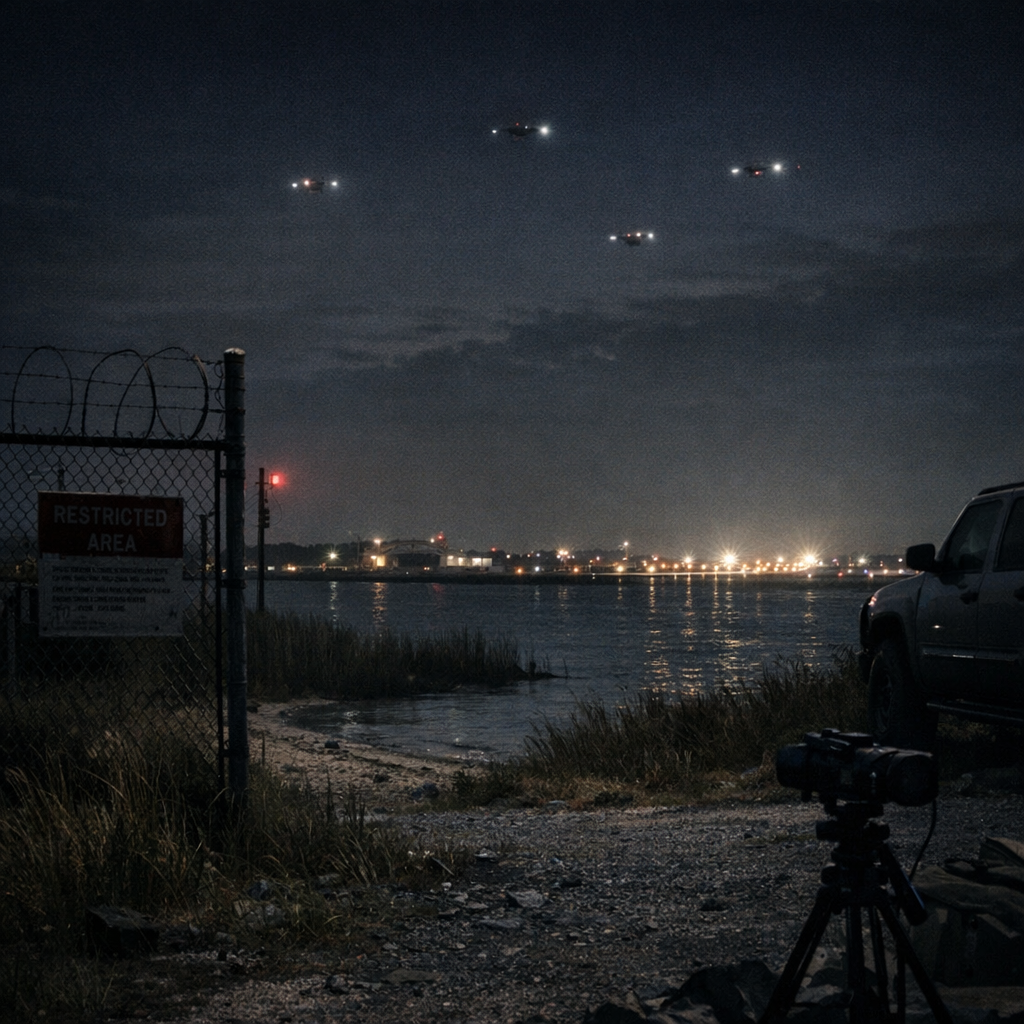
Just before dawn, strange lights kept appearing over one of America’s most sensitive Air Force bases, and nobody on the ground seemed able to stop them. That detail alone was enough to turn a real security scare into something darker: whispers of hidden technology, restricted airspace, and a mystery that sounded too serious to be just another drone story.
Langley UFO incursions refers to reports of multiple unknown objects seen near Joint Base Langley-Eustis in late 2023. Some people claim the sightings point to true unidentified aerial phenomena, but the stronger reading is that a real base-security problem involving likely drones got pulled into the wider UFO narrative before the evidence was clear. What makes the case interesting is not proof of aliens, but how quickly an ordinary airspace threat can start to look like something far stranger.
What Happened
In December 2023, reports began to surface that clusters of unidentified objects had been seen at night near Joint Base Langley-Eustis in Virginia. This was not a random location. Langley is home to advanced U.S. Air Force assets, including F-22 fighters, which means any repeated intrusion into nearby airspace is taken seriously.
What gave the story its charge was the pattern. According to later reporting, the objects did not appear once and vanish. They reportedly returned over multiple nights, sometimes in groups, and were described in ways that suggested coordinated movement. For people already primed by years of military UAP headlines, that was enough to make the case feel like the start of another disclosure-era mystery.
Picture the scene for a moment: a dark coastal sky, trained observers staring upward, and a secured military environment dealing with something it cannot immediately identify. That is the kind of human moment that changes how a story spreads. Once people hear that a major base saw repeated intrusions and still struggled to pin them down, the mind naturally jumps ahead of the facts.
But the early reports did not establish that these objects were extraterrestrial, physics-defying, or even beyond known technology. What they established was more basic and, in some ways, more alarming: there were unidentified aerial objects near a critical military site, and the response system did not seem built for quick certainty.
This matters because Langley already sits in a broader pattern readers may recognize from cases like UFOs Over Nuclear Bases: Security Threat or the Pattern That Won’t Go Away?. When a sensitive site is involved, mystery grows fast. The location itself becomes part of the evidence in the public imagination.
Why People Believe It
The UFO framing did not appear out of nowhere. It grew from several believable pressures stacking on top of each other. First, there was the setting: a major Air Force installation. Second, there was repetition: multiple nights, not one stray report. Third, there was uncertainty: if the military did not immediately explain the objects, many people assumed the truth must be bigger than a drone problem.
There is also a timing issue. The Langley story emerged after years of high-profile military UAP coverage. By then, the public had already seen the Navy videos, heard congressional testimony, and watched the word UAP move from internet forums into official hearings. In that climate, a report about unknown objects near Langley was almost guaranteed to be read through a UFO lens.
Another reason the theory sticks is that drones feel too small as an answer. When people hear that multiple objects repeatedly entered restricted airspace, they imagine a dramatic technological capability. A simple explanation can seem emotionally unsatisfying. Yet that gap between what feels important and what is actually proven is where many conspiracy stories gain power.
That same pattern shows up in stories about drone swarms and misidentified lights. Once sightings happen near something secretive, every missing detail starts to look intentional. A surveillance failure becomes a hidden-program rumor. A weak public explanation starts to feel like a cover-up.
There is one more layer. People know the U.S. military does keep real classified programs hidden. Because that part is true, it becomes easier to believe that any unresolved airspace event might involve secret technology, foreign systems, or something even harder to explain. Real secrecy creates fertile ground for larger speculation.
Claims vs Evidence
Claim: The objects over Langley were true UFOs in the strongest sense: craft with unknown origin, unusual performance, or capabilities beyond current human systems.
Evidence: Public reporting does not clearly establish any of that. The available information shows repeated unidentified objects near the base, but “unidentified” only means they were not immediately confirmed. It does not automatically mean extraordinary.
Claim: The incursions prove the military secretly knows more than it is saying.
Evidence: The military often knows less in real time than the public assumes. A fast-moving nighttime airspace incident can involve gaps in sensor coverage, reporting delays, classification issues, and uncertainty between agencies. Lack of a clean public answer is not the same thing as proof of hidden knowledge.
Claim: Because the events happened over Langley, the objects must have been highly advanced.
Evidence: That conclusion sounds intuitive, but it skips a step. Sensitive sites can be targeted precisely because they are sensitive. If the objects were drones, the story may point to a serious vulnerability, not an impossible technology. In other words, the base matters, but not in the way many people assume.
Claim: The incident fits the same category as the strongest military UFO cases.
Evidence: It may fit the broad category of military UAP reporting, but similarity of setting does not equal similarity of proof. Cases with infrared footage, radar discussion, or trained-witness testimony still have serious limits, as seen in the Pentagon UFO video debate. Langley’s core problem is even narrower: repeated sightings do not by themselves tell us what the objects were.
A misunderstood detail here is the word “incursion.” It sounds dramatic, and in security terms it is. But “incursion” describes unauthorized entry into airspace, not the nature of the craft. A drone incursion is still an incursion. That word can make a very earthly problem sound automatically otherworldly.
Reality Check
The strongest angle on the Langley case is not “the military saw aliens.” It is this: a genuine airspace-security incident became blended with UFO framing because the public had already been trained to read unknown military sightings as part of a larger disclosure story.
That distinction matters. There is a difference between a mystery and a conclusion. The Langley reports support the idea that something unidentified was operating near a major base. They do not, on the public evidence, support a leap to extraterrestrial craft or impossible performance.
In fact, the drone explanation is powerful precisely because it is mundane. Small drones are hard to track, cheap to deploy, and capable of creating outsized confusion. If several were flown in a coordinated way, they could produce exactly the kind of repeated uncertainty that fuels bigger theories. That does not make the event harmless. It makes it a modern security problem.
There is also a contradiction worth noticing. Many people treat “it was probably drones” as if that closes the case. It doesn’t. If drones repeatedly approached a military base and forced officials into uncertainty, that is still a major story. The less exotic explanation may actually be more troubling, because it points to a practical weakness rather than a cinematic mystery.
Readers who followed NORAD UFO tracking stories will recognize the same evidence ceiling. Systems can detect something unusual without producing enough public data to define it cleanly. That gap between detection and explanation is where speculation rushes in.
So what is the most reasonable conclusion? The public record most strongly supports a real incident involving unidentified objects, likely tied to drone concerns, that became entangled with broader UAP culture. That means the UFO label tells us more about the current information environment than about the actual origin of the objects.
Conclusion
The Langley case is compelling because it sits at the exact point where two modern anxieties meet: fear of hidden things in the sky, and fear that critical systems are less secure than they look. That combination makes almost any unclear airspace event feel larger than life.
For now, the case does not offer confirmed evidence of alien craft or breakthrough technology. What it offers is something more grounded and, in its own way, more revealing: a case study in how a real security breach can quickly be retold as a UFO mystery when the facts arrive slowly and the setting already feels secret.
If that is disappointing, it should not be. A good investigation is not supposed to reward the biggest theory. It is supposed to separate what was seen, what was claimed, and what the evidence can actually carry. In the Langley story, that line matters more than ever.
🔎 If this story stayed with you, the author suggests these real cases next:
- Drone Swarm Conspiracy: Secret Tests or a Panic Built on Misidentified Lights?
- NORAD UFO Tracking: Hard Radar Evidence or Stories Built on Missing Data?
- UFOs Over Nuclear Bases: Security Threat or the Pattern That Won’t Go Away?
Explore more Alien & UFO Theories stories here: