
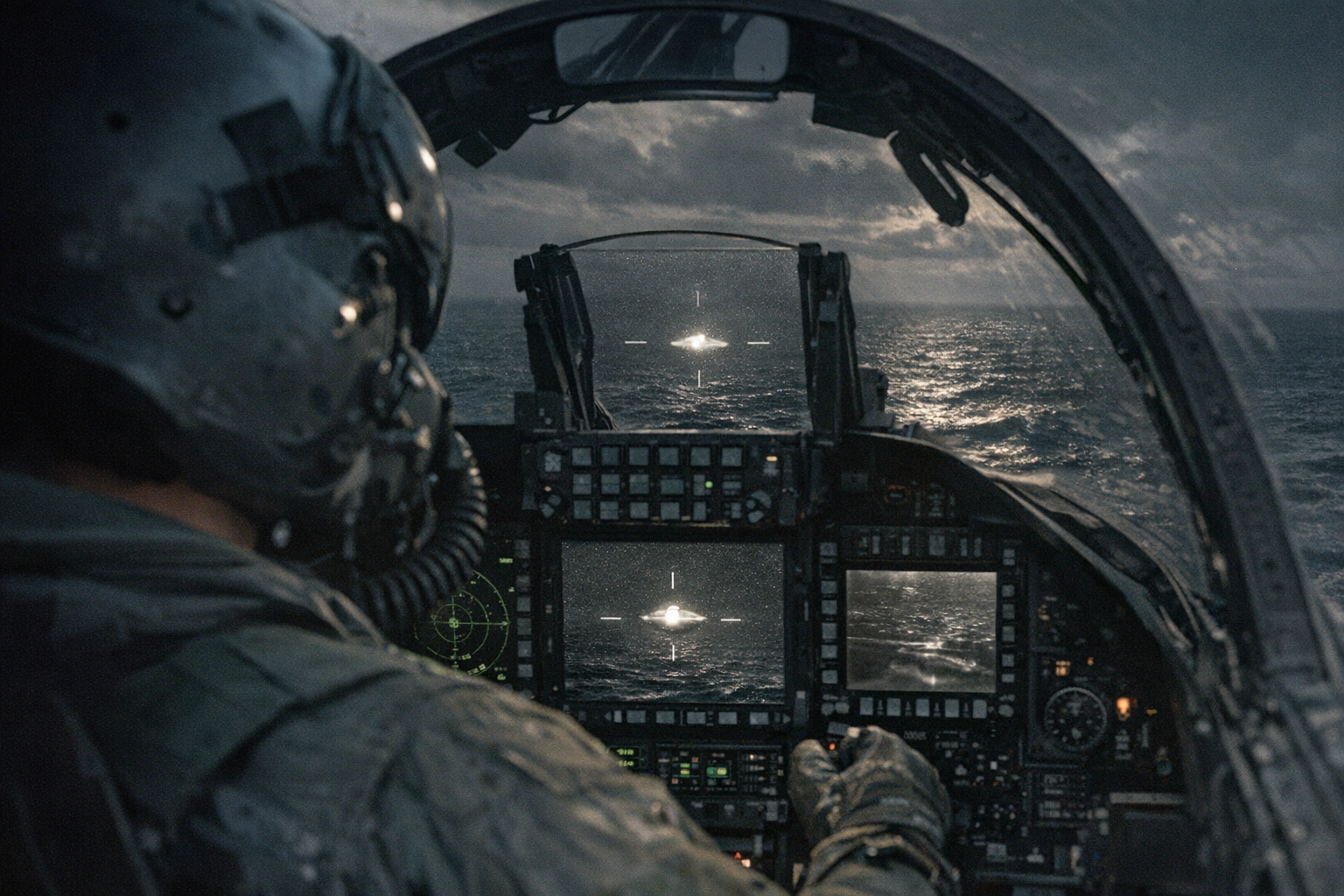
The clips were real, the pilots were real, and the confusion was real too. That is exactly why the Pentagon UFO videos became such a powerful modern mystery: they offered authentic military footage of something unresolved, then left the public to decide whether unresolved meant advanced technology, a sensor illusion, a national-security blind spot, or something far more dramatic.
Setup
The story usually revolves around three short Navy videos known as FLIR1, Gimbal, and GoFast. In each case, military personnel tracked an object that did not fit neatly into the explanation available at that moment. The footage looked stranger because it came from serious systems and serious observers. These were not anonymous clips uploaded without context. They were tied to trained aviators, military sensors, and an official release that made the subject impossible to dismiss as obvious internet fiction.
That official release mattered. When the Department of Defense confirmed the videos were authentic Navy footage, it settled one major question at once: the clips themselves were not fabricated hoaxes. But that confirmation also created a second problem. Once many people heard “authentic,” they quietly replaced it with “proven.” That leap is where the biggest misunderstanding began.
🔎 Related Investigation:
The videos entered public culture during a period when distrust of institutions was already high. So when a government long associated with secrecy acknowledged that the clips were real, believers saw vindication. Skeptics saw an identification problem, not an extraterrestrial one. Both sides were reacting to the same narrow fact, but giving it very different weight.
What people claim
The strongest public claims tend to sound simple. The objects moved in ways conventional aircraft cannot. Military pilots were stunned by what they saw. The Pentagon authenticated the footage. Therefore, the videos must show technology beyond known human capability.
That argument has emotional force because it joins authority with mystery. A witness saying “I saw something strange” is one thing. A Navy pilot saying it while backed by infrared footage feels different. The case gains even more power from the idea that governments often say less than they know. That broader suspicion is part of why stories about hidden influence, covert narratives, and information management spread so easily. It is also why readers who follow political mysteries often drift from UFO footage into topics like Operation Mockingbird, where the question is not what appeared in the sky, but how official institutions shape what the public believes it is seeing.
🔎 Related Investigation:
There is also a visual trap built into the footage itself. Sensor imagery strips away normal scale and context. A tiny shape on a dark display can seem to lurch, rotate, or outrun explanation because the viewer lacks the full geometry of distance, angle, and tracking behavior. In a mystery vacuum, the human mind fills in the rest.
Why it spread
The Pentagon UFO videos spread because they sit at the intersection of three powerful forces: credible witnesses, official acknowledgment, and incomplete evidence. That combination is unusually potent. If the witnesses were weak, people would dismiss the case. If the government never confirmed the videos, they would remain fringe clips. If the evidence were complete, the story might have ended quickly. Instead, the case landed in the most viral zone possible: real enough to matter, limited enough to argue over.
The shift from “UFO” to “UAP” also helped normalize discussion. For decades, “UFO” carried baggage ranging from pulp fiction to outright ridicule. “UAP” sounded procedural, technical, and less theatrical. The change did not solve the mystery, but it changed the tone. Suddenly the same underlying question could be discussed in congressional hearings, mainstream reporting, and defense language without the older stigma attached.
Public appetite did the rest. Once the videos were framed as evidence that something extraordinary might be hiding in plain sight, every ambiguity became fuel. Rotation became impossible motion, uncertainty became suppression, and an unresolved tracking problem became proof that the public was seeing only the edge of a much bigger secret.
What evidence shows
The evidence supports several claims strongly. First, the footage is authentic military material. Second, trained military personnel encountered aerial objects they did not immediately identify. Third, those incidents were considered serious enough to preserve, discuss, and later release publicly. Those are meaningful facts, and they are enough to keep the case important.
But the evidence does not show what many headlines implied. It does not establish extraterrestrial origin. It does not prove impossible physics. It does not demonstrate that every dramatic interpretation of the objects’ movement is correct. It does not confirm a secret reverse-engineering program. It does not even guarantee that the public clips, by themselves, contain everything needed to reconstruct the events with confidence.
That gap matters. Analysts who have studied the videos have argued that at least some of the most dramatic effects may be influenced by sensor behavior, camera perspective, target lock mechanics, glare, relative motion, and uncertainty about range. None of those possibilities makes the incidents meaningless. They simply narrow what the clips can honestly prove without additional data.
Pilot testimony is also important without being final. Experienced aviators are stronger witnesses than random strangers because they are trained to observe aircraft, motion, and anomalies in high-pressure environments. But expertise is not magic. Even skilled observers work with partial information. A pilot’s sincere uncertainty is evidence of an unresolved encounter, not automatic evidence of a nonhuman craft.
The broader government response points in a similar direction. Official interest shows that unidentified aerial incidents can raise real concerns involving surveillance, restricted airspace, sensor limitations, or foreign technology. That is significant. It still falls short of proving the most extraordinary explanation on offer.
Where confusion came from
Most of the confusion came from collapsing different kinds of truth into one sentence. “The footage is real” is true. “The incidents were unidentified at the time” is also true. But many readers fused those claims into “the Pentagon proved alien craft,” which the available evidence does not support.
Media framing made that collapse worse. Stronger headlines attract more attention than narrower conclusions, and a title built around proof travels faster than one built around uncertainty. The original version of this article leaned into that same problem. It treated a real confirmation of authenticity as if it resolved the deeper question of origin. It did not.
Another source of confusion is the word “unidentified” itself. In ordinary conversation, many people hear it as a clue pointing toward something extraordinary. In technical use, it means something much less dramatic: an object was not confidently classified with the information available at that moment. That distinction sounds dry, but it is the center of the whole case.
There is also a cultural habit of assuming secrecy must protect the most sensational explanation. Sometimes secrecy protects something routine but sensitive. Sometimes it protects uncertainty itself. A government can acknowledge a problem, investigate it seriously, and still have no dramatic answer to reveal. That possibility is less cinematic, but often more realistic.
Reality Check
The Pentagon UFO videos remain compelling because they sit in the uncomfortable middle. They are stronger than internet folklore because they involve authentic footage and credible witnesses. They are weaker than definitive proof because the public still lacks the complete context needed to settle the biggest claims cleanly.
The most defensible conclusion is not that the videos proved alien visitation. It is that they confirmed a narrower and still significant reality: military personnel recorded aerial incidents they could not confidently explain in real time, and the government later acknowledged the footage as genuine. That leaves room for unresolved questions, but it does not license every answer.
In that sense, the Pentagon UFO videos are a lesson in how modern mysteries form. A real event occurs. Official acknowledgment gives it weight. Limited evidence leaves key gaps. Public imagination rushes in to fill them. What survives is a story balanced between fact and projection. The footage confirmed a mystery. It did not solve it.
🔎 If this story made you think, here are more conspiracy investigations worth exploring next:
- Government UFO Programs: From Project Blue Book to AATIP to AARO
- Roswell UFO Crash: What the Original Witnesses Claimed and What the Records Actually Show
- UFO Evidence in America: Why the Strongest Cases Never Fully Go Away
📂 Explore more in this category:
Political Conspiracies