
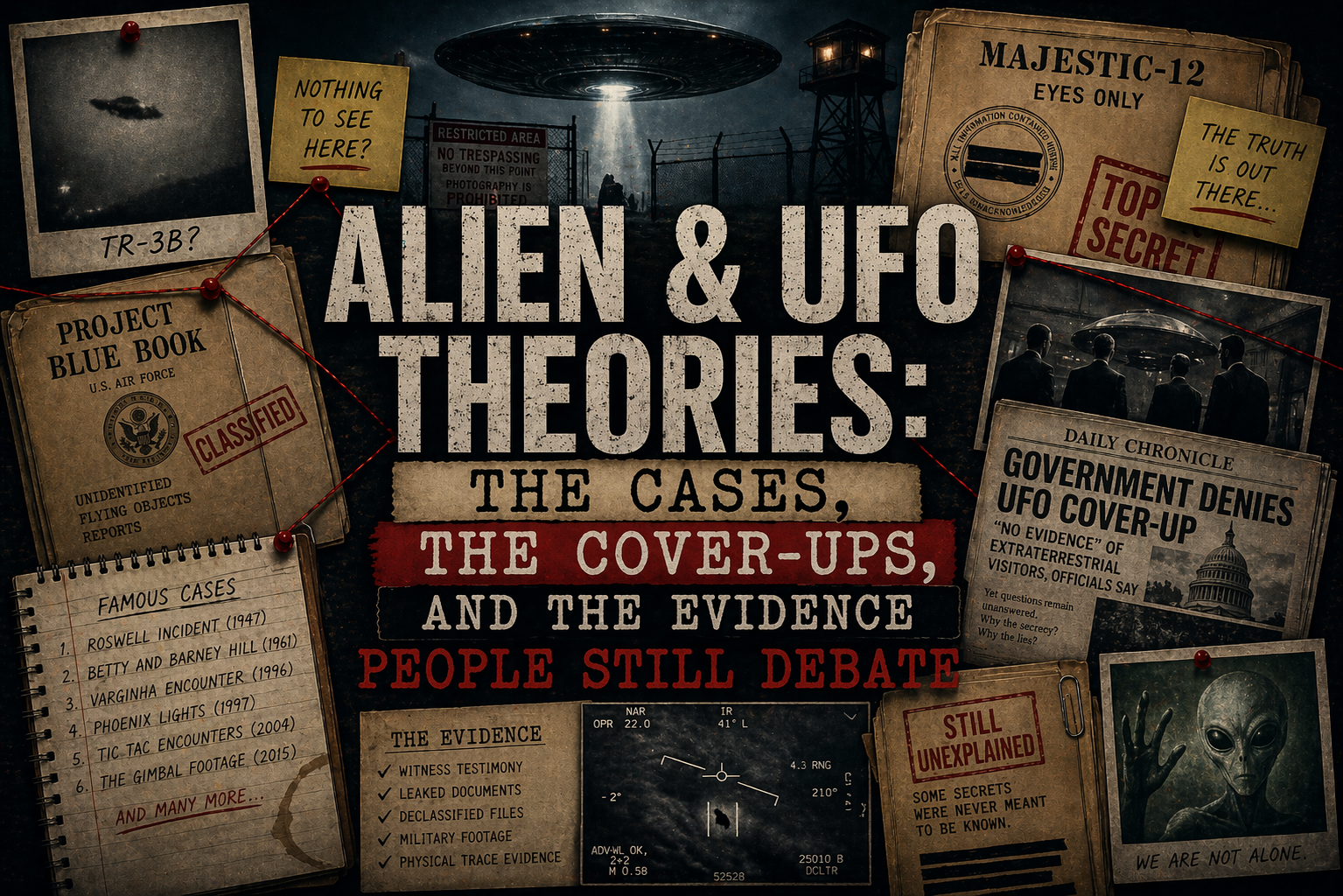
The public UFO file does not open with one clean answer. It opens like a cabinet full of half-redacted reports, grainy military clips, old crash legends, witness statements, and official remarks that confirm the mystery while refusing to solve it.
Alien and UFO theories are a broad category of claims about unidentified objects, possible non-human craft, government secrecy, and the evidence people use to argue about them. People claim the record points to hidden recoveries, military encounters, whistleblower revelations, and decades of suppressed knowledge. The reality is more complicated: many famous stories are weak or overstated, some sightings remain unresolved, and government interest in unidentified aerial phenomena is real without proving alien visitation.
What Happened
The modern UFO conversation did not grow from one sighting. It grew from layers: newspaper panics, military investigations, Cold War secrecy, pop culture, whistleblower claims, radar cases, and official studies that kept the subject alive even when individual cases fell apart. That is why this page works best as a category guide, not as one giant proof argument.
Some readers enter through classic cases. Roswell remains the most famous crash story because the official explanation changed, witnesses disagreed, and the idea of recovered wreckage became part of American folklore. Other readers start with personalities, especially Bob Lazar, whose Area 51 claims helped turn a real secret test range into the center of modern reverse-engineering lore.
Another doorway is military footage. The Tic Tac UFO incident stands out because trained pilots, ship systems, and later public attention made it harder to dismiss as just another blurry light. Broader explainers on Navy UFO videos show why Gimbal, GoFast, Omaha, and related cases still divide people: they are interesting, but the available public data often leaves room for more than one explanation.
Then there is the disclosure side of the category. The AARO UAP report, congressional hearings, whistleblower testimony, and the Schumer UAP Disclosure Act shifted the conversation from late-night radio into policy language. The topic now includes record-release fights, special access program questions, reporting protections, classification rules, and the public’s suspicion that “we looked into it” is not the same as full transparency.
The category also reaches beyond the Pentagon. Personal cases such as the Travis Walton UFO incident, intimidation folklore like Men in Black stories, and base rumors around Area 51 show how the UFO mystery became a culture of secrecy, not just a list of sightings.
Why People Believe It
People believe alien and UFO cover-up claims because the subject sits in a dangerous middle ground. It is not pure fiction. Governments have investigated unidentified aerial reports. Military agencies do classify aircraft programs. Pilots and radar operators sometimes report things they cannot identify. Those facts give the category a serious base.
But serious does not mean solved. The belief grows in the space between official acknowledgment and public explanation. When a government office says an object was unidentified, believers hear a door opening. Skeptics hear a limited statement: unidentified does not mean extraterrestrial. Both reactions are understandable, which is why the argument never fully dies.
Secrecy is the other fuel source. Classified aviation, sensor capabilities, intelligence collection, and national security restrictions can hide normal military details. To the public, though, a blacked-out document can look the same whether it protects a drone program, a radar method, a spy platform, or something stranger. That visual absence becomes part of the story.
There is also a pattern effect. One sighting can be mistaken. One photograph can be staged. One witness can misremember. But when decades of sightings, documents, hearings, videos, leaks, and rumors stack together, the archive feels larger than any single debunk. The danger is that people sometimes treat the size of the archive as proof, when it is really a reason to sort the archive more carefully.
Claims vs Evidence
Claim: UFO evidence proves aliens are visiting Earth. Evidence: Public evidence does not prove that. It shows that some objects were difficult to identify, that official agencies have investigated them, and that credible witnesses have reported unusual events. That is not the same as confirmed non-human craft.
Claim: Roswell proves the government recovered alien technology. Evidence: Roswell is historically important because of secrecy, witness disputes, and shifting explanations, but the public record still does not confirm recovered extraterrestrial material. It works best as a classic case study in how secrecy and inconsistent messaging can create a long-running myth.
Claim: Bob Lazar exposed a real reverse-engineering program. Evidence: Lazar’s story shaped UFO culture and Area 51 mythology, but the strongest version of the claim still depends on testimony, disputed credentials, and missing hard evidence. The broader idea of secret aerospace work is plausible; the specific claim of proven alien technology remains unconfirmed.
Claim: Military videos are the smoking gun. Evidence: Military footage matters because pilots, sensor systems, and official releases add weight. Still, video alone can fail to prove distance, speed, size, origin, or intent. A clip can be worth investigating without becoming final proof.
Claim: Disclosure politics prove hidden programs exist. Evidence: Laws, hearings, and reports prove that institutions are arguing about transparency, record handling, and unidentified reports. They do not automatically prove crash retrievals or alien bodies. The Schumer UAP Disclosure Act and AARO debates are important because they show the system struggling with trust, not because they settle the alien question.
Claim: Every unresolved case belongs in one hidden master conspiracy. Evidence: That is where the logic often breaks. Different cases may have different explanations: misidentified aircraft, sensor errors, balloons, drones, classified tests, natural phenomena, hoaxes, or genuinely unresolved events. A healthy UFO category keeps those buckets separate instead of forcing every mystery into one answer.
Reality Check
The clearest reality is that UFOs are real as reports of unidentified objects. People see things they cannot explain, and some of those reports involve trained observers or official review. That alone is enough to make the subject worth covering seriously.
The second reality is that “unidentified” is not a synonym for alien. It means the available information did not produce a firm public identification. Sometimes that is because the data is poor. Sometimes it is because the right information is classified. Sometimes it is because a case was never investigated well enough in the first place.
The third reality is that this category now contains several subclusters, each with its own strength and weakness. Classic cases like Roswell are powerful culturally but often thin on hard proof. Military-video cases are stronger on official context but still limited by missing data. Disclosure politics are rich in documents and public hearings but can drift into speculation. Whistleblower stories can raise important questions, yet they still need records, names, materials, and verifiable chains of custody.
That is why this guide should not compete with a future evidence-specific proof hub. A proof hub can rank evidence types and explain what would count as stronger confirmation. This page has a different job: help readers navigate the whole Alien & UFO Theories category without treating every case as equal.
The useful path is subcluster thinking. Start with classic crash lore if you want to understand why the cover-up myth became so durable. Move to Navy and radar cases if you want modern military evidence. Read AARO and disclosure-law stories if you want the government-transparency fight. Explore whistleblowers and crash-retrieval claims if you want the most explosive allegations, but keep asking what has been independently verified.
Conclusion
Alien and UFO theories keep returning because they combine secrecy, wonder, mistrust, and incomplete evidence. The strongest cases are not strong because they prove aliens. They are strong because they expose a real tension between what people report, what institutions admit, and what the public is allowed to see.
The weakest version of the category turns every light in the sky into a spacecraft and every redaction into a confession. The strongest version does the opposite: it separates classic cases, military videos, whistleblower claims, disclosure politics, drones, crash retrieval rumors, and evidence standards into different lanes. Some claims collapse. Some remain open. Some mainly reveal how secrecy works.
That is the best way to read this section of CrackTheConspiracy.com. Do not believe everything, and do not mock everything. Follow the evidence, check the gaps, and pay attention to which part of the UFO archive you are actually looking at.
🔎 If this story stayed with you, the author suggests these real cases next:
- Roswell UFO Crash: What the Original Witnesses Claimed and What the Records Actually Show
- Tic Tac UFO Incident: Best Military Evidence or a Story Bigger Than the Data?
- AARO UAP Report: Clear Answers or a Review That Left the Biggest Claims Open?
Explore more Alien & UFO Theories stories here: