
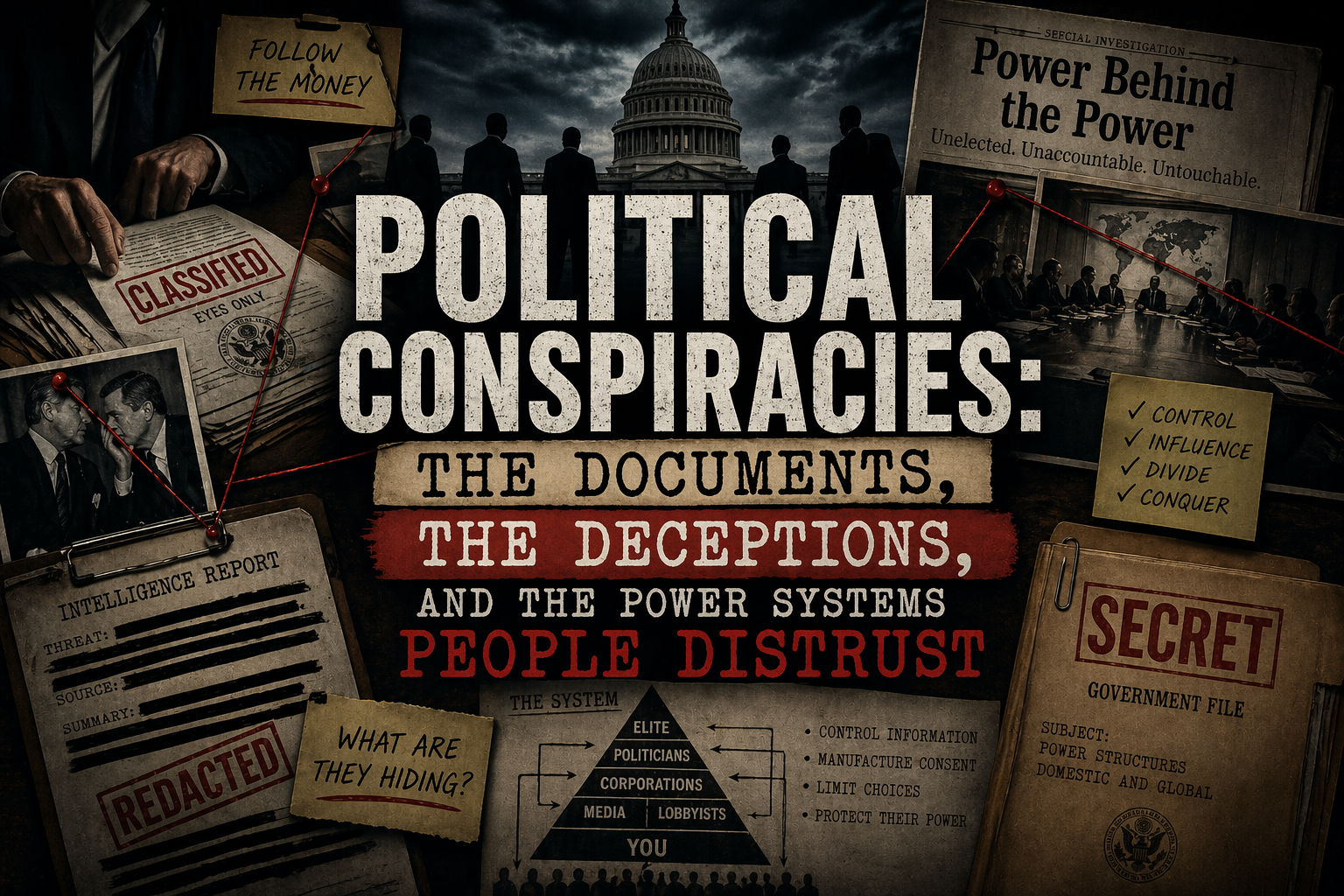
The most revealing political file is rarely the one with the smoking gun circled in red. It is the half-released memo, the blacked-out name, the quiet hearing, and the program that officials insisted was impossible until the documents proved it existed.
Political conspiracies are claims that hidden officials, intelligence agencies, campaigns, donors, contractors, or private networks shape public events while giving the public a cleaner story. Some claims grow from documented abuses, declassified programs, and real secrecy; others stretch those facts into one giant hidden-control system. The reality is usually mixed: power does hide things, but each claim still has to be tested against records, motives, timelines, and evidence.
What Happened
Political conspiracy theories grow in the gap between how democracy is supposed to work and how power often works in practice. Voters see elections, press conferences, committees, courts, and public reports. Behind that surface are classified briefings, emergency authorities, intelligence programs, campaign money, private lobbying, and documents the public may not see for years.
That gap does not automatically prove a conspiracy. It does explain why political conspiracies keep returning. When people later learn that an official story was incomplete, the next denial feels weaker. When records show that a covert program existed, a new secret program sounds possible. When powerful institutions investigate themselves, suspicion becomes part of the atmosphere.
This hub is meant to sort that suspicion, not inflate it. The strongest political conspiracy claims usually start with something concrete: a court filing, leaked document, congressional report, whistleblower complaint, budget line, transcript, or declassified memo. The weakest ones rely only on mood: “it feels staged,†“they all know each other,†or “the timing is too perfect.†Suspicion can begin an investigation, but it cannot finish one.
The category covers several connected but different lanes. There are hidden-power theories, such as the deep state debate. There are intelligence and media-influence claims, including Operation Mockingbird. There are documented domestic-abuse cases, surveillance fears, emergency-powers concerns, election distrust, assassination theories, false-flag claims, and leaks that reveal how much can happen outside ordinary public view.
Why People Believe It
People believe political conspiracy claims because history gives them reasons not to accept every official explanation at face value. Governments have lied. Agencies have hidden programs. Political actors have protected their own interests. National security language has sometimes been used to delay accountability or keep embarrassing facts out of sight.
Confirmed examples matter. The FBI’s COINTELPRO program showed that activists and political groups were targeted under the language of security. Congressional investigations exposed intelligence abuses that sounded unbelievable before they were documented. Surveillance debates are not imaginary when laws, courts, and technologies really do allow broad data collection.
That history creates a pattern the public remembers: first denial, then partial admission, then reform promises, then another secret. Once people learn that cycle, they begin looking for it everywhere. Sometimes they are right to look. Sometimes the pattern they see is coincidence, incompetence, bureaucracy, profit, rivalry, or ordinary political self-protection.
The emotional pull is also simple. Political conspiracies make chaos feel organized. A confusing war, a sudden emergency, a disputed election, or a shocking assassination becomes easier to process if someone planned it from the start. That does not make the theory true, but it explains why broad hidden-power stories can feel more satisfying than messy reality.
Claims vs Evidence
Claim: A permanent hidden government runs the country no matter who wins elections.
Evidence: Permanent agencies, courts, contractors, military offices, and intelligence systems do outlast elected leaders. They can resist change, protect budgets, and shape policy through expertise and inertia. But proving one coordinated hidden ruling network requires more than showing that bureaucracy is powerful. The evidence has to show command, coordination, and intent.
Claim: Intelligence agencies shaped public opinion through journalists and media outlets.
Evidence: Concerns about media influence did not appear from nowhere. Cold War intelligence work, source relationships, propaganda efforts, and later investigations gave the public reasons to ask hard questions. The safer conclusion is that influence and access have existed; the weaker leap is claiming every major news story follows one central script.
Claim: The government targets critics when they become inconvenient.
Evidence: This is one of the strongest documented areas in political conspiracy history. COINTELPRO is not folklore. It is a real example of state power being used against domestic political groups. But that fact should sharpen standards, not erase them. A modern claim still needs names, records, legal process, documented conduct, and a clear timeline.
Claim: Modern identity and surveillance systems are building a permanent tracking state.
Evidence: The fear is understandable because data systems really are expanding. Digital identity programs, biometrics, license-plate readers, financial monitoring, phone data, and database sharing can create a surveillance effect even without one master control room. The Digital ID conspiracy debate is strongest when it focuses on real privacy risks, data access, and oversight, not when it jumps straight to total control.
Claim: Emergency powers are a back door around democracy.
Evidence: Emergency authority is real, and it can concentrate power quickly. The concern behind Emergency Powers conspiracy claims is not irrational: crises can expand executive action, secrecy, surveillance, and military or security involvement. The key question is whether safeguards, courts, legislatures, and expiration rules actually limit that power once the emergency fades.
Reality Check
The reality is not that all political conspiracies are fake. That answer ignores too much history. There have been real covert actions, real domestic abuses, real surveillance programs, real propaganda concerns, real secrecy failures, and real attempts by powerful people to hide what they were doing.
The reality is also not that every major event is controlled by one hidden machine. That answer is too neat. Political power is fragmented and competitive. Agencies fight each other. Parties leak against each other. Donors disagree. Officials make mistakes. Bureaucracies often hide failure, embarrassment, and liability rather than a brilliant master plan.
A better test uses five questions. First, what is documented? Second, who is making the claim, and what do they gain from it? Third, what would have to be true for the theory to work? Fourth, what evidence would prove it wrong? Fifth, does the theory explain the facts better than normal politics, secrecy, profit, incompetence, fear, or institutional self-preservation?
That test matters because real abuses can be used to sell exaggerated theories. A documented surveillance law can reveal serious privacy risk without proving total population control. A private donor network can distort policy without proving puppet rule. A classified program can deserve exposure without confirming every rumor attached to it.
Political conspiracies remain powerful because they begin with a truth people can verify: power prefers privacy. The challenge is keeping that truth from becoming a shortcut. If every redaction becomes proof of a master plan, evidence stops mattering. If every denial is accepted without question, history gets ignored. The useful path is harder: trust documents, test claims, and keep the difference between proof and suspicion visible.
Conclusion
Political conspiracies are best understood as a spectrum. On one end are confirmed deceptions, exposed programs, and documented abuses. In the middle are disputed claims with partial evidence, suspicious timing, or unanswered questions. On the far end are totalizing theories that connect every institution into one hidden command structure without enough proof.
This hub should help readers move through that spectrum without getting lost. The important question is not whether powerful people ever hide things. They do. The question is what a specific case proves, what it only suggests, and where the story leaves the evidence behind.
That is where political conspiracy research becomes useful instead of addictive. It does not ask readers to trust blindly or distrust blindly. It asks them to follow the paper trail, compare claims against records, and notice when a real abuse is being used to sell a much bigger story than the evidence can carry.
🔎 If this story stayed with you, the author suggests these real cases next:
- Operation Mockingbird: Did the CIA Really Shape the News?
- COINTELPRO: National Security Program or Proof the State Targets Its Critics?
- Emergency Powers Conspiracy: Backup Government or Democracy Override?
Explore more Political Conspiracies stories here: