
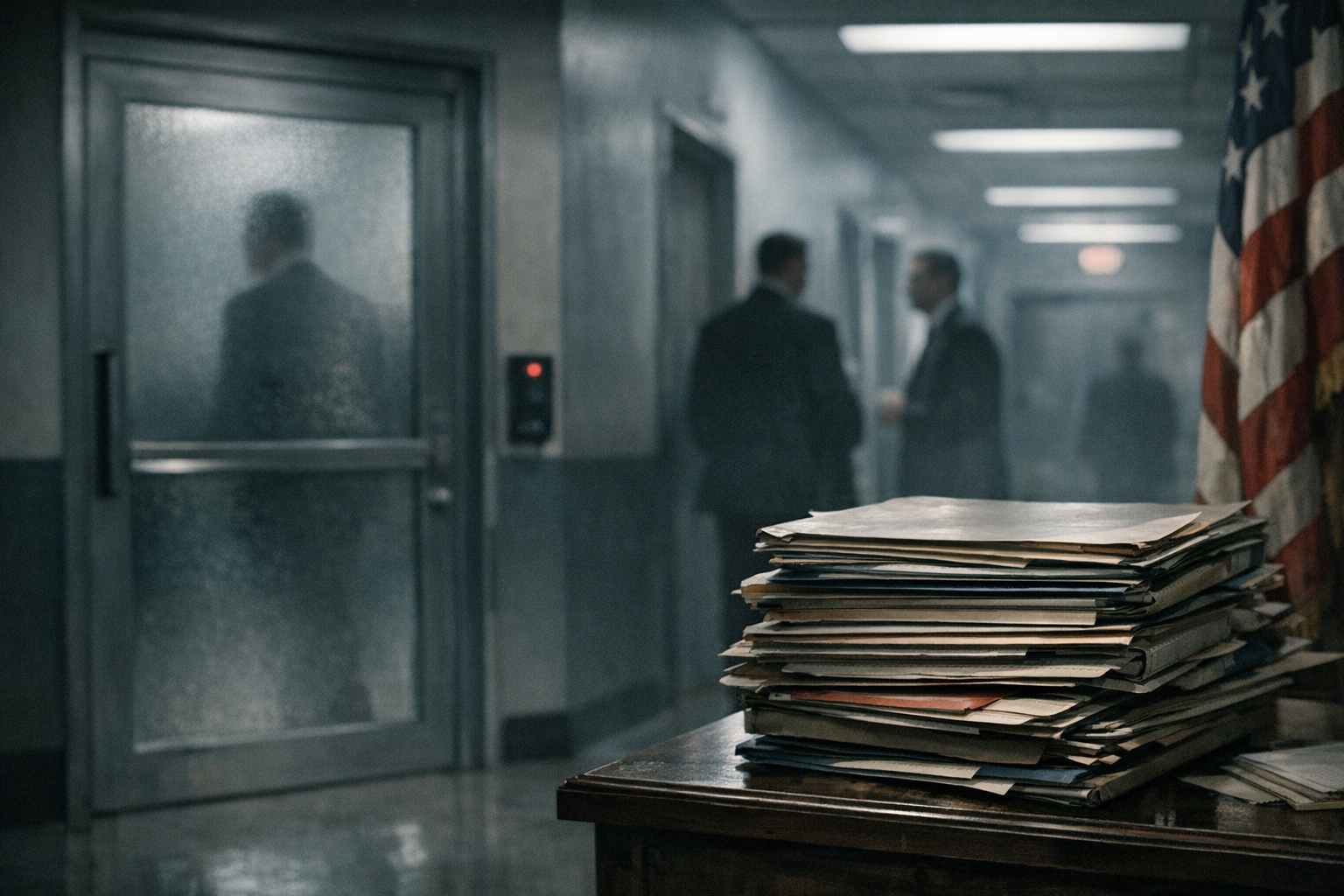
The doors close, the cameras leave, and a new president walks into a building full of people who were there long before election night. In the quiet hallways of Washington, where badges open doors the public never sees, the phrase deep state explained has become a way to describe a fear that power does not really change hands at all.
That fear is why the deep state theory refuses to die. It speaks to a simple suspicion: if leaders come and go but major systems keep moving in the same direction, then maybe someone hidden is steering from behind the curtain.
What Happened
The term “deep state” did not begin as a modern American internet slogan. It was used in countries like Turkey to describe alleged networks of military, intelligence, and political figures who were said to operate behind public government.
🔎 Related Investigation:
In the United States, the phrase took on a broader meaning. It became a catch-all label for career officials, intelligence agencies, military leaders, major contractors, and powerful insiders who seem to outlast elections. To supporters of the theory, that durability does not look like normal bureaucracy. It looks like control.
Part of the theory grew from real moments of tension between elected leaders and permanent institutions. Presidents have fought with intelligence agencies. Whistleblowers have exposed hidden programs. Declassified records have shown that governments sometimes do keep major operations secret from the public for years.
That history matters. A person watching from home can see a new administration promise sweeping change, then watch courts, agencies, briefings, internal leaks, and national security systems slow everything down. From the outside, it can feel less like a debate and more like running into a wall that was always there.
There is also a human scene at the center of this idea. Picture a voter staying up late on election night, believing the whole direction of the country is about to change. Then months later, the wars, surveillance systems, intelligence briefings, and agency rules still look strangely familiar. That emotional gap is where the deep state idea finds oxygen.
Why People Believe It
People believe in a deep state for a reason: large systems are hard to see clearly. Government is layered, slow, and often secretive. When decisions are made in classified settings, the public is left with fragments. Mystery invites story.
Supporters of the theory point to unelected power centers that are undeniably real. Intelligence agencies do gather secret information. Bureaucrats do shape policy details. Military and security officials do remain in place while elected leaders rotate in and out. Lobbyists and contractors also influence what gets funded and what does not.
That does not automatically prove a hidden ruling network. But it does explain why the theory feels believable. The modern state is massive. Most people never see how decisions move through departments, legal reviews, internal memos, intelligence assessments, and budget chains. What they do see is continuity.
The theory also spreads because it simplifies frustration. It turns a complicated system into a single villain. Instead of saying, “many institutions have overlapping power and resist disruption,” it says, “there is a hidden machine in charge.” The second version is much easier to remember, repeat, and fear.
Some of that suspicion overlaps with older theories about shadow governments and who really pulls the strings behind power. It also echoes broader ideas about the New World Order and whether global control is coordinated or exaggerated.
Claims vs Evidence
Claim: A hidden network of officials secretly rules the country no matter who gets elected.
Evidence: There is evidence that permanent institutions hold real power. Agencies survive elections. Intelligence communities protect classified operations. Senior civil servants often shape policy execution. But that is not the same as proving one unified secret command structure.
🔎 Related Investigation:
Claim: Leaks, internal resistance, and slow-walked policies prove coordinated sabotage by a deep state.
Evidence: Some leaks are political. Some resistance comes from lawful process, internal disagreement, or fear of bad policy. In a huge government, friction can happen without a master plan. Bureaucratic resistance is real, but coordination is much harder to prove.
Claim: Intelligence agencies and defense networks secretly decide national direction.
Evidence: Intelligence and defense agencies do influence national direction, especially in foreign policy and security matters. That influence is significant. However, influence is not proof of total control. Elected leaders, courts, Congress, media pressure, donors, and public opinion still matter too.
Claim: Because real conspiracies have happened before, this one is probably real too.
Evidence: History shows that governments can lie, hide operations, and protect institutions. Cases like Operation Mockingbird and claims of intelligence influence over media give people a reason to stay skeptical. But each case has to stand on its own. Past secrecy does not automatically confirm every new theory.
Reality Check
The strongest version of the deep state idea is not that a single secret council runs everything from a dark room. That picture is dramatic, but the evidence for it is weak. The more realistic version is less cinematic and, in some ways, more unsettling.
What we do know is that modern governments create durable systems of power. Intelligence agencies, military structures, regulators, legal offices, and career officials can preserve continuity even when elected leadership changes. That can protect stability, but it can also frustrate democracy when the public expects fast change.
So the real question is not whether permanent institutions exist. They do. The better question is whether those institutions act as one secret network with shared hidden goals. On that point, solid proof is thin. Power inside government is often fragmented, competitive, and messy rather than perfectly coordinated.
That matters because conspiracy thinking can flatten complexity. If every disagreement, leak, delay, or bureaucratic block becomes proof of a deep state, then ordinary institutional behavior starts looking supernatural. A huge machine can seem invisible simply because it is complicated, not because it is secretly all-powerful.
Still, dismissing the concern completely would be lazy. Unelected influence is real. National security secrecy is real. Bureaucratic inertia is real. Public distrust did not appear out of nowhere. The deep state theory survives because it is built on a true observation—some power does outlast elections—even if the most dramatic version goes too far.
The most honest conclusion is that this theory lands in the middle. There is no confirmed evidence of one all-controlling hidden government. But there is plenty of evidence that permanent institutions, secrecy, and entrenched interests shape outcomes more than many voters realize.
Conclusion
Deep state fears begin in a place that feels understandable: the sense that voting changes the faces on screen, but not always the machinery behind them. That feeling is powerful because sometimes the machinery is real, and sometimes it is simply more complicated than it looks.
In the end, the deep state is best understood not as a proven secret empire, but as a conspiracy label wrapped around a real problem: unelected power inside large systems. The theory becomes misleading when it turns that problem into one neat hidden mastermind. Reality is usually less tidy, more bureaucratic, and harder to fit into a single story.
🔎 If this story stayed with you, the author suggests these real cases next:
- Shadow Governments: Who Really Pulls the Strings Behind Power?
- Operation Mockingbird: Did the CIA Really Shape the News?
- Election Fraud Theories: What the Claims Said vs What the Evidence Actually Showed
Explore more Political Conspiracies stories here: